Friday, December 17, 2021

Debtors Prisons on This Day in History


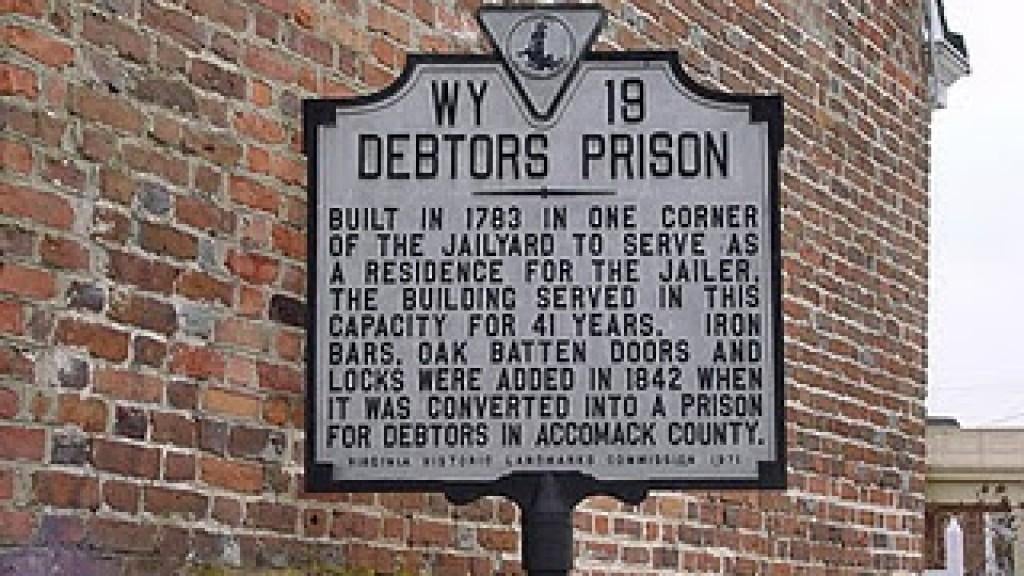
This day in history: Kentucky abolished debtors prisons on this day in 1821. 

A debtors' prison is a prison for people who are unable to pay debt. Through the mid-1800s, debtors' prisons (usually similar in form to locked workhouses) were a common way to deal with unpaid debt in Western Europe. Destitute persons who were unable to pay a court-ordered judgment would be incarcerated in these prisons until they had worked off their debt via labor or secured outside funds to pay the balance. The product of their labor went towards both the costs of their incarceration and their accrued debt. Increasing access and lenience throughout the history of bankruptcy law have made prison terms for unaggravated indigence obsolete over most of the world.

"Systems of debt bondage have existed for thousands of years. It was a common practice throughout Ancient Greece and the Roman Empire. A person who owed a debt could be compelled into serving their creditor for many years. These sorts of practices spun-off into debtors’ prisons in the Middle Ages, though debt bondage continued to exist and is still practiced in many parts of the world...ou’ve probably heard someone refer to jail as 'the clink.' What you may not have realized is that it’s the name of a real prison in England. The Clink was built in 1144 and was in operation for centuries. That means it housed all manner of prisoners over the years, including many debtors. Even the famous could end up in debtors’ prison. William Hughton, playwright and Shakespearean contemporary, found himself in The Clink for failing to pay back a loan from London entrepreneur Philip Henslowe." Source

Debtors Prisons in the past could be quite harsh: "The prisons were full of rats, lice and fleas. The prisoners were denied basic necessities of life such as food, water and clothing. It is said that these places were dirty and filthy that around 25% of the inmates died due to these horrible living conditions. The debtors were imprisoned and tortured at the pleasure of the creditors. When other countries of Europe had legislation limiting the debt imprisonment term to 1 year, England did not have such a law. When in 1842, the fleet prison was closed; it was found that debtors were there for more than 30 years." Source

Since the late 20th century, the term debtors' prison has also sometimes been applied by critics to criminal justice systems in which a court can sentence someone to prison over willfully unpaid criminal fees, usually following the order of a judge. For example, in some jurisdictions within the United States, people can be held in contempt of court and jailed after willful non-payment of child support, garnishments, confiscations, fines, or back taxes. Additionally, though properly served civil duties over private debts in nations such as the United States will merely result in a default judgment being rendered in absentia if the defendant willfully declines to appear by law, a substantial number of indigent debtors are legally incarcerated for the crime of failing to appear at civil debt proceedings as ordered by a judge. In this case, the crime is not indigence, but disobeying the judge's order to appear before the court. Critics argue that the "willful" terminology is subject to individual mens rea (intention) determination by a judge, rather than statute, and that since this presents the potential for judges to incarcerate legitimately indigent individuals, it amounts to a de facto "debtors' prison" system. 


Thursday, December 16, 2021

The "Baron of Bank Robbery" on This Day in History


Today in History: German-American bank robber Herman Lamm died on this day in 1930. Lamm is widely considered one of the most brilliant and efficient bank robbers to have ever lived, and has been described as "the father of modern bank robbery". By his death in 1930, his techniques had already been widely imitated by other bank robbers across the country including bank robber John Dillinger.

Lamm was a member of the Prussian army and after he was discharged, he decided that a bank heist needed military planning and training. His system (what became known as "The Lamm Technique") involved carefully studying a target bank for many hours before the robbery, developing a detailed floor plan, noting the location of safes, taking meticulous notes and establishing escape routes.

"Lamm assigned each gang member a specific job, along with a specific zone of the bank they were charged with surveying and a strict timetable to complete their stage of the robbery. Among the jobs he assigned to his fellow robbers were the lookout, the getaway driver, the lobby man and the vault man. He also put his men through a series of rehearsals, some of which involved using a full-scale mock-up of the interior of the bank. Lamm stressed the importance of timing during these practice runs, and used stopwatches to ensure the proper results were achieved. He only allowed his gang members to stay in a bank for a specific period of time, regardless of how much money they could steal." Wikipedia

Lamm is also credited with devising the first detailed bank robbery getaway maps. Once he targeted a bank, he mapped the nearby back roads to a tenth of a mile. He meticulously developed getaway plans for each of his robberies. Before every heist, Lamm obtained a nondescript car with a high-powered engine, and often recruited drivers who had been involved in auto racing. He would spend days doing practice runs.

Lamm's gang was considered the most efficient gang of bank robbers of the era. It all came to an end after robbing the Citizens State Bank in Clinton Indiana. However, it took thousands of angry Indiana citizens and 200 police (many newly deputized) to stop him. He shot himself rather than surrender to the mob.


Wednesday, December 15, 2021

Bible Scholar E.W. Bullinger on This Day in History


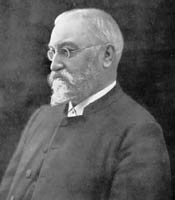
This day in history: Anglican clergyman and biblical scholar E.W. [Ethelbert William] Bullinger was born on this day (December 15) in 1837. Bullinger is noted for writing four major works: A Critical Lexicon and Concordance to the English and Greek New Testament, Number in Scripture, Figures of Speech Used in the Bible and The Companion Bible, which still sits prominently on my bookshelf, and is not the first one I've owned.

It is a testament to his genius that his writings are still being sold today and held in high regard. Details that have fascinated me is where he points out the many times the Sopherim (ancient Jewish scribes and copyists) have made changes to Scripture and why they did it. 

At Luke 23:43 where it says, "Verily I say unto thee, Today shalt thou be with me in paradise" Bullinger argued convincingly that the comma should come after "Today", not before it. Bullinger also argued that the death of Jesus occurred on a Wednesday, not a Friday, after Pilate had condemned him at the previous midnight, and he also held that Jesus was crucified on a single upright stake without a crossbar [see appendix 162 in the Companion Bible...a position that is lexically sound], with four, not two criminals and that this last view was supported by a group of five crosses of different origins in Brittany. ["Mislead by tradition and the ignorance of Scripture on the part of medieval painters, it is the general belief that only two were crucified with the Lord. But Scripture does not say so... it is clear [from cited Scriptural evidence] that there were four "others" crucified with the Lord.... To show that we are not without evidence, even from tradition, we may state that there is a "Calvary" to be seen at Ploubezere near Lannion, in the Cotes-du-Nord, Brittany, known as Les Cinq Croix ("The Five Crosses"). There is a high cross in the center, with four lower ones, two on either side."]

Bullinger argued for the mortality of the soul, the cessation of the soul between death and resurrection. He did not express any views concerning the final state of the lost, but many of his followers hold to annihilationism.

His book on the stars have led many to conclude that that the signs of the zodiac and the names of certain stars once carried a non-occult meaning to the Hebrew patriarchs and ancient Israel. 

Bullinger strongly opposed the theory of evolution and held that Adam was created in 4004 BC. Some believe that Bullinger may have been a flat-earther, though he may simply have associated with other flat-earthers due to their mutual disdain of Darwinism.

Tuesday, December 14, 2021

The Wright Brothers at Kitty Hawk on This Day in History


The Wright brothers made their first attempt to fly the Wright Flyer at Kitty Hawk, North Carolina on this day (December 14) in 1903.

The Wright Flyer was a plane they built in the back room of Wright Cycle Company, the Dayton bicycle shop where they sold/repaired bicycles. 

The News Wheel wrote an article entitled "Why North Carolina Needs to Take “First in Flight” Off Its License Plates" arguing that "Aviation history runs deep throughout the city of Dayton, Ohio. The local Air Force base — Wright Patterson — got half its name from the familial duo. The city is also home to the Wright brothers’ original cycling company..."

However, Dayton Ohio now plans to demolish the Wright brothers first bicycle shop claiming it is a nuisance, instead of preserving it as a historical artifact. Honestly, what else is Dayton Ohio known for?

Did you know: The Wright brothers were both high school dropouts, and neither of them ever married. Wilbur told reporters that he didn’t have time for both a wife AND an airplane.

Neil Armstrong carried a piece of the Wright Flyer with him to the moon. 

It was a toy from their father that started their obsession with aviation. "When the brothers were youngsters in 1878, their father returned home one evening with a gift that he tossed into the air. 'Instead of falling to the floor, as we expected,' the brothers recalled in a 1908 magazine article, 'it flew across the room till it struck the ceiling, where it fluttered awhile, and finally sank to the floor.' The model helicopter made of cork, bamboo and paper and powered by a rubber band mesmerized the boys and sparked their passion for aviation." Source

Monday, December 13, 2021

Herd Psychologist Gustave Le Bon on This Day in History


Today in History: Gustave Le Bon died on this day in 1931. He is best known for his 1895 work The Crowd: A Study of the Popular Mind, which is considered one of the seminal works of crowd psychology. This book became very influential, though he was ignored in his lifetime because he was critical of democracy and socialism. He wrote, "The Socialists of every school are loathe to admit the importance of intellectual superiority. Their high priest Marx understands by the term work nothing but manual labour, and relegates the spirit of invention, capacity, and direction, which has nevertheless transformed the world, to a second place. This hatred of intelligence on the part of the Socialists is well founded, for it is precisely this intelligence that will prove the eternal obstacle on which all their ideas of equality will shatter themselves."

Despite this, Adolf Hitler and Benito Mussolini used his book to learn how to incite a mob. 

Gustave le Bon has been reborn these past 2 years with the resurgence of civil unrest. 

"Gustave Le Bon, the French philosopher who 126 years ago in The Psychology of Crowds, was the first thinker systematically to outline how herd psychology differs from that of the individual. Le Bon it was who observed that the consciousness bestowed by membership of a crowd can be transformative, possessing individual members with ‘a sort of collective mind which makes them feel, think and act in a manner quite differently from that in which each individual would feel, think and act were that person in a state of isolation.’ In such a ‘psychological crowd’, individual personality disappears, brain activity is replaced by reflex activity: a lowering of intelligence, provoking a complete transformation of sentiments, which collectively may manifest as better and worse than those of the crowd’s constituent members. A crowd may just as easily become heroic or criminal, but is generally disposed towards destruction. ‘The ascendancy of crowds,’ wrote Le Bon, ‘indicates the death throes of a civilisation.’ The upward climb to civilisation is an intellectual process driven by individuals; the descent is a herd in stampede. 
‘Crowds are only useful for destruction.’"~John Waters

His brilliance in understanding mobs is displayed in the following quotes:

"All the civilizations we know have been created and directed by small intellectual aristocracies, never by people in the mass. The power of crowds is only to destroy."

"In crowds it is stupidity and not mother wit that is accumulated."

"The role of the scholar is to destroy chimeras, that of the statesman is to make use of them."

"If atheism spread, it would become a religion as intolerable as the ancient ones."

"One of the most constant characteristics of beliefs is their intolerance. The stronger the belief, the greater its intolerance. Men dominated by a certitude cannot tolerate those who do not accept it."

“Crowds exhibit a docile respect for force, And are but slightly impressed by kindness, Which for them is scarcely other than a form of weakness. Their sympathies have never been bestowed upon easy going masters, but the tyrants who vigorously oppressed them. It is to these latter that they always erect the loftiest statues. It is true that they willingly trample on the despot whom they have stripped of his power, but it is because having lost his power he resumes his place among the feeble who are to be despised because they are not to be feared. The type of hero dear to a crowd will always have the semblance of a Caesar, His insignia attract them, His authority overawes them, and his sword instills them with fear.”

"In a crowd every sentiment and act is contagious, and contagious to such a degree that an individual readily sacrifices his personal interest to the collective interest."

"A chain of logical argumentation is totally incomprehensible to crowds"

"The masses have never thirsted after truth. They turn aside from evidence that is not to their taste."

"The leaders [of crowds] are not gifted with keen foresight, nor could they be, as this quality generally conduces to doubt and inactivity."

"The majority of men, especially among the masses, do not possess clear and reasoned ideas on any subject whatever outside their own speciality."

Of Socialism he wrote: "One nation, at least, will have to suffer . . . for the instruction of the world. It will be one of those practical lessons which alone can enlighten the nations who are amused with the dreams of happiness displayed before their eyes by the priests of the new [socialist] faith."

The Crowd, and Mackay's Extraordinary Popular Delusions and the Madness of Crowds are two of the greatest texts from the 19th century that deal with crowd psychology and the irrational behavior that characterizes large groups of people acting en masse.

See also:


Sunday, December 12, 2021

The Mysterious Disappearance of Dorothy Arnold on This Day in History


This day in history: American socialite and heiress Dorothy Arnold mysteriously disappeared in New York on this day in 1910. 

On the morning of December 12, 1910, Arnold informed her mother that she was going shopping for a dress. Mary Francis offered to go with her daughter, but Dorothy declined the offer, telling her mother she would call her if she found a suitable dress. According to the Arnold family, Dorothy had approximately $25–30 cash in her possession (approximately $694 to $833 in today's money). 

She went to one store to buy chocolates, and then another store to buy a book. The clerks who waited on Arnold in both stores later said that she was courteous and did not exhibit any unusual behavior.

Outside the bookstore, Arnold ran into a friend named Gladys King who recalled that the two spoke briefly about Marjorie's upcoming debutante party and that Arnold seemed to be in good spirits. King then excused herself to meet her mother for lunch. She recalled that Arnold told her she was going to walk home through Central Park. 

There were no published reports of Dorothy Arnold actually buying a dress.

By the early evening, Arnold had failed to return home for dinner. As she never missed meals without informing her family, the Arnolds became worried. They began calling Arnold's friends to find her whereabouts but no one had seen her. 

Fearing that their daughter's disappearance would draw unwanted media attention and could become socially embarrassing, the Arnold family didn't report Dorothy's disappearance to the police for weeks. It is speculated that the family was influenced by the 1909 disappearance of Adele Boas, a 13 year old girl who was reported missing from Central Park and later found to have run away to Boston. She later returned home. The Boas family, also prominent New Yorkers, were scandalized and shamed in the newspapers after the incident.

In an attempt to keep the incident out of the press, the Arnold family quietly contacted John S. Keith, a family friend and lawyer, the morning following Dorothy's disappearance. Keith arrived at the family home and searched Arnold's bedroom. He discovered that except for the outfit she was wearing, all of Arnold's clothes and other personal belongings were in her room. Keith also found personal letters with foreign postmarks in her desk, two folders for transatlantic ocean liners on the desk, and burned papers in the fireplace. The burned papers were presumed to be the rejected manuscripts Arnold submitted to McClure's magazine. Over the following weeks, Keith visited jails, hospitals and morgues in New York City, Philadelphia and Boston, but did not find any sign of Arnold. After Keith's search proved fruitless, he suggested that the Arnold family hire Pinkerton detectives to investigate.

The Pinkertons theorized that she may have eloped. 

By the end of January 1911, the NYPD said they still believed that Arnold was alive and would return on her own accord. Arnold's family, however, said they had come to believe that she was dead. Around this time, Francis Arnold told the press that he believed from the start that his daughter had been attacked and killed while walking home through Central Park and that her body had been thrown into the Central Park Reservoir. He cited two clues, which he would not publicly disclose, that confirmed his suspicions.

Police dismissed his theory because in the days leading up to Arnold's disappearance, the temperature in New York City had dropped to 21 degrees Fahrenheit and the reservoir had frozen solid. The police searched Central Park anyway but found no trace of Dorothy Arnold. When the reservoir thawed that spring, police searched the water but did not find a body.

Numerous theories and rumors regarding Arnold's disappearance continued. One theory was that Arnold had slipped on an icy sidewalk, struck her head and was in a hospital with total amnesia. 

Some of Arnold's family members and friends also said they believed that Arnold had committed suicide because of a failed relationship.

One of the more widespread rumors was that Arnold had become pregnant, had sought an abortion, had died during or after the botched procedure, and had been secretly buried or cremated. This rumor gained some credibility when, in early April 1916, an illegal abortion clinic operating out of the basement of a home in Bellevue, Pennsylvania was raided by police. The clinic was run by Dr. C.C. Meredith and became notoriously known as "The House of Mystery," after numerous women from the area went missing after visiting the clinic. One of the doctors who worked at the clinic, Dr. H.E. Lutz, testified to the New York County District Attorney that Dr. Meredith told him that Arnold had died there after experiencing complications from an abortion. Dr. Lutz claimed that, like many of the women who had undergone abortions at the clinic and died, her body was burned in the furnace.

While the district attorney said he believed that Arnold had died at the clinic, Francis Arnold said he thought the story was "...ridiculous and absolutely untrue." The Arnold family lawyer John S. Keith later told the media that two months after Dorothy Arnold disappeared, he got a tip from an attorney in Pittsburgh that she was in a local sanatorium. Keith and two other detectives traveled to Pittsburgh but discovered that the woman was not Arnold.

In April 1916, a convicted felon named Edward Glennoris claimed that he was paid $250 to bury the body of a young woman in December 1910. Further investigation proved his claim was false.

Years after Arnold disappeared, numerous alleged sightings from all over the U.S. were still being reported. Police continued to investigate the reports, but all proved to be false. The Arnold family also continued to receive letters from women claiming to be Dorothy Arnold. These were also investigated and also proved to be false. One such letter came from an attorney in California who claimed that Arnold was living as "Ella Nevins" in Los Angeles, a claim that her father disputed.

The case gained attention again on April 8, 1921, when "during a lecture in New York, Captain John H. Ayers of the Bureau of Missing Persons claimed that Dorothy Arnold's fate had been known to the Bureau and her family for some time. Ayers refused to elaborate and would not say if Arnold was alive or dead." The following day, Ayers claimed that he was misquoted and denied that Arnold's fate was known.

In the weeks following his daughter's disappearance, Francis Arnold spent approximately $250,000 trying to find his daughter. He continued to maintain that he believed Dorothy had been kidnapped and murdered on the day she disappeared or shortly thereafter.

"According to the National Missing and Unidentified Persons (NamUS) database, which is funded by the U.S. Department of Justice, more than 600,000 persons of all ages go missing every year, and approximately 4,400 unidentified bodies are recovered every year." Source

Saturday, December 11, 2021

The Last Execution in Canada on This Day in History


This day in history: Arthur Lucas, originally from the U.S. state of Georgia, was one of the two last people to be executed in Canada, on this day (December 11) in 1962. Lucas had been convicted of the murder of a police informant from Detroit and his common-law wife. The murders took place in Toronto. Lucas, along with fellow prisoner Ronald Turpin, was executed at the Toronto (Don) Jail by hanging, the only form of civilian capital punishment ever used in post-Confederation Canada, although the military employed execution by firing squad.

Chaplain Cyrill Everitt attended the double hanging and in 1986, shortly before his death, he revealed that Lucas's head was "nearly torn right off" because the hangman had miscalculated the man's weight.

In the far past, execution methods were often creative, if not downright cruel and painful. The methods used were:

The breaking wheel, also known as the Catherine wheel or simply the Wheel, was a torture method used for public execution primarily in Europe from antiquity through the Middle Ages into the early modern period by breaking the bones of a criminal or bludgeoning them to death. "The victim's limbs were tied to the spokes and the wheel itself was slowly revolved. Through the openings between the spokes, the torturer usually hit the victim with an iron hammer that could easily break the victim's bones. Once his bones were broken, he was left on the wheel to die, sometimes placed on a tall pole so the birds could feed from the still-living human." Source

Keelhauling: a form of punishment and potential execution once meted out to sailors at sea. The sailor was tied to a line looped beneath the vessel, thrown overboard on one side of the ship, and dragged under the ship's keel, either from one side of the ship to the other, or the length of the ship (from bow to stern). 

Sawing: the act of sawing or cutting a living person in half, either sagittally (usually midsagittally), or transversely.

Hanging, drawing, and quartering

Burning at the stake

Flaying, also known colloquially as skinning, was a method of slow and painful execution in which skin is removed from the body. Generally, an attempt is made to keep the removed portion of skin intact.

Slow slicing, also known as Lingchi and death by a thousand cuts, was a form of torture and execution used in China from roughly 900 until 1905 where a knife was used to methodically remove portions of the body over an extended period of time, eventually resulting in death. 

Death by boiling was a method of execution in which a person is killed by being immersed in a boiling liquid. Due to the lengthy process, death by boiling is an extremely painful method of execution. Executions of this type were often carried out using a large vessel such as a cauldron or a sealed kettle filled with a liquid such as water, oil, tar, or tallow, and a hook and pulley system. 

Impalement

Mazzatello, or more properly mazzolatura (to hit with a mace), was a method of capital punishment occasionallly used by the Papal States for the most loathsome crimes, involving the infliction of head trauma. The method was named after the implement used in the execution: a large, long-handled mallet or pollaxe. If you've seen Midsommar, you know what this is.

Blowing from a gun, which was a method of execution in which the victim is typically tied to the mouth of a cannon which is then fired.

Schwedentrunk, aka Swedish drink, was a method of torture and execution in which the victim is forced to swallow large amounts of foul liquid, such as excrement. 

Scaphism, also known as the boats, was an ancient Persian method of execution. It entailed trapping the victim between two boats, feeding and covering them with milk and honey, and allowing them to fester and be devoured by insects and other vermin over time. 

One legendary method of execution was the blood eagle, where the ribs were severed from the spine with a sharp tool, and the lungs pulled through the opening to create a pair of "wings". There is continuing debate about whether the rite was a literary invention, a mistranslation of the original texts, or an authentic historic practice.

Another ancient method that is questioned by historians is that of the brazen bull. The brazen bull, also known as the bronze bull, Sicilian bull, or bull of Phalaris, was a hollow bull made out of bronze with a door in one side. According to legends the brazen bull was designed in the form and size of an actual bull and had an acoustic apparatus that converted screams into the sound of a bull. The condemned were locked inside the device, and a fire was set under it, heating the metal until the person inside was roasted to death.

54 countries still have capital punishment today, with China being the leader in executions.

See also Suicide and Philosophy - 50 Books on CDrom or The Mysteries of Death - 250 Books on DVDrom