Thursday, December 15, 2022

The Bill of Rights on This Day in History


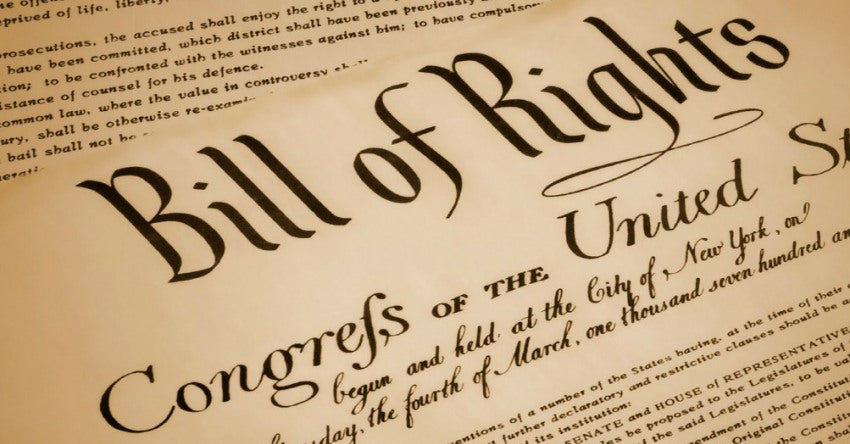
This Day in History: The United States Bill of Rights becomes law when ratified by the Virginia General Assembly on this day in 1791.

From Lawrence Reed:

Americans over the age of 60 will likely remember the hilarious TV game show that ran for 25 years (1965-1980) called Hollywood Squares. On the show, host Peter Marshall (still living at age 95) once directed this question to comedian Paul Lynde: “Pride, anger, covetousness, lust, gluttony, envy and sloth are collectively known as what?”

Sustained laughter ensued when Lynde replied, “The Bill of Rights.” (The correct answer, of course, is the Seven Deadly Sins.)

It was on this very day in 1791—December 15—that a young United States of America formally adopted the first ten amendments to its Constitution that we call the Bill of Rights. Those amendments were fundamental and foundational, as bedrock as it gets, without which adoption of the Constitution itself might not have occurred. In fewer than 500 words, many of our most cherished liberties are expressed as rights to be protected. It’s a roster of instructions to government to keep out of where it doesn’t belong.

Not long ago, the late and famous trial attorney F. Lee Bailey (1933-2021) posed a poignant question to which he provided a disturbing answer: “Can any of you seriously say the Bill of Rights could get through Congress today? It wouldn’t even get out of committee!”

Bailey was likely right, which makes it even more urgent that Americans renew a learned passion for the Bill of Rights. Toward that end, I offer here a sample of thoughts in its defense:

_____

  1. The concept that the Bill of Rights and other constitutional protections against arbitrary government are inoperative when they become inconvenient or when expediency dictates otherwise is a very dangerous doctrine and if allowed to flourish would destroy the benefit of a written Constitution and undermine the basis of our government. - Supreme Court Justice Hugo Black
  2. Show me that age and country where the rights and liberties of the people were placed on the sole chance of their rulers being good men, without a consequent loss of liberty? - Patrick Henry
  3. The Bill of Rights wasn’t enacted to give us any rights. It was enacted so the Government could not take away from us any rights that we already had. - Kenneth G. Eade, author
  4. The very purpose of a Bill of Rights was to withdraw certain subjects from the vicissitudes of political controversy, to place them beyond the reach of majorities, and to establish them as legal principles to be applied by the courts. One’s right to life, liberty, and property, to free speech, a free press, freedom of worship and assembly, and other fundamental rights may not be submitted to vote; they depend on the outcome of no elections. - Robert H. Jackson, Supreme Court Justice
  5. Education on the value of free speech and the other freedoms reserved by the Bill of Rights, about what happens when you don't have them, and about how to exercise and protect them, should be an essential prerequisite for being an American citizen — or indeed a citizen of any nation, the more so to the degree that such rights remain unprotected. If we can't think for ourselves, if we're unwilling to question authority, then we're just putty in the hands of those in power. But if the citizens are educated and form their own opinions, then those in power work for us…In the demon-haunted world that we inhabit by virtue of being human, this may be all that stands between us and the enveloping darkness." - Carl Sagan, astronomer
  6.  "There are two ways to choke off free expression. We've already discussed one of them: clamp down on free speech and declare some topics off-limits. That strategy is straightforward enough. The other, more insidious way to limit free expression is to try to change the very language people use" - Dennis Prager, author
  7. "Before a standing army can rule, the people must be disarmed; as they are in almost every kingdom of Europe. The supreme power in America cannot enforce unjust laws by the sword; because the whole body of the people are armed and constitute a force superior to any bands of regular troops that can be, on any pretense, raised in the United States." - Noah Webster
  8. "The constitutions of most of our States assert, that all power is inherent in the people; that they may exercise it by themselves, … or they may act by representatives, freely and equally chosen; that it is their right and duty to be at all times armed; that they are entitled to freedom of person, freedom of religion, freedom of property, and freedom of the press." - Thomas Jefferson
  9. "In 1942, there were 110,000 Japanese American citizens in good standing, law-abiding people who were thrown into internment camps simply because their parents were born in the wrong country. That's all they did wrong. They had no right to a lawyer, no right to a fair trial, no right to a jury of their peers no right to due process of any kind. The only right they had: "Right this way" into the internment camps! Just when these American citizens needed their rights the most, their government took them away! And rights aren’t rights if someone can take them away. They’re just privileges." - George Carlin
  10. "The first article of the Bill of Rights provides that Congress shall make no law respecting freedom of worship or abridging freedom of opinion. There are some among us who seem to feel that this provision goes too far, even for the purpose of preventing tyranny over the mind of man. Of course, there are dangers in religious freedom and freedom of opinion. But to deny these rights is worse than dangerous, it is absolutely fatal to liberty. The external threat to liberty should not drive us into suppressing liberty at home. Those who want the Government to regulate matters of the mind and spirit are like men who are so afraid of being murdered that they commit suicide to avoid assassination." - Harry Truman
  11. "In respect to political rights, we hold woman to be justly entitled to all we claim for man. We go farther and express our conviction that all political rights which it is expedient for man to exercise, it is equally so for women. All that distinguishes man as an intelligent and accountable being, is equally true of woman; and if that government is only just which governs by the free consent of the governed, there can be no reason in the world for denying to woman the exercise of the elective franchise, or a hand in making and administering the laws of the land. Our doctrine is, that “Right is of no sex." - Frederick Douglass
  12. "The Bill of Rights is the United States. The United States is the Bill of Rights. Compromise the Bill of Rights and you dissolve the very foundation upon which the Union stands… Nowhere in the Bill of Rights are the words ‘unless inconvenient’ to be found." - A. E. Samaan, historian

Rights and Non-Rights: Distinguishing the Two by Lawrence W. Reed

Historic Figures Who Recognized that Speech is Freedom’s First Line of Defense by Lawrence W. Reed

The Holiday That Isn’t by Lawrence W. Reed

George Mason: Father of the Bill of Rights by Raymond Polin

The Bill of Rights is America’s Bulwark Against Government Overreach by Gary Galles

Mercy Otis Warren: Conscience of Great Causes by Lawrence W. Reed

Lawrence W. Reed
Lawrence W. Reed

Lawrence W. Reed is FEE's President Emeritus, Humphreys Family Senior Fellow, and Ron Manners Global Ambassador for Liberty, having served for nearly 11 years as FEE’s president (2008-2019). He is author of the 2020 book, Was Jesus a Socialist? as well as Real Heroes: Incredible True Stories of Courage, Character, and Conviction and Excuse Me, Professor: Challenging the Myths of ProgressivismFollow on LinkedIn and Like his public figure page on Facebook. His website is www.lawrencewreed.com.

This article was originally published on FEE.org. Read the original article.

Wednesday, December 14, 2022

Gothic Horror Writer Shirley Jackson on This Day in History

Ruth Franklin on Shirley Jackson

This Day In History: Author Shirley Jackson was born on this day in 1916. Jackson gained significant public attention for her short story The Lottery, which presents the sinister underside of a bucolic American village. She actually wrote The Lottery in a single morning, and many people wrote to her believing that the story was true.

In 1959, she published The Haunting of Hill House, a supernatural horror novel widely considered to be one of the best ghost stories ever written. Jackson's 1962 novel We Have Always Lived in the Castle is a Gothic mystery which has been described as Jackson's masterpiece.

She was raised in a family of Christian Scientists, and she would angrily recall her mother and grandmother praying over her little brother’s broken arm rather than taking him to a hospital. Her parents never attended her wedding because she married a Jew.

She had a huge library of witchcraft books, and she was fascinated by a book called "An Adventure" which details a "true" ghost story involving Marie Antoinette written by two academics. She was the inspiration for other writers, including Stephen King, Neil Gaiman and Joyce Carol Oates.

Jackson was of English ancestry, and her family heritage can be traced to the Revolutionary War hero General Nathanael Greene.

By the 1960s, Jackson's health began to deteriorate significantly, ultimately leading to her death due to a heart condition in 1965 at the age of 48.


Tuesday, December 13, 2022

The Deadly "White Friday" on This Day in History


This Day in History: White Friday occurred on this day in 1916 during the Italian Front of World War I, when an avalanche struck Austro-Hungarian barracks on Mount Marmolada, killing 270 soldiers. Other avalanches the same day struck Italian and other Austro-Hungarian positions, killing hundreds. According to some reports both sides deliberately fired shells into the weakened snowpacks in an attempt to bury the other side, making this an early example of Mutually Assured Destruction.

An accurate estimation of the number of casualties from the White Friday avalanches is not available. Historical documents suggest at least 2,000 victims among the soldiers and a few dozens among civilians.

In the aftermath of White Friday, 10,000 soldiers on all sides were killed in December from avalanches. Altogether, it constituted the greatest number of deaths caused by snow/ice debris from avalanches in history. When including all avalanche-related deaths (this includes mud and rock slides triggered subsequently by an avalanche), White Friday is the second-worst avalanche-related disaster recorded, after the 1970 HuascarĂ¡n avalanche.

Monday, December 12, 2022

Tortured Artist Edvard Munch on This Day in History


This Day In History: Artist Edvard Munch was born on this day in 1863. He is best known for his painting, "The Scream," an image that inspired the mask in the Wes Craven movie "Scream" and the poster for ‘Home Alone’ featuring Macauly Caulkin. 

In his diary in 1892, Munch describes his inspiration for The Scream:

"One evening I was walking along a path, the city was on one side and the fjord below. I felt tired and ill. I stopped and looked out over the fjord – the sun was setting, and the clouds turning blood red. I sensed a scream passing through nature; it seemed to me that I heard the scream. I painted this picture, painted the clouds as actual blood. The color shrieked. This became The Scream."

The bridge depicted in The Scream is said to have been a popular spot for suicides, and it was within listening distance of a slaughterhouse and an insane asylum. 

During the 1994 Winter Olympics in Lillehammer, thieves placed a ladder up to the window of the National Gallery in Oslo, made their way inside, and made off with the painting. The theft was so easily committed, they left a note that read, "Thanks for the poor security." The painting was recovered within three months. It was stolen again 10 years later. London bookies were taking bets in 2012 that the painting would be stolen again before it went to auction at 20/1 odds.

Munch's later years were private, but not after battling heavy drinking and a mental breakdown.

Sunday, December 11, 2022

Forger Elmyr de Hory on This Day in History

 \

This Day In History: Art forger Elmyr de Hory died on this day in 1976. This artist is said to have sold over 1000 forgeries to reputable art galleries all over the world. He was so good at it that he became famous to the point that people wanted to buy his known forgeries. To this day, his forgeries still sell for a lot of money. In fact, there are now forgeries of Elmyr de Hory's forgeries. 

After the war, de Hory attempted to make an honest living as an artist, but soon discovered that he had an uncanny ability to copy the styles of noted painters. In 1946, he sold a pen-and-ink drawing to a British woman who mistook it for an original work by Picasso. His financial desperation trumped his scruples, as was most often the case for the next two decades. To his mind, it offered redemption from the starving artist scenario, buttressed by the comfortable rationalization that his buyers were getting something beautiful at "friendly" prices. He began to sell his Picasso pastiches to art galleries around Paris, claiming that he was a displaced Hungarian aristocrat and his offerings were what remained from his family's art collection or else that he had acquired them directly from the artist, whom he had known during his years in Paris.

De Hory expanded his forgeries to include works in the manner of Henri Matisse, Amedeo Modigliani and Renoir. When some of the galleries de Hory had sold his forgeries to were becoming suspicious, he began to use pseudonyms and to sell his work by mail order. Some of de Hory's many pseudonyms included Louis Cassou, Joseph Dory, Joseph Dory-Boutin, Elmyr Herzog, Elmyr Hoffman and E. Raynal. (Fernand Legros listed de Hory's pseudonyms; "Elmyr de Hory, Elmer Hoffman, Elementer alias Hofman, baron de Hory, Haury, Hury or Hurry, Hory, baron Raynal, Raynor, Raynol or Rainol, comte de Herzog, baron de Boughady, von Bonhyday, Boundjy, Elmyr Lazlo, Dauray, Dory, Boutin, Dory-Boutin, Cassou Robert or Cassou Charles, Louis Curiel or Curiel Charles.)

His success came to a halt in Boston after he sold one of his "Matisse" drawings to the Fogg Museum at Harvard University in the mid-1950s. Shortly after its sale, he offered a "Modigliani" and a "Renoir" drawing from his collection. An alert curator noticed a stylistic similarity among the three drawings and refused to buy his subsequent offerings. She then began contacting other institutions and galleries, asking if they knew or had purchased artworks from the debonair E. Raynal. The American art network was now aware of the suave collector and seller of dubious works by modern masters.

By 1966, more of de Hory's paintings were being revealed as forgeries; one man in particular, Texas oil magnate Algur H. Meadows, to whom Legros had sold 56 forged paintings, was so outraged to learn that most of his collection was forged that he demanded the arrest and prosecution of Legros. Angered, Legros decided to hide from the police at de Hory's house on Ibiza, where he asserted ownership and threatened to evict de Hory. Coupled with this and with Legros's increasingly violent mood swings, de Hory decided to leave Ibiza. Legros and Lessard were apprehended soon thereafter and imprisoned on charges of check fraud.

De Hory continued to elude the police for some time but, tired of life in exile, decided to move back to Ibiza to accept his fate. In August 1968, a Spanish court convicted him of the crimes of homosexuality, showing no visible means of support, and consorting with criminals (Legros), sentencing him to two months in prison in Ibiza. He was never directly charged with forgery because the court could not prove that he had ever created any forgeries on Spanish soil. He was released in October 1968 and expelled from Ibiza for one year. During that time he resided in Torremolinos, Spain.

One year following his release, de Hory, by then a celebrity, returned to Ibiza. He told his story to Clifford Irving, who wrote the biography Fake! The Story of Elmyr de Hory the Greatest Art Forger of Our Time. De Hory appeared in several television interviews and was featured with Irving in the Orson Welles documentary F for Fake (1973). In Welles's film, de Hory questioned what it was that made his forgeries inferior to the actual paintings created by the artists he imitated, particularly since they had fooled so many experts and were always appreciated when it was believed that they were genuine. In F for Fake, Welles also poses questions about the nature of the creative process, how trickery, illusion, and duplicity often prevail in the art world, and thus, in some respects, downplays the culpability of the art forger de Hory and outliers like him.

It is estimated that all de Hory forgeries were sold for more than $50 million in today's value. As Pablo Picasso once said, "Good artists copy but great artists steal." There is also Charles Caleb Colton remark: "Imitation is the sincerest form of flattery."

Saturday, December 10, 2022

The "Racist" Huckleberry Finn on This Day in History


“We all do no end of feeling, and we mistake it for thinking.” Mark Twain

This Day In History: Mark Twain's Adventures of Huckleberry Finn was published on this day in 1884. Now when Huck Finn book is mentioned, it is done so in terms of it supposed racism. 

"Mark Twain’s Adventures of Huckleberry Finn is a classic by most any measure—T.S. Eliot called it a masterpiece, and Ernest Hemingway pronounced it the source of 'all modern American literature.' Yet, for decades, it has been disappearing from grade school curricula across the country, relegated to optional reading lists, or banned outright, appearing again and again on lists of the nation’s most challenged books, and all for its repeated use of [one] single, singularly offensive word." ~ Michelle Malkin

Mark Twain is not alone. When judging the past in terms of modern pearl clutching morals, few older books walk away unscathed. Willy Wonka, Sherlock Holmes, To Kill a Mockingbird, Narnia, Agatha Christie, Secret Garden, Little House on the Prairie, Rudyard Kipling, Babar the Elephant, Dr Dolittle etc., are all under scrutiny with similar accusations.

There is so much in older classical literature to be offended by in our present politically correct atmosphere: the patriarchy, the lack of diversity, straight couples, Euro-centrism, gilded age capitalism, etc. Did you know that we have lost 14 IQ points since the Victorian era? Perhaps we are in a bad position to be judging our betters.

I often wonder how many of our modern books will be unable to pass some moral test in the future that we, at present cannot even perceive of, especially as the Overton Window shifts day after day.

.....................

In old American English slang. The phrase "a huckleberry over my persimmon" meant "a bit beyond my abilities." "I'm your huckleberry" (Doc Holliday, Tombstone) is another way of saying that you are the right man for the job.

Listen to the Adventures of Huckleberry Finn


Friday, December 9, 2022

Global Corruption on This Day in History


This Day in History: International Anti-Corruption Day has been observed annually, on 9 December, since the passage of the United Nations Convention Against Corruption on 31 October 2003 to raise public awareness for anti-corruption.

However, corruption still abounds.

From Laura Williams:

You know the clichĂ© “power corrupts,” but what does corruption look like? Wherever people have a little bit of power over other people, at least some will misuse it. Most people are not evil or cruel, but if they think they’ll get away with it, they’ll game the system to get rich.

Each year, at least 5 percent of the global gross domestic product (GDP) is wasted by corruption. Corruption makes everything cost more. You might be forced to pay bribes for a permit to build your house, pay police to use roads or bridges, pay kidnappers to avoid violence, to save your child’s life from disease. But corruption costs more than just money.

Around the world and throughout the centuries, people with power have found ways to exploit others and enrich themselves.

When the wealthy and well-connected get special access to power, we all suffer. Corruption threatens civic and human rights. Citizens lose autonomy over their bodies and their property, journalists lose their right to speak truth to power. Checks and balances get weaker: elections may be cancelled or rigged to protect the corrupt. Prosecutors and judges are bribed into silence. The rule of law begins to unravel.

Around the world and throughout the centuries, people with power have found ways to exploit others and enrich themselves. The costs—both economic and humanitarian—are devastating.

After the fall of the Soviet Union, Russians were pressured to pay for a “krysha” (literally “roof” but meaning “protection”), essentially safety from criminal gangs. Recently, extortion has become an accepted function of government. The government offices that control access to medical care, education, housing, and utilities are highly corrupt bureaucracies, and demand bribes just to do their jobs.

Officials who can hand out contracts or land triple their salaries in graft and kickbacks. Police can be bought off and judges bribed, so criminal extortion often goes unpunished. Organized crime syndicates conspire with government ministries to exploit average people and then evade justice.

Though growing wealthier by the day, China has lagged behind other developed economies due to corruption. Bribery of public officials is commonplace, with 35 percent of Chinese companies admitting to paying bribes for special licenses or to evade taxes.

Average citizens often must pay “facilitation payments” to access public services. An accepted system of favors, bribes, and gifts known as guanxi (literally: ‘relationship’) obscures the total cost of corruption, which may be 10 percent of China’s GDP.

Recent crackdowns that saw 58,0000 corrupt officials indicted were politically motivated and highly selective. The strict rule of the Communist Party in China, and its close ties to the military, perpetuates further enriching the wealthy through “public” power.

South African police officers are among the most corrupt in the world. Women are particularly vulnerable, sometimes accused of being sex workers and then assaulted by officers as a “test.” Actual sex workers suffer abuse to avoid arrest. Police often accuse drivers of being under the influence, then demand money to release them.

Prison-building corporation Bosasa secured profitable deals by bribing individual cabinet ministers and the president’s close associates with cash, cars, vacations, and homes. Bosasa’s executives also bribed journalists and prosecutors, resulting in (according to Corruption Watch) “the near destruction of the law enforcement agencies responsible for investigating and prosecuting perpetrators of corruption.”

Somalians live with corruption in every aspect of civic life. 80% of state funds are withdrawn by individuals, and not spent on social services. Would-be voters meet with violence, threats, and harassment. Journalists—at least 30 since 2008—have been murdered for investigating corruption or human rights abuses.

Entrepreneurship is barely legal, and most transactions include bribes or violence. Trade is dominated by those with financial ties to the ruling elite. The embezzlement of public funds saps what little money Somalia has to invest in the welfare of its people. Courts lack authority to prosecute corruption.

As many as 90 percent of Indians work in semi-legal “gray” markets, so they live in constant fear and become easy to extort. Two-thirds of Indians report bribing an official at least once last year. The typical fee to obtain a driver’s license is more than doubled by bribes, and truckers are routinely stopped at makeshift highway checkpoints where regulators or police demand cash.

An exceptionally high tax rate is selectively applied; buying favorable rates or exemption from fines is an established part of the tax system. Few independent media sources exist, and investigative reporting on corruption, especially at high levels, is dangerous for journalists.

The well-publicized devastation of the Venezuelan economy followed a decade of embezzlement and rampant theft at the highest levels of government. Customs officials sell illegal passports to non-citizens, often for the purposes of transporting weapons or drugs.

Government price controls encouraged officials to overstate the costs of basic goods, then sell subsidized goods on the black market for personal gain. Venezuela’s military was caught trafficking food rations. Shortages of medicine, electricity, and clean water are still widespread. Government officials went on printing (and then pocketing) money as inflation increased to nearly 1 million percent. Now 90 percent of the population of a once-wealthy nation lives in poverty.

To retain power while the country’s economy fell apart, Presidents Chavez and Maduro have murdered journalists, attacked protesters, jailed opposition leaders, and terrorized their population.

US data is much harder to acquire. Trillions can get lost, $16 Billion missing here, $10 Billion overpaid there... a person could get suspicious. Likely, it’s 5-10 percent of government spending, or 3-5 percent of GDP.

In general, the wealthier and freer the people, the less corrupt and more transparent their government.

Independent courts, a free press, lower taxes, and less government spending all contribute to oversight of power and the ability of citizens to oust abusers.

Corruption is a constant, but strong civic institutions can help combat its worst effects.

Laura Williams
Laura Williams

Dr. Laura Williams  teaches communication strategy to undergraduates and executives. She is a passionate advocate for critical thinking, individual liberties, and the Oxford Comma.

This article was originally published on FEE.org. Read the original article.