Thursday, April 6, 2017
Death, Ghosts and the Origin of Religion by Andrew Lang 1894
For more see The Religions of the World - 250 Books on DVDrom and Over 100 of the Freakiest, Creepiest and Scariest Books on DVDrom
For a list of all of my disks and digital books click here
THE GHOST THEORY OF THE ORIGIN OF RELIGION by Andrew Lang 1894
Among the many hypotheses as to the origin of religion, that which we may call the evolutionary, or anthropological, is most congenial to modern habits of thought. The old belief in a sudden, miraculous revelation is commonly rejected, though, in one sense, religion was none the less 'revealed,' even if man was obliged to work his way to the conception of deity by degrees. To attain that conception was the necessary result of man's reflection on the sum of his relations to the universe. The attainment, however, of the monotheistic idea is not now generally regarded as immediate and instinctive. A slow advance, a prolonged evolution was required, whether we accept Mr. Max Muller's theory of 'the sense of the Infinite,' or whether we prefer the anthropological hypothesis. The latter scheme, with various modifications, is the scheme of Epicurus, Lucretius, Hume, Mr. Tylor, and Mr. Herbert Spencer. Man half consciously transferred his implicit sense that he was a living and rational being to nature in general, and recognised that earth, sky, wind, clouds, trees, the lower animals, and so on, were persons like himself, persons perhaps more powerful and awful than himself. This transference of personality can scarcely be called the result of a conscious process of reasoning. Man might recognise personality everywhere, without much more thought or argument than a kitten exerts when it takes a cork or a ball for a living playmate. But consciousness must have reached a more explicit stage, when man began to ask himself what a person is, what life is, and when he arrived at the conclusion that life is a spirit. To advance from that conclusion; to explain all life as the manifestation of indwelling spirits; then to withdraw the conception of life and personality from inanimate things, to select from among spirits One more powerful than the rest, to recognise that One as disembodied, as superior, then as supreme, then as unique, and so to attain the monotheistic conception, has been, according to the evolutionary hypothesis, the tendency of human thought.
Unluckily we cannot study the process in its course of action. Perhaps there is no savage race so lowly endowed, that it does not possess, in addition to a world of 'spirits,' something that answers to the conception of God. Whether that is so, or not, is a question of evidence. We have often been told that this or the other people 'has no religious ideas at all'. But later we hear that they do possess a belief in spirits, and very often better information proves that, in one stage or other of advance or degradation, the theistic conception of a Maker and Judge of the world is also present. Meanwhile even civilised and monotheistic peoples also admit the existence of a world of spirits of the dead, of 'demons' (as in Platonism), of saints (as in Catholicism), of devils, of angels, or of subordinate deities. Thus the elements of religion are universally distributed in all degrees of culture, though one element is more conspicuous in one place or mood, another more conspicuous in another. In one mood the savage, or the civilised man, may be called monotheistic, in another mood atheistic, in a third, practically polytheistic. Only a few men anywhere, and they only when consciously engaged in speculation, assume a really definite and exclusive mental attitude on the subject. The orthodox monotheistic Mussulman has his afreets, and djinns; the Jew, or the Christian, has his angels; the Catholic has his saints; the Platonist has his demons; Superstition has its ghosts. The question is whether all these spiritual beings are only ghosts raised to higher powers: or (in the case of deity), to the highest conceivable power, while, even when this last process has been accomplished, we ask whether other ghosts, on lower grades, continue to be recognised. Meanwhile the whole anthropological hypothesis, whether valid or invalid, lies behind history, behind the experience of even the most backward races at present extant. If it be urged, as by Hume, that the conception of a supreme deity is only a reflection of kingship in human society, we must observe that some monarchical races, like the Aztecs, seem to have possessed no recognised monarchical Zeus; while something very like the monotheistic conception is found among races so remote from the monarchical state of society as to have no obvious distinctions of rank, like the Australian blacks. Moreover the evidence, on such difficult points, is obscure, and fluctuating, and capable of various interpretation. Even among the most backward peoples, the traceable shadow of a monotheistic idea often seems to bear marks of degradation and disuse, rather than of nascent development. There is a God, but He is neglected, and tribal spirits receive prayer and sacrifice. Just as in art there is a point where we find it difficult to decide whether an object is decadent, or archaic, so it is in the study of religious conceptions.
These are a few among the inevitable difficulties and obscurities which haunt the anthropological or evolutionary theory of the origin of religion. Other difficulties meet us at the very beginning. The theory regards gods as merely ghosts or spirits, raised to a higher, or to the highest power. Mankind, according to the system, was inevitably led, by the action of reason upon apparent facts, to endow all things, from humanity itself to earth, sky, rain, sea, fire, with conscious personality, life, spirit; and these attributes were as gradually withdrawn again, under stress of better knowledge, till only man was left with a soul, and only the universe was left with a God. The last scientific step, then, it may be inferred, is to deprive the universe of a God, and mankind of souls.
This step may be naturally taken by those who conceive that the whole process of ghost and godmaking is based on a mere set of natural and inevitable fallacies, and who decline to recognise that
these progressive fallacies (if fallacies they are) may be steps on a divinely appointed road towards truth; that He led us by a way that we knew not, and a path we did not understand. Yet, of course, it is plain that a conclusion may be correct, although it was reached by erroneous processes. All scientific verities have been attained in this manner, by a gradual modification and improvement of inadequate working hypotheses, by the slow substitution of correctness for error. Thus monotheism and the doctrine of the soul may be in no worse case than the Copernican theory, or the theory of the circulation of the blood, or the Darwinian theory; itself the successor of innumerable savage guesses, conjectures of Empedocles, ideas of Cuvier, of the elder Darwin, of Lamarck, and of Chambers.
At present, of course, the theistic hypothesis, and the hypothesis of a soul, do not admit of scientific verification. The difficulty is to demonstrate that 'mind' may exist, and work, apart from
'matter'. But it may conceivably become verifiable that the relations of 'mind' and 'matter' are, at all events, less obviously and immediately interdependent, that will and judgment are less closely and exclusively attached to physical organisms than modern science has believed. Now, according to the anthropological theory of the origin of religion, it was precisely from the opposite of the scientific belief,—it was from the belief that consciousness and will may be exerted apart from, at a distance from, the physical organism,—that the savage fallacies began, which ended, ex hypothesi, in monotheism, and in the doctrine of the soul. The savage, it is said, started from normal facts, which he misinterpreted. But suppose he started, not from normal facts alone, but also from abnormal facts,—from facts which science does not yet recognise at all,—then it is possible that the conclusions of the savage, though far too sweeping, and in parts undeniably erroneous, are yet, to a certain extent, not mistaken. He may have had 'a sane spot in his mind,' and a sane impulse may have led him into the right direction. Man may have faculties which savages recognise, and which physical science does not recognise. Man may be surrounded by agencies which savages exaggerate, and which science disregards altogether, and these faculties and agencies may point to an element of truth which is often cast aside as a survival of superstition, as the 'after-image' of an illusion.
The lowest known stage, and, according to the evolutionary hypothesis, the earliest stage in religion, is the belief in the ghosts of the dead, and in no other spiritual entities. Whether this belief anywhere exists alone, and untempered by higher creeds, is another question. These ghosts are fed, propitiated, receive worship, and, to put it briefly, the fittest ghosts survive, and become gods. Meanwhile the conception of ghosts of the dead is more or less consciously extended, so that spirits who never were incarnate as men become credible beings. They may inform inanimate objects, trees, rivers, fire, clouds, earth, sky, the great natural departments, and thence polytheism results. There are political processes, the consolidation of a state, for example, which help to blend these gods of various different origins into a divine consistory. One of these gods, it may be of sky, or air, becomes king, and reflection may gradually come to recognise him not only as supreme, but as, theoretically, unique, and thus Zeus, from a very limited monarchy, may rise to solitary all-fatherhood. Yet Zeus may, originally, have been only the ghost of a dead medicine-man who was called 'Sky,' or he may have been the departmental spirit who presided over the sky, or he may have been sky conceived of as a personality, or these different elements may have been mingled in Zeus. But the whole conception of spirit, in any case, was derived, it is argued, from the conception of ghosts, and that conception may be traced to erroneous savage interpretations of natural and normal facts.
If all this be valid, the idea of God is derived from a savage fallacy, though, of course, it does not follow that an idea is erroneous, because it was attained by mistaken processes and from false premises. That, however, is the inference which many minds are inclined to draw from the evolutionary hypothesis. But if the facts on which the savage reasoned are, some of them, rare, abnormal, and not scientifically accepted; if, in short, they are facts demonstrative of unrecognised human faculties, if these faculties raise a presumption that will, mind, and organism are less closely interdependent than science supposes, then the savage reasoning may contain an important element of rejected truth. It may even seem, at least, conceivable that certain factors in the conception of 'spirit' were not necessarily evolved as the anthropological hypothesis conceives them to have been.
Science had scarcely begun her secular conflict with religion, when she discovered that the battle must be fought on haunted ground, on the field of the ghosts of the dead. 'There are no gods, or only _dei otiosi_, careless, indolent deities. There is nothing conscious that survives death, no soul that can exist apart from the fleshly body.' Such were the doctrines of Epicurus and Lucretius, but to these human nature opposed 'facts'; we see, people said, men long dead in our dreams, or even when awake: the Homeric Achilles, beholding Patroclus in a dream, instantly infers that there verily is a shadow, an eidolon, a shadowy consciousness, shadowy presence, which outlasts the death of the body. To this Epicurus and Lucretius reply, that the belief is caused by fallacious inferences from facts, these facts, appearances beheld in sleep or vision, these spectral faces of the long dead, are caused by 'films peeled off from the surface of objects, which fly to and fro through the air, and do likewise frighten our minds when they present themselves to us awake as well as in sleep, what time we behold strange shapes, and "idols" of the lightbereaved,' Lucretius expressly advances this doctrine of 'films' (an application of the Democritean theory of perception), 'that we may not believe that souls break loose from Acheron, or that shades fly about among the living, or that any part of us is left behind after death'. Believers in ghosts must have replied that they do not see, in sleep or awake, 'films' representing a mouldering corpse, as they ought to do on the Lucretian hypothesis, but the image, or idolon of a living face. Plutarch says that if philosophers may laugh, these long enduring 'films,' from a body perhaps many ages deep in dust, are laughable. However Lucretius is so wedded to his 'films' that he explains a purely fanciful being, like a centaur, by a fortuitous combination of the film of a man with the film of a horse. A 'ghost' then, is, to the mind of Lucretius, merely a casual persistent film of a dead man, composed of atoms very light which can fly at inconceivable speed, and are not arrested by material obstacles. By parity of reasoning no doubt, if Pythagoras is seen at the same moment in Thurii and Metapontum, only a film of him is beheld at one of these two places. The Democritean theory of ordinary perception thus becomes the Lucretian theory of dreams and ghosts. Not that Lucretius denies the existence of a rational soul, in living men, a portion of it may even leave the body during sleep, and only a spark may be left in the embers of the physical organism. If even that spark withdraws, death follows, and the soul, no longer warmly housed in the body, ceases to exist. For the 'film' (ghost) is not the soul, and the soul is not the film, whereas savage philosophy identifies the soul with the ghost. Even Lucretius retains the savage conception of the soul as a thing of rarer matter, a thing partly separable from the body, but that thing is resolved for ever into its elements on the death of the body. His imaginary 'film,' on the other hand, may apparently endure for ages.
The Lucretian theory had, for Lucretius, the advantages of being physical, and of dealing a blow at the hated doctrine of a future life. For the public it had the disadvantages of being incapable of proof, of not explaining the facts, as conceived to exist, and of being highly ridiculous, as Plutarch observed. Much later philosophers explained all apparitions as impressions of sense, recorded on the brain, and so actively revived that they seemed to have an objective existence. One or two stock cases (Nicolai's, and Mrs. A.'s), in which people in a morbid condition, saw hallucinations which they knew to be hallucinations, did, and do, a great deal of duty. Mr. Sully has them, as Hibbert and Brewster have them, engaged as protagonists. Collective hallucinations, and the hallucinations of the sane which coincide with the death, or other crisis in the experience of the person who seemed to be seen, were set down to imagination, 'expectant attention,' imposture, mistaken identity, and so forth.
Without dwelling on the causes, physical or psychological, which have been said by Frazer of Tiree (1707), Ferrier, Hibbert, Scott, and others, to account for the hallucinations of the sane, for
'ghosts,' Mr. Tylor has ably erected his theory of animism, or the belief in spirits. Thinking savages, he says, 'were deeply impressed by two groups of biological phenomena,' by the facts of living, dying, sleep, trance, waking and disease. They asked: 'What is the difference between a living body and a dead one?' They wanted to know the causes of sleep, trance and death. They were also concerned to explain the appearances of dead or absent human beings in dreams and waking visions. Now it was plain that 'life' could go away, as it does in death, or seems to do in dreamless sleep. Again, a phantasm of a living man can go away and appear to waking or sleeping people at a distance. The conclusion was reached by savages that the phantasm which thus appears is identical with the life which 'goes away' in sleep or trance. Sometimes it returns, when the man wakes, or escapes from his trance. Sometimes it stays away, he dies, his body corrupts, but the phantasm endures, and is occasionally seen in sleeping or waking vision. The general result of savage thought is that man's life must be conceived as a personal and rational entity, called his 'soul,' while it remains in his body, his 'wraith,' when it is beheld at a distance during his life, his 'ghost,' when it is observed after his death. Many circumstances confirmed or illustrated this savage hypothesis. Breath remains with the body during life, deserts it at death. Hence the words spiritus, 'spirit,' PNEUMA, anima, and, when the separable nature of the shadow is noticed, hence come 'shade,' 'umbra,' with analogues in many languages. The hypothesis was also strengthened, by the great difficulty which savages feel in discriminating between what occurs in dreams, and what occurs to men awake. Many civilised persons feel the same difficulty with regard to hallucinations beheld by them when in bed, asleep or awake they know not, on the dim border of existence. Reflection on all these experiences ended in the belief in spirits, in souls of the living, in wraiths of the living, in ghosts of the dead, and, finally, in God.
This theory is most cogently presented by Mr. Tylor, and is confirmed by examples chosen from his wide range of reading. But, among these normal and natural facts, as of sleep, dream, breath, life, dying, Mr. Tylor includes (not as facts, but as examples of applied animistic theory) cases of 'clairvoyance,' apparitions of the dying seen by the living at a distance, second sight, ghostly disturbances of knocking and rapping, movements of objects, and so forth. It is not a question for Mr. Tylor whether clairvoyance ever occurs: whether 'death-bed wraiths' have been seen to an extent not explicable by the laws of chance, whether disturbances and movements of objects not to be accounted for by human agency are matters of universal and often well-attested report. Into the question of fact, Mr. Tylor explicitly declines to enter; these things only concern him because they have been commonly explained by the 'animistic hypothesis,' that is, by the fancied action of spirits. The animistic hypothesis, again, is the result, naturally fallacious, of savage man's reasonings on life, death, sleep, dreams, trance, breath, shadow and the other kindred biological phenomena. Thus clairvoyance (on the animistic hypothesis) is the flight of the conscious 'spirit' of a living man across space or time; the 'deathbed wraith' is the visible apparition of the newly emancipated 'spirit,' and 'spirits' cause the unexplained disturbances and movements of objects. In fact it is certain that the animistic hypothesis (though a mere fallacy) does colligate a great number of facts very neatly, and has persisted from times of low savagery to the present age of reason. So here is a case of the savage origin and persistent 'survival' of a hypothesis,—the most potent hypothesis in the history of humanity.
From Mr. Tylor's point of view, his concern with the subject ceases here, it is "not his business to ascertain whether the abnormal facts are facts or fancies. Yet, to other students, this question is very important. First, if clairvoyance, wraiths, and the other alleged phenomena, really do occur, or have occurred, then savage man had much better grounds for the animistic hypothesis than if no such phenomena ever existed. For instance, if a medicine-man not only went into trances, but brought back from these expeditions knowledge otherwise inaccessible, then there were better grounds for believing in a consciousness exerted apart from the body than if there were no evidence but that of non-veridical dreams. If merely the dream-coincidences which the laws of chance permit were observed, the belief in the soul's dream-flight would win less favourable and general acceptance than it would if clairvoyance, 'the sleep of the shadow,' were a real if rare experience. The very name given by the Eskimos to the hypnotic state, 'the sleep of the shadow,' proves that savages do make distinctions between normal and abnormal conditions of slumber.
In the same way a few genuine wraiths, or ghosts, or 'veridical hallucinations,' would be enough to start the animistic hypothesis, or to confirm it notably, if it was already started. As to disturbances and movements of objects unexplained, these, in his own experience, suggested, even to De Morgan, the hypothesis of a conscious, active, and purposeful will, not that of any human being present. Now such a will is hardly to be defined otherwise than as 'spiritual'. This order of phenomena, like those of clairvoyance and wraiths, might either give rise to the savage animistic hypothesis, or, at least, might confirm it greatly. In fact, if the sets of abnormal phenomena existed, or were held to exist, savage man scarcely needed the normal phenomena for the basis of his spiritual belief. The normal phenomena lent him such terms as 'spirit,' 'shadow,' but much of his theory might have been built on the foundation of the abnormal phenomena alone. A 'veridical hallucination' of the dying would give him a 'wraith'; a recognised hallucination of the dead would give him a ghost: the often reported and unexplained movements and disturbances would give him a vui, 'house spirit,' 'brownie,' 'domovoy,' follet, lar, or lutin. Or these occurrences might suggest to the thinking savage that some discontented influence survived from the recently dead.
Four thousand years have passed since houses were haunted in Egypt, and have left some sane, educated, and methodical men to meet the same annoyances as the ancient Egyptians did, by the
same measures. We do not pretend to discover, without examination, the causes of the sounds and sights which baffle trained and not superstitious investigators. But we do say that similar
occurrences, in a kraal or an Eskimo hut, in a wigwam, in a cave, or under a gunyeh, would greatly confirm the animistic hypothesis of savages. The theory of imposture (in some cases) does undeniably break down, for the people who hold it cannot even suggest a modus operandi within the reach of the human beings concerned, as in the case of the Wesleys. The theory of contagious hallucination of all the senses is the property of Coleridge alone. The hypothesis of a nervous force which sets up centres of conscious action is confined to Hartmann, and to certain Highland philosophers, cavalierly dismissed by the Rev. Robert Kirk as 'men illiterate'. Instead of making these guesses, the savage thinkers merely applied the animistic hypothesis, which they had found to work very well already, and, as De Morgan says, to colligate the phenomena better than any other theory. We cannot easily conceive men who know neither sleep nor dreams, but if the normal phenomena of sleep and dreams had not existed, the abnormal phenomena already described, if they occurred, as they are universally said to do, could have given rise, when speculated upon, to the belief in spirits.
But, it may reasonably be urged, 'the natural familiar facts of life, death, sleep, waking, dreams, breath, and shadows, are all versce causes, do undeniably exist, and, without the aid of any of your abnormal facts, afford basis enough for the animistic hypothesis. Moreover, after countless thousands of years, during which superstition has muttered about your abnormal facts, official science still declines to hear a word on the topic of clairvoyance or telepathy. You don't find the Royal Society investigating second sight, or attending to legends about tables which rebel against the law of gravitation.'
These are cogent remarks. Normal facts, perhaps, may have suggested the belief in spirits, the animistic hypothesis. But we do not find the hypothesis (among the backward races) where abnormal facts are not alleged to be matters of comparatively frequent experience. Consequently we do not know that the normal facts, alone, suggested the existence of spirits to early thinkers, we can only make the statement on a priori grounds. Like George Eliot's rural sage we 'think it sounds a deal likelier'. But that, after all, though a taking, is not a powerful and conclusive syllogism.
Again, we certainly do not expect to see the Royal Society inquiring into second sight, or clairvoyance, or thought transference. When the Royal Society was first founded several of its members,
Pepys, F.R.S. ; Mr. Robert Boyle, F.R.S.; the Rev. Joseph Glanvill, F.R.S., went into these things a good deal. But, in spite of their title, they were only amateurs. They had no professional dignity to keep up. They were well aware that they, unlike the late Mr. Faraday, did not know, by inspiration or by common-sense, the limits of the possible. They tried all things, it was such a superstitious age. Now men of science, or the majority of them, for there are some exceptions, know what is, and what is not possible. They know that germs of life may possibly come down on meteorites from somewhere else, and they produced an argument for the existence of a bathybius. But they also know that a man is not a bird to be in two places at once, like Pythagoras, and that nobody can see through a stone wall. These, and similar allegations, they reckon impossible, and, if the facts happen, so much the worse for the facts. They can only be due to imposture or mal-observation, and there is an end of the matter. This is the view of official science. Unluckily, not many years ago, official science was equally certain that the ordinary phenomena of hypnotism were based on imposture and on mal-observation. These phenomena, too, were tabooed. But so many people could testify to them, and they could be so easily explained by the suggestive force of suggestion, that they were reluctantly admitted within the sacred citadel. Many people, sane, not superstitious, healthy, and even renowned as scientific specialists, attest the existence of the still rarer phenomena which are said, in certain cases, to accompany the now more familiar incidents of hypnotism. But these phenomena have never yet been explained by any theory which science recognises, as she does recognise that suggestion is suggestive.
Therefore these rarer phenomena manifestly do not exist, and cannot be the subject of legitimate inquiry. These are unanswerable observations, and it is only the antiquarian who can venture, in his humble way, to reply to them. His answer has a certain force ad hominem, that is, as addressed to anthropologists. They, too, have but recently been admitted within the scientific fold; time was when their facts were regarded as mere travellers' tales. Mr. Max Muller is now, perhaps, almost alone in his very low estimate of anthropological evidence, and, possibly, even that sturdy champion is beginning to yield ground. Defending the validity of the testimony on which anthropologists reason about the evolution of religion, custom, manners, mythology, law, Mr. Tylor writes:
'It is a matter worthy of consideration that the accounts of similar phenomena of culture, recurring in different parts of the world, actually supply incidental proof of their own authenticity. . . . The test of recurrence comes in. . . . The possibility of intentional or unintentional mystification is often barred by such a state of things as that a similar statement is made in two remote lands by two witnesses, of whom A lived a century before B, and B appears never to have heard of A.'
If for 'similar phenomena of culture' here, we substitute ' similar abnormal phenomena ' (such as clairvoyance, wraiths, unexplained disturbances), Mr. Tyler's argument in favour of his evidence for institutions applies equally well to our evidence for mysterious 'facts'. ' How distant are the countries,' he goes on, 'how wide apart are the dates, how different the creeds and characters in the catalogue of the facts of civihsation, needs no further showing'—to the student of Mr. Tylor's erudite footnotes. In place of 'facts of civilisation' read 'psychical phenomena,' and Mr. Tylor's argument applies to the evidence for these rejected and scouted beliefs.
The countries from which 'ghosts' and 'wraiths' and 'clairvoyance' are reported are 'distant'; the dates are 'wide apart'; the 'creeds and characters of the observers' are 'different'; yet the evidence is as uniform, and as recurrent, as it is in the case of institutions, manners, customs. Indeed the evidence for the rejected and abnormal phenomena is even more 'recurrent' than the evidence for customs and institutions. Polyandry, totemism, human sacrifice, the taboo, are only reported as existing in remote and semi-civilised countries. Clairvoyance, wraiths, ghosts, mysterious disturbances and movements of objects are reported as existing, not only in distant ages, but to-day; not only among savages or barbarians, but in London, Paris, Milan. No ages can be more wide apart, few countries much more distant, than ancient Egypt and modern England: no characters look more different than that of an old scribe under Pharaoh, and that of a distinguished soldier under Queen Victoria. Yet the scribe of Khemi and General Campbell suffer from the same inexplicable annoyance, attribute it to the same very abnormal agency, and attempt (not unsuccessfully) to communicate with that agency, in precisely the same way.
This, though a striking, is an isolated and perhaps a casual example of recurrence and uniformity in evidence. Mr. Tylor's Primitive Culture is itself a store-house of other examples, to which more may easily be added. For example, there is the old and savage belief in a 'sending'. The medicine-man, or medium, or witch, can despatch a conscious, visible, and intelligent agent, non-normal, to do his bidding at a distance. This belief is often illustrated in the Scandinavian sagas. Rink testifies to it among the Eskimo, Grinnell among the Pawnees: Porphyry alleges that by some such 'telepathic impact' Plotinus, from a distance, made a hostile magician named Alexander 'double up like-an empty bag,' and saw and reported this agreeable circumstance. Hardly any abnormal phenomenon or faculty sounds less plausible, and the 'spectral evidence' for the presence 'of a witch's 'sending,' when the poor woman could establish an alibi for her visible self, appeared dubious even to Cotton Mather. But, in their Phantasms of the Living, Messrs. Gurney and Myers give cases in which a visible 'sending' was intentionally emitted by Baron Schrenck Notzing, by a stock-broker, by a young student of engineering, and by a French hospital nurse, to take no other instances. The person visited frequently by the 'sendings' in the last cases was a French physician engaged in the hospital, who reports and attests the facts. All the cases are given at first hand on the testimony of the senders and of the recipients of the sendings. Bulwer Lytton was familiar with the belief, and uses the 'shining shadow' in _A Strange Story_. Now here is uniform recurrent evidence from widely severed ages, from distant countries, from the Polar North, the American prairie, Neoplatonic Egypt and Greece, England and New England of the seventeenth century, and England and Germany of to-day. The 'creeds and characters of the observers' are as 'different' as Neoplatonism, Shamanism, Christianity of divers sects, and probably Agnosticism or indifference. All these conditions of unvarying testimony constitute good evidence for institutions and customs; anthropologists, who eagerly accept such testimony in their own studies, may decide as to whether they deserve total neglect when adduced in another field of anthropology.
Turning from 'sendings,' or 'telepathy' voluntarily brought to bear on one living person by another, we might examine 'death-bed wraiths,' or the telepathic impact—'if that hypothesis of theirs be sound'—produced by a dying on a living human being. A savage example, in which a Fuegian native on board an English ship saw his father, who was expiring in Tierra del Fuego, has the respectable authority of Mr. Darwin's Cruise of the Beagle. Instances, on the other hand, in which Australian blacks, or Fijians, see the phantasms of dead kinsmen warning them of their decease (which follows punctually) may be found in Messrs. Fison and Howitt's Kamilaroi and Kurnai.
From New Zealand Mr. Tylor cites, with his authorities, the following example: 'A party of Maoris (one of whom told the story) were seated round a fire in the open air, when there appeared,
seen only by two of them, the figure of a relative left ill at home. They exclaimed, the figure vanished, and, on the return of the party, it appeared that the sick man had died about the time of the vision.' A traveller in New Zealand illustrates the native belief in the death-wraith by an amusing anecdote. A Rangatira, or native gentleman, had gone on the war-path. One day he walked into his wife's house, but after a few moments could not be found. The military expedition did not return, so the lady, taking it for granted that her husband, the owner of the wraith, was dead, married an admirer. The hallucination, however, was not 'veridical'; the warrior came home, but he admitted that he had no remedy and no feud against his successor. The owner of a wraith which has been seen may be assumed to be dead. Such is Maori belief. The modern civilised examples of death-wraiths, attested and recorded in Phantasms of the Living, are numerous; but statistics prove that a lady who marries again on the strength of a wraith may commit an error of judgment, and become liable to the penalty of bigamy. The Maoris, no statisticians, take a more liberal and tolerant view. These are comparatively scanty examples from savage life, but then they are corroborated by the wealth of recurrent and coincident evidence from civilised races, ancient and modern.
On the point of clairvoyance, it is unnecessary to dwell. The second-sighted man, the seer of events remote in space or not yet accomplished in time, is familiar everywhere, from the Hebrides to the Coppermine River, from the Samoyed and Eskimo to the Zulu, from the Euphrates to the Hague. The noises heard in 'haunted houses,' the knocking, routing, dragging of heavy bodies, is recorded, Mr. Tylor says, by Dayaks, Singhalese, Siamese, and Esths; Dennys, in his Folk-lore of China, notes the occurrences in the Celestial Empire; Grimm, in his German Mythology, gives examples, starting from the communicative knocks of a spirit near Bingen, in the chronicle of Rudolf (856), and Suetonius tells a similar tale from imperial Rome. The physician of Catherine de Medicis, Ambroise Pare, describes every one of the noises heard by the Wesleys, long after his day, as familiar, and as caused by devils. Recurrence and conformity of evidence cannot be found in greater force.
The anthropological test of evidence for the abnormal and rejected phenomena is thus amply satisfied. Unless we say that these phenomena are 'impossible,' whereas totemism, the couvade, cannibalism, are possible, the testimony to clairvoyance, and the other peculiar occurrences, is as good in its way as the evidence for odd and scarcely credible customs and institutions. There remains a last and notable circumstance. All the abnormal phenomena, in the modern and mediaeval tales, occur most frequently in the presence of convulsionaries, like the so-called victims of witches, like the Hon. Master Sandilands, Lord Torphichen's son (1720), like the grandson of William Morse in New England (1680), and like Bovet's case of the demon of Spraiton.
The 'mediums' of modern spiritualism, like Francis Fey, are, or pretend to be, subject to fits, anaesthesia, jerks, convulsive movements, and trance. As Mr. Tylor says about his savage jossakeeds, powwows, Birraarks, peaimen, everywhere 'these people suffer from hysterical, convulsive, and epileptic affections'. Thus the physical condition, all the world over, of persons who exhibit most freely the accepted phenomena, is identical. All the world over, too,the same persons are credited with the rejected phenomena, clairvoyance, 'discerning of spirits,' powers of voluntary 'telepathic' and 'telekinetic' impact. Thus we find that uniform and recurrent evidence vouches for a mass of phenomena which science scouts. Science has now accepted a portion of the mass, but still rejects the stranger occurrences. Our argument is that their invariably alleged presence, in attendance on the minor occurrences, is, at least, a point worthy of examination. The undesigned coincidences of testimony represent a great deal of smoke, and proverbial wisdom suggests a presumption in favour of a few sparks of fire. Now, if there are such sparks, the animistic hypothesis may not, of course, be valid,—'spirits' may not exist,—but the universal belief in their existence may have had its origin, not in normal facts only, but in abnormal facts. And these facts, at the lowest estimate, must suggest that man may have faculties, and be surrounded by agencies, which physical science does not take into account in its theory of the universe and of human nature.
We have already argued that the doctrines of theism and of the soul need not to be false, even if they were arrived at slowly, after a succession of grosser opinions. But if the doctrines were reached by a process which started from real facts of human nature, observed by savages, but not yet recognised by physical science, then there may have been grains of truth even in the cruder and earlier ideas, and these grains of gold may have been disengaged, and fashioned, not without Divine aid, into the sacred things of spiritual religion.
The stories which we have been considering are often trivial, sometimes comic; but they are universally diffused, and as well established as universally coincident testimony can establish anything. Now, if there be but one spark of real fire to all this smoke, then the purely materialistic theories of life and of the world must be reconsidered. They seem verywell established, but so have many other theories seemed, that are long gone the way of all things human. The authority for the Maori belief (p. 354) is Polack's New Zealand, vol. i. p. 269.
For more see The Religions of the World - 250 Books on DVDrom and Over 100 of the Freakiest, Creepiest and Scariest Books on DVDrom
For a list of all of my disks and digital books click here
10 Reasons Socialism is Harmful, by Roger W. Babson 1921
See also Over 300 PDF/Acrobat Books on Socialism, Communism and Economics
For a list of all of my disks and digital books click here - Visit my Econ blog at http://fredericbastiat1850.blogspot.com/
Many of the socialists are honest and conscientious. The need is to convert them rather than to make them more bitter. Men cannot be converted by abuse. Men can be converted only by appealing to their hearts and their intellects. With many people, socialism is a form of religion. Like some other dangerous beliefs, the effect of preaching it is often harmful. There are ten reasons why the preaching of socialism is harmful.
(1) Socialism directs people's minds from the production of wealth toward the division of wealth. The fact that there is only enough already produced to keep civilization going a few months shows that this is a very dangerous doctrine.
(2) Socialism sets class against class to an even greater extent than does the competitive system, although the solution of our industrial problems will come about only through co-operation.
(3) Socialism directs the thought of the people to the symptoms of the disease instead of the cause, It does not go to the heart of the difficulty.
(4) Socialism gives the underworld a dose of morphia to keep it feeling good when it really needs a surgical operation. The competitive system must be reformed rather than asphyxiated.
(5) Socialism tries to set aside the law of supply and demand which always has determined, which does, and which always will determine production and prices.
(6) Socialism gives a wrong reason for government ownership. The government should engage only in such activities and pass such laws as are necessary to give the individual the fullest opportunity for self-determination. To the extent that government ownership can give man more freedom of expression, to that extent government ownership should be encouraged; but when government ownership tends to suppress individual initiative and development, it loses its effectiveness.
(7) Socialism sets aside the only known method of selecting the fittest. Socialism tends to substitute votes for efficiency. Socialism would operate a horse-race by walking the horses back and forth in front of the grandstand and then would determine the winner by voting instead of by racing the horses.
(8) Socialism discourages thrift. Capital is only stored-up wages. The only permanent way that men can create work for themselves is by investing their money rather than by spending it. The world needs more capital instead of less capital.
(9) Socialism stands for the pig-trough philosophy rather than for the work-bench philosophy. It may be Christian in its conception, but it is pagan in its operation.
(10) Socialism talks about the rights of people instead of the duties of people. The great need today is to preach duty and responsibility, The competitive system should not be cast aside until there exists a race with sufficient religion to get on without it.
Wednesday, April 5, 2017
What is the Best New Testament: Colwell's Apparatus
Colwell's apparatus was taken from his book, "What Is The Best New Testament" University of Chicage Press, 1951.
Colwell's Rule of Bible Translations
Below the table are the 64 scriptures from John's Gospel that Colwell uses to determine accuracy in a New Testament. The message being:
*Is your Bible faithful to the best manuscripts available? If not, then why not? What is the motivation behind choosing a weaker reading?*
Why is the TR (Textus Receptus/Received Text) weaker. According to Colwell,
"No scholar today employs this text for any scholarly purpose except as he may use it in writing the history of the Greek New Testament. The King James version is undoubtably the most inaccurate English New Testament in common use today...The King James stands at the bottom of the list also in regard to three spurious passages selected as tests (Mk 16:9-20; Jn 7:53-8:11 and 1 John 5:7-8)." pp. 99, 100
Versions in bold italics are those Colwell had printed, the others are added by me using the same criteria.
| Translation | Agrees with the Critical Text |
Agrees with the later Textus Receptus |
Other |
|---|---|---|---|
| New World Translation | 64 | 0 | 0 |
| 21st Century NT* | 64 | 0 | 0 |
| Goodspeed* | 64 | 0 | 0 |
| Rotherham | 62 | 2 | 0 |
| Byington/BLE | 61 | 3 | 0 |
| New Revised Standard | 60 | 3 | 1 |
| 20th Century NT | 59 | 4 | 1 |
| Lattimore | 59 | 5 | 0 |
| New American Standard | 59 | 5 | 0 |
| Westminster | 58 | 6 | 0 |
| American Standard Ver. | 58 | 6 | 0 |
| Revised Version 1885 | 57 | 7 | 0 |
| Beck's An American Trans | 56 | 8 | 0 |
| New Jerusalem Bible | 56 | 8 | 0 |
| Revised Standard Version | 56 | 8 | 0 |
| New American Bible | 56 | 7 | 1 |
| Moffatt | 56 | 7 | 1 |
| New Berkeley Version | 56 | 7 | 1 |
| Riverside New Testament | 55 | 9 | 0 |
| Barclay's New Testament | 55 | 8 | 1 |
| Kleist & Lilly New Test. | 55 | 9 | 0 |
| Wuest's Expanded Trans. | 54 | 10 | 0 |
| New English Bible | 53 | 9 | 2 |
| Holman Christian Standard | 53 | 11 | 0 |
| God's Word Translation | 53 | 11 | 0 |
| Weymouth's New Test. | 53 | 11 | 0 |
| Williams New Testament | 52 | 12 | 0 |
| English Standard Version | 52 | 10 | 2 |
| Spencer | 51 | 13 | 0 |
| New International Version | 51 | 10 | 3 |
| Basic English Bible | 51 | 12 | 1 |
| New Century Version | 51 | 12 | 1 |
| International Standard Ver | 50 | 14 | 0 |
| Ferrar Fenton | 50 | 14 | 0 |
| Good News Bible | 50 | 12 | 2 |
| Jerusalem Bible | 49 | 15 | 0 |
| Recovery NT | 49 | 15 | 0 |
| NET Bible | 49 | 13 | 2 |
| Jewish NT | 49 | 13 | 2 |
| The Message | 48 | 13 | 3 |
| Centenary Version | 47 | 16 | 1 |
| Contemporary English Ver | 46 | 15 | 3 |
| JB Phillips | 45 | 17 | 2 |
| Living Bible | 42 | 15 | 7 |
| New Living Translation | 41 | 19 | 4 |
| Amplified Bible | 37 | 27 | 0 |
| Confraternity Version | 35 | 27 | 2 |
| Concordant Literal NT | 25 | 28 | 1 |
| Knox Version | 33 | 29 | 2 |
| Challoner | 25 | 27 | 2 |
| Hebrew Names Version | 8 | 55 | 1 |
| New King James Version | 0 | 63 | 1 |
| Revised Webster | 0 | 64 | 0 |
| King James Version | 0 | 64 | 0 |
*The 21st Century NT has 64 points due to its being a dual Literal/Free Translation. Where one side (usually the Free side) had the weaker reading, it was usually corrected by the truer reading on the literal side. At the same time, each side held alone would have done remarkably well, especially the literal side. I think it is encumbent on any Free/Dynamic Equivalent/Paraphrased Bible to include a literal text, if nothing else, than for ease of mind and conscience.
*Colwell chose Goodspeed version as his top New Testament, but I disagree. While taking him at his word for the most part, I cannot agree when it comes to the reading at John 1:18. Colwell's true reading of this verse has "the only begotten God," a faithful rendering of MONOGENHS QEOS. Goodspeed actually has "divine Only Son," a weaker reading as it seeks to combine the reading of both the Textus Receptus (TR) and the Westcott and Hort (WH) text. I left it at the top out of respect for Colwell, but it really deserves a reading of 63, placing the New World Translation as the best stand alone version of the New Testament in English.
The list of 64: TR = Textus Receptus; WH = Westcott and Hort Text
1:15 TR This was he of whom I spake
WH For it was he who said it
1:18 TR the only begotten Son
WH the only begotten God
1:27 TR He it is, who coming after me is preferred before me
WH He is to come after me
1:28 TR Bethabara
WH Bethany
1:39 TR Come and see
WH Come and you will see
1:49 TR Nathanael answered and saith unto him
WH Nathanael answered
1:51 TR Hereafter ye shall see heaven
WH you will see heaven
3:15 TR That whosoever believeth in him should not perish, but have eternal
life
WH That whoever believes in him may have eternal life
3:25 TR between John's disciples and the Jews
WH between John's disciples and a Jew
4:15 TR come hither to draw
WH come all this way to draw
4:35-36 TR they are white already to harvest. And he that reapeth
WH they are white for harvesting. The reaper is already
4:42 TR is indeed the Christ, the Saviour of the world
WH is indeed the Saviour of the world
4:43 TR departed thence, and went into Galilee
WH went on to Galilee
5:2 TR Bethasda
WH Bethzatha
5:3 TR a great multitude
WH a multitude
5:3-4 TR waiting for the moving of the water. For an angel went down at a
certain season into the pool, and troubled the water: whosoever then first
after the troubling of the water stepped in was made whole of whatsoever
disease he had.
WH omitted
5:12 TR Take up thy bed, and walk?
WH pick it up and walk?
5:16 TR persecute Jesus, and sought to slay him, because
WH persecute Jesus because
5:30 TR of the Father which hath sent me
WH him who hath sent me
6:11 TR he distributed to the disciples, and the disciples to them that were
set down
WH he distributed to them that were set down
6:17 TR Jesus was not come to them
WH Jesus had not yet come to them
6:22 TR none other boat there, save that one whereinto his disciples were
entered, and that Jesus went not with his disciples into the boat
WH no other boat there except one and that Jesus had not gone into the boat
with his disciples
6:39 TR of the Father who has sent me
WH of him who has sent me
6:40 TR of him who has sent me
WH of my Father
6:47 TR He that believeth on me hath everlasting life
WH He that believeth hath everlasting life
6:51 TR and the bread that I will give is my flesh, which I will give for
the life of the world
WH and the bread that I will give is my flesh, on behalf of the life of the
world.
6:58 TR not as your fathers did eat manna
WH not as your fathers ate and died
6:63 TR the words which I speak
WH the words which I have spoken
6:69 TR thou art that Christ, the Son of the living God
WH you are the Holy One of God
7:20 TR the crowd answered and said
WH the crowd answered
7:26 TR Do the rulers know truly that this is truly the Christ?
WH Do the rulers know that this is the Christ?
7:39 TR for not yet was the Holy Spirit
WH for not yet was the Spirit
7:40 TR many of the crowd
WH some of the crowd
7:53-8:11 TR Pericope Adulterae
WH omits (or in appendix)
8:59 TR and went out of the temple, going through the midst of them, and so
passed by.
WH and went out of the temple
9:4 TR it is necessary for me to work
WH it is necessary for us to work
9:11 TR to the pool of Siloam
WH to Siloam
10:4 TR whenever he puts out his own sheep
WH whenever he puts out all his own
10:26 TR because ye are not of my sheep, as I said unto you
WH because ye are not of my sheep
10:29 TR he who gives to me is greater than all
WH that which he gives me is greater than all
11:30 TR but he was in the place
WH but he was still in the place
11:41 TR Then they took away the stone from the place where the corpse was
lying
WH Then they took away the stone
12:4 TR Judas Iscariot, Simon's son
WH Judas Iscariot
12:22 TR and again Andrew and Philip
WH Andrew and Philip went
12:41 TR These things said Isaiah, when he saw his glory
WH These things said Isaiah, because he saw his glory
12:47 TR my words, and believe not
WH my words, and does not keep them
13:18 TR the one who eats bread with me
WH the one who eats my bread
14:4 TR you know where I am going and you know the way
WH you know where I am going
14:28 TR because I said I am going
WH because I am going
16:4 TR whenever the time comes
WH whenever their time comes
16:16 TR and ye shall see me, because I go to the Father
WH and ye shall see me
16:27 TR I came out from God
WH I came out from the Father
17:11 TR keep those whom you gave me in your name
WH keep them in your name which you gave me
17:21 TR let them be one in us
WH let them be "in us"
18:20 TR where the Jews always meet together
WH where all the Jews meet together
18:40 TR and they all cried out again
WH and they cried out again
19:3 TR and they said
WH and they marched up to him saying
19:29 TR and they filled a sponge with the wine
WH a sponge soaked with wine
19:39 TR a mixture of myrrh and aloes
WH a roll of myrrh and aloes
20:16 TR she said to him Rabbouni
WH she said to him in Hebrew Rabbouni
20:29 TR Is it because you have seen me, Thomas, that you believe
WH Is it because you have seen me that you believe
21:3 TR they went out and embarked in the boat immediately
WH they went out and embarked in the boat
21:15 TR Simon son of Jonah
WH Simon son of John
Colwell's apparatus was taken from the Book, "What is the Best New Testament" by E.C. Colwell, University of Chicage Press.
This is a great listen and at the end he talks about Jason Beduhn and the New World Translation
-Heinz Schmitz
Superstition of the Number 13 by EJ Jones 1906
Superstition of the Number Thirteen by EJ Jones 1906
For more see The Number 13 & Other Superstitions - 100 Books on DVDROM
Thirteen enjoys among Numerals a dual position peculiarly its own. It is somewhat singular that a number regarded by some so sacredly as to be reverently venerated should have acquired in the eyes of others an unpopularity stigmatised by all that is evil, unlucky, and undesirable.
Passing swiftly from the remoter ages of superstition to more modern times of seemingly sounder reasoning, one finds it typical alike of good and evil according to the particular circumstances of the case. Superstition dies hard; and while the twentieth century, with its ripening intelligence, is wonderfully able to accept with alacrity what the revolution of ages has brought about in so many desirable directions, one sees it clinging here and there, like limpets to the rock, some persons even still going so far as to refuse to dine in a company of thirteen lest death should thereby claim too soon an unwilling victim. This notion is popularly supposed to have arisen through that memorable meal from which Judas rose to meet his doom.
Nothing is more surprising than the inconsistency and contrariness, at times, of the human race. Dr G. Russell Forbes has recently drawn passing attention to what is recorded in verse on the marble table in the chapel of the Triclinium Pauperum in Rome, adjoining the Church of St Gregory on the Caelian Hill—namely, that Pope Gregory the Great was in the habit of entertaining every morning twelve poor men. On one occasion Christ appeared as the thirteenth, and henceforth thirteen became 'lucky' for the time being. Here, as elsewhere in the numeral world, may be observed a strong tendency to let fancy take so powerful a possession of the mind that it appears to that abnormal imagination no longer as fancy but as fact. Thirteen, however, was the symbol of Death considerably earlier even than the beginning of the Christian era. If the Tarot or Gipsies' Gospel be referred to, it will be found that the thirteenth card is represented by a skeleton with his scythe. This symbolism may be traced through ancient oral tradition to the thirteenth letter of that sacred word of the Hebrew Kabbalah, YHWH, a word never, it is supposed, uttered by the Israelites themselves, and only by the High Priest once a year. A number being attributed to each letter of the alphabet, every word in due course gained a numerical value; and so from this ancient conception of an occult meaning in numbers certain results were attained. As the principal doctrines of the Kabbalah endeavoured to portray not only the nature of the Deity, the divine emanations, the cosmogony, the creation, the nature of the angels and of men, but also their destiny, it can be understood how 'death' became associated with its 'own' number.
Sitting down as the thirteenth at dinner was, we are told in the old Norse mythology, deemed 'unlucky' by the Scandinavians, because, at a banquet in the Valhalla, Loki, the Scandinavian God of Strife and Evil, intruded himself on one occasion, making the 'thirteenth' guest, and succeeded in his desire to kill, with an arrow of mistletoe, Balder, the God of Peace. It is noticeable that in this instance the thirteenth guest was the emblematic embodiment of Evil. In the case of Pope Gregory the thirteenth guest was the symbolic omen of Good.
'Thirteen,' says Wynn Westcott in his treatise on Numbers, 'was the sacred number of the Mexicans and the people of Yucatan. The method of computation among the Mexican priests,' he continues, 'was by weeks of thirteen days—their year being twenty-eight weeks of thirteen days and one over. Thirteen years formed an indiction— a week of years—the thirteen days over forming another week. Four times thirteen, or fifty-two, was their "cycle." In Yucatan there were thirteen snake gods.' He draws attention, too, to the fact that old authors speak of 'thirteen' as a number used to procure agreement among married people. Thirteen, it should be pointed out, is the number of the Hebrew word _achad_—unity.
We find from the old Julian Calendar that the feast known as epulum Jovis took place on the 13th November; and according to the Breviary of Salisbury, festivals were, before the Reformation, held on January 13th, August 13th, October 13th, and September 13th.
In opposition to this, the Turks, Russians, Italians, French, and English have all shown themselves more or less prejudiced, from time to time, against 'thirteen.' Moore in his Diary refers to a dinner of thirteen at Madame Catalini's, when a French Countess was hastily summoned to remedy the grievance. French prejudice, if report be true, has even gone so far as to delete the dreaded figure from their door-numbers; while individuals styled _quartozienes_ have held themselves in readiness to avert by their presence a supposed foreshadowing calamity. Yet prior to 1825 the Irish, superstitious in many ways though they be, could calmly carry about with them a coin worth just thirteen pence.
Thirteen—the 'baker's dozen' is, of course, everywhere regarded as including a vantage loaf. 'Would you not,' pertinently asks Dr Forbes, in contending for the luck lurking in thirteen, 'rather have thirteen guineas than twelve?'
A Thirteenth Club at one time made itself conspicuous in a ludicrous endeavour to upset this widely spread prejudice and other ill-foreboding omens by boldly breaking mirrors and otherwise identifying themselves with skulls and skeletons, black cats, cross-eyed waiters, and coffin-shaped saltcellars, so that the Spectator in 1894 found itself unable to refrain from facetiously exclaiming, 'Who could have believed that there were one hundred and sixty-nine men in London so singularly lacking in humour!'
Mention might also be made of the celebrated 'Thirteenth Regiment,' of whom it was spoken: 'Gallant deeds in all parts of the globe for upwards of one hundred and eight years, combined with excellent conduct in quarters, have obtained for the regiment the respect of the country, and the Queen [Victoria] has graciously named it after her Royal Consort, in testimony of its many and varied services.'
Attention may now be turned to several lately revived instances in the annals of American history of 'thirteen' being felicitous rather than the reverse. The country of this ever-increasingly prosperous people was, it is contended, discovered on the 13th; comprised originally thirteen States; and the national motto, intentionally or not, 'E pluribus unum,' consists of just thirteen letters. The American eagle claims to have exactly thirteen feathers on each wing. General Washington, when raising the Republican standard, was saluted with thirteen guns. It might almost be styled the 'Land of Thirteen.'
A remarkable example in evidence of the influence which personal feeling may have over one's opinion is worth recalling. Bismarck is credited with holding in supreme veneration the number 3, but he had a particular antipathy to it when preceded by the figure 1, and would never, it is said, sit down to dine if he happened to be the thirteenth person at table. Pythagoras declared three to be the 'perfect' number, typical of 'beginning, middle, and end.' Bismarck's reasons for his predilection were briefly stated at the time of his death. He served three masters; he was responsible for and fought in three great wars; he signed three treaties of peace; he arranged the meeting of three Emperors; he established the Triple Alliance; in the FrancoGerman War he had three horses killed under him; he had three names (Bismarck, Schoenhausen, and Lauenburg); he acquired three titles (Count, Prince, Duke); the ancient arms of his family are a leaf of clover and three oak-leaves. His family motto, 'In Trinitate robur' — Strength in Trinity— was surely in itself sufficient to give a leaning in this particular direction. So closely were his feelings associated with the triple number that the caricaturist represented him with three hairs on his head. He had three children. Under his administration the Conservatives, National Liberals, and Ultramontanes were formed. These circumstances considered, then, it is hardly to be wondered at that Bismarck should have had a penchant for 'three' rather than for 'thirteen.'
Richard Wagner the musician, on the other hand, preferred 'thirteen.' Born in 1813, Fate endowed him with a name of thirteen letters, and in course of time allowed him to compose thirteen works. His Tannhauser was finished on April 13th, and was first performed in Paris on March 13th. He left Bayreuth on September 13th, and died February 13th.
Even in the present year of grace folks may be found firmly believing that there is 'luck in odd numbers'—not alone in three and thirteen, but in seven also. As shown in a former paper, like 'three' and 'thirteen,' 'seven' has played no inconspicuous part in the story of the past. Had Cobden been a man of constitution a little less matter-of-fact he might have dwelt with a sense of satisfaction on the number seven; for was it not owing to the power of seven men and the patience of seven years that those crushing Corn Laws were in the end so completely conquered and overthrown?' Luck will come, if it can,' was, in substance, what Carlyle once tersely and soundly predicted; to which one ventures to add, Yes, and in the train of three and seven and thirteen irrespectively, and in spite of rather than because of any particular number. The reflection carries with it an amazing amount of comforting consolation. But it should not be forgotten that while awaiting its appearance one may be actually speeding its advent in a calm pursuance of the Chelsea philosopher's sensible counsel: 'Work— work hard; work well.'
An instance in which this may be seen, and in association with the so-called 'unlucky' number, is in the time-honoured and still popular game of whist. Thirteen cards are dealt out to, and rigorously demanded by, each player. It depends largely, of course, upon the player himself whether those thirteen cards are turned to his advantage or disadvantage.
One more remark about thirteen. At roulette, quite recently, 'thirteen' was reported as having come up 'three times in succession,' losing the Casino, it was stated, no less than five thousand pounds—enough, one would think, to upset the prejudiced attitude of many a superstitious mind. The case strikingly bears out the contention advanced above. The winners found thirteen lucky; the Casino found thirteen unlucky. How, under these particular conditions, could it possibly be any otherwise?
For more see The Number 13 & Other Superstitions - 100 Books on DVDROM
The Mystery of the Dog by Ernest Bell 1917
THE dog has long been a mystery to us.
Why does he of all animals desert his own kind and attach himself to man, and this not in any one country or at any particular period or time?
From the earliest prehistoric ages where traces have been found of man there also have been signs that he has been accompanied by his dog, and it is the same in all parts of the globe, from the North to the South Pole.
Creatures so different as the tiny griffon, whom you can hold in the palm of your hand. and the huge boar-hound (Great Dane), four feet high, have this same characteristic, that they live with man and adopt him as their master or god. We think there must be some meaning, unknown to us, behind this, and we have sometimes wondered whether it may be that the soul of the dog may need communion with the human soul in order to forward its development and work out its destiny.
But lately we have wondered whether it may not be the other way about — whether the dog is not there in order that men, with their temptation to forget all else in their material lives, may not always have before them an example of unselfish devotion, boundless love, and unswerving faith.
It's Getting Better All the Time: 100 Greatest Trends in the Last 100 Years
It’s not for nothing that economics is tagged “the dismal science.” Part of that reputation traces to its realistic no-pie-in-the-sky nature, but another part goes to the ongoing influence of thinkers like Thomas Malthus, who saw population outracing food output; Karl Marx, who saw evil capital crushing the rising working class; and John Maynard Keynes, who saw government demand-management as the only way to beat unemployment and the business cycle. (For the record, David Levy has shown that Thomas Carlyle coined the term “the dismal science” not for reasons such as those, but because the practitioners of economic science opposed racial slavery. See Ideas on Liberty, March 2000.)More recently, noneconomists like biologist Paul Ehrlich of Stanford University, Lester Brown of the World Watch Institute, and presidential candidates Ralph Nader of the Green Party and Pat Buchanan of the Reform Party have jumped on the World-Is-Going-To-Hell bandwagon.
Here’s how Newsweek reported on “Global 2000,” a 1980 multimillion-dollar U.S. government study authorized by President Jimmy Carter: “The year: 2000. The place: Earth, a desolate planet slowly dying of its own accumulating follies. Half the forests are gone; sand dunes spread where fertile lands once lay. Nearly 2 million species of plants, birds, insects, and animals have vanished. Yet man is propagating so fast that. . . .” Well, you get the flavor of “Global 2000”; it was caught in a bumper sticker of that day: “Stop the Planet! I Want to Get Off!”
Pessimist Ehrlich has been especially wrongheaded. In 1969, on the very eve of the Green Revolution of zooming farm productivity, he foresaw that hundreds of millions of people “will starve to death,” including tens of millions in the United States. Somehow he won a MacArthur Foundation “genius” award.
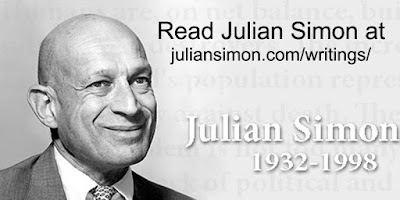
Enter optimist—and realist—Julian Simon (1932–1998). Economist Simon had the annoying habit of confronting the doomers and gloomers with hard facts. He concluded that population literature was wrong, that there is no “population bomb,” that we are not running out of resources, that human beings are not only consumers but producers, and that they are indeed our “ultimate resource.”
In 1980 Simon made a famous bet with Ehrlich that the prices of any five natural resources would fall ten years hence. Ehrlich leaped at the chance—and in 1990 had to pay up.
Enter too, Stephen Moore, long a research associate of Julian Simon, and today a brilliant young economist and thinker in his own right. He prevailed on the Cato Institute to complete and publish Simon’s unfinished manuscript. The two authors set the central premise that there was likely more improvement in the human condition in the twentieth century than in all previous centuries combined.
Through more than 100 color data charts, each supported by about a page of text, they maintain that compared to previous generations, we Americans are in the great majority healthier; live longer; are richer; can afford to buy far more things; have better jobs; earn higher pay; have more time for recreation, travel, sports, and the arts; have bigger and better homes; are at much less risk from catastrophic accidents; and breathe cleaner air and drink safer water. They also show that black Americans have shared in the prosperity and that the income gap between blacks and whites is closing, as is the income gap between men and women. The authors note that at the start of the twentieth century almost no women went to college; today women are more likely to attend college than are men.
And so on and on go the upbeat trends, a welcome breath of fresh air in the dark ruminations on the dismal science. For opinion polls show that many Americans still fret about the human prospect. They regard technological change as a net negative development, worry that the income gap between the rich and the poor is wider than 100 years ago (not so), and fear that the environment is worse mainly because of the automobile (forgetting that the horse pulling a buggy or wagon was a far greater polluter than the auto). Ben Wattenberg titled his 1984 book The Good News Is The Bad News Is Wrong, and Moore and Simon succeed in proving that that really is the case.
Yes, there are also some unfavorable trends, found where government policy holds sway. Social indicators such as divorce and out-of-wedlock births are grim. Taxes are higher and government much bigger. Educational quantity is way up, but its quality is way down. Rita Simon, Julian’s widow, a faculty member at American University and author of the foreword to the book, notes that the twentieth century saw the rise of Nazism, Stalinism, and Maoism but also their fall; that in side-by-side comparisons, South Korea has been far more prosperous than North Korea, West Germany than East Germany, and Taiwan than mainland China. Government control, so often prescribed by the gloom-and-doom set, has been a dismal failure.
Maybe market economics should be renamed “the enriching science.”
William Peterson, an adjunct scholar at the Heritage Foundation, is a contributing editor to Ideas on Liberty.
William H. Peterson
This article was originally published on FEE.org. Read the original article.
Tuesday, April 4, 2017
The English Bible as a Classic by Talbot Chambers D.D. 1879
THE ENGLISH BIBLE AS A CLASSIC BY TALBOT W. CHAMBERS, D.D.
Pastor of the Collegiate Reformed Dutch Church, New Pork.
See also The King James Version Bible Companion: 100 Books on DVD, and Over 60 Different Editions of the King James Bible on DVDROM
KING JAMES'S BIBLE. The merits of the Authorized Version, in point of fidelity to the original, are universally acknowledged. No other version, ancient or modern, surpasses it, save, perhaps, the Dutch, which was made subsequently, and profited by the labors of the English translators. But a version may be faithful without being elegant. It may be accurate without adequately representing the riches of the language in which it is made. The glory of the English Bible is that while it conveys the mind of the Spirit with great exactness, it does this in such a may that the book become the highest existing standard of our noble tongue. Lord Macaulay calls it a stupendous work, which, if everything else in our language should perish, would alone suffice to show the whole extent of its beauty and power.
For a list of all of my digital books click here - Join my Facebook Group
It is true that Mr. Hallam (Literature of Europe, 11, 58) dissents from this view, and seems to regard it as a sort of superstition; but surely he is wrong. The praise of our version is not confined to men of any creed or class, but comes from nearly every eminent critic. Men who differ as widely in other matters as Addison, Swift, Coleridge, Matthew Arnold, both the Newmans, and Mr. Ruskin, yet agree on this point; and Mr. Huxley gave voice to a common opinion when he said, "It is written in the noblest and purest English, and abounds in exquisite beauties of mere literary form." It is, therefore, neither prejudice nor thoughtlessness which affirms this book to be the first of English classics. Indeed, its pages speak for themselves. In simplicity and strength, in the union of Saxon force and in Latin dignity, in idiomatic case and rhythmic flow, they have no superior.
STYLE OF THE VERSION.-Nor is it difficult to account for this. It is true that the style of writing which prevailed among men of letters in the reigns of Elizabeth and James I was not adopted to such composition. In many of these there was a strange fondness for alliteration, antithesis, fanciful analogies, pedantic allusions, and all sorts of conceits. Even Shakespeare has verbal quibbles which "make the judicious grieve." And when these are avoided, as in Bacon and Raleigh, there is a degree of stiffness, of inversion and occasionally of affectation, which would be an insuperable barrier in the way of popular acceptance and favor. The authors of our Bible seem to have been preserved from this error by a sort of providential preparation. In the course of the religious discussions which prevailed in England from the days of Wycliffe down there had grown up what Mr. Marsh calls "a consecrated diction," an assemblage of the best forms of expression suited to the communication of sacred truths. This dialect, if one may so style it, avoided equally the pedantry of the schools and the vulgarisms of the market-place. It never crawled upon the ground and never soared in the clouds. It was simple and direct, yet pure and dignified. It was intelligible to all classes, yet offensive to none. It seized as if by instinct the best elements of the vernacular speech, and moulded them into the most suitable grammatical forms; hence it is marked by the absence of book language or "inkhorn terms," and also of mere colloquial speech. The book was not the production of a single mind, but of many wise and good men, laboring through a series of years. The earliest and most influential of all was the martyr Tyndale, whose New Testament was issued in 1525. This was followed by Coverdale's Bible (1535), Rogers's (1537), Cranmer's (1539), the Geneva Bible (1560), the Bishops' (1568). At last, in 1611, the final outcome of these years of toil appeared in our present Bible as it came from the hand of King James's translators. During all this period the process of revision went steadily forward, almost constantly gaining in every element of vigor and appropriateness.
Authors Of King James's Version.—The character of the authors had much to do with the perfection of their work. They were men of learning, judgment and piety, animated only by the sincere desire to render God's most holy Word accessible to all their countrymen. They toiled not for fame or pelf or any party interest, but for God's glory and the souls of men. They were in full and hearty sympathy with the book upon which they wrought. It was the guide of their lives, the arbiter of their differences, the charter of their hope for eternity. They prized it with reverence, they loved it with passion; and because of their devotion to it not a few of them suffered spoiling of their goods, bonds, imprisonments, and exile, and some even death itself. The grave purpose, the intense convictions, of such men lifted them above all puerilities and affectations. It was not for them to seek out artificial refinement or strive to gild refined gold; nor, on the other hand, could they stoop to coarseness or slang. They forgot themselves in their work, and hence the marvellous union it displays, of simplicity and majesty, homeliness and beauty. "They were far more studious of the matter than of the manner; and there is no surer preservative against writing ill or more potent charm for writing well." (Augustus Hare.) Seeking merely to furnish to their fellows the divine oracles in an intelligible form, they not only did that, but gave to all succeeding generations a masterpiece of English composition, one that shows our language at its best, unfolding its varied resources both of vocabulary and of idiom, and offering many striking specimens of its melodious rhythm.
Conservative Influence Of King James's Version.—No small regard is due to our Bible for its influence in preserving our language from corruption. Time and again there has been an influx of alien elements introduced by a capricious fashion, or by some able but unwise leader. But amid all the vagaries of popular taste, and the changes occasioned by social revolutions, or the progress of knowledge and discovery, this book has stood like a massive breakwater, unyielding and invincible. Perpetually in the hands of the people, used in public and private worship, resorted to in all controversies, employed in schools and education, in short, a daily companion from the cradle to the grave, it has so shaped the tastes and judgments of men that, however for a time misled, they were always in the end recalled to the older and better model, and renewed their adhesion to the pure "well of English undefyled."
Other Revisions.—That the book deserves what has been claimed for it is shown by its history. When it first came from the press there were two other versions in general use. One of these, the Bishops' Bible, was most prized at court and found in all the churches; the other, the Geneva Bible, was cherished in the household and the closet of the middle classes. Now, no royal edict, no decree of convocation, commanded the use of King James's version, yet simply by its own merits it overpowered both these rivals, and, in the course of a single generation, became the accepted book of the entire nation. In after years repeated attempts were made to introduce a new translation; but they all failed, whether put forth by coxcombs, like the man who improved "Jesus wept" into "Jesus burst into a flood of tears," or by profound and elegant scholars, such as Bishop Lowth, or Dr. George Campbell, of Aberdeen. The reason of the failure was not the perfect correctness of the authorized Scripture: no one claims for it any such infallibility. The progress of Biblical knowledge in very many directions has shown the need of much correction. But the gain of the modern versions, in this respect, was so counterbalanced by the loss in style and tone of feeling that the Christian public would none of them; and these amended Bibles, or parts of Bibles, however loudly heralded, or under whatever high names issued, have passed out of recollection, or are consulted only by curious scholars.
Present Revision.—The same thing is shown by the principles which underlie the revision now going on in England and America. This is a very elaborate enterprise, undertaken under the highest auspices, and representing, as far as possible, all bodies of English-speaking Christians. In these respects it far exceeds anything of the kind ever attempted before. Yet its conductors announce at the threshold that they neither intend nor desire a new translation; that is not needed, and if accomplished would prove an inevitable failure. All they aim at, therefore, is to make only such corrections as the progress of the language or of Biblical science may render necessary, and in all changes to preserve, as far as possible, the very form and spirit of the existing Bible. Each of them heartily concurs in the judgment pronounced on this point by a late distinguished pervert to Romanism, Dr. F. W. Faber, with whose eloquent and touching words this paper concludes:—
Faber On the King James's Version.—"Who will say that the uncommon beauty and marvellous English of the Protestant Bible is not one of the great strongholds of heresy in this country? It lives on the ear, like music that can never be forgotten, like the sound of church bells, which the convert hardly knows how he can forego. Its felicities often seem to be almost things rather than words. It is part of the national mind, and the anchor of national seriousness. Nay, it is worshiped with a positive idolatry, in extenuation of whose grotesque fanaticism its intrinsic beauty pleads availingly with the man of letters and the scholar. The memory of the dead passes into it. The potent traditions of childhood are stereotyped in its verses. The power of all the griefs and trials of a man are hid beneath its words. It is the representative of his best moments, and all that there has been about him of soft and gentle, and pure and penitent and good, speaks to him forever out of his Protestant Bible. It is his sacred thing which doubt has never dimmed and controversy never soiled."
For a list of all of my digital books click here - Join my Facebook Group
Subscribe to:
Posts (Atom)