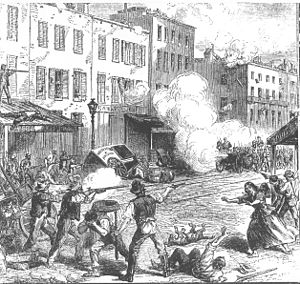
This day in history: The New York City draft riots began on this day in 1863. In New York City, opponents of conscription begin three days of rioting which will be later regarded as the worst in United States history.
"It is true that conscription was tried for a time in the Civil War, but it seems to have done far more harm than good. The Draft Act became law in March of 1863 and the first call-up was made the following July. The resulting “draft riots” in New York, Boston, and other places necessitated the calling of regiments from the battlefields of Gettysburg to shoot American citizens who were rebelling against the then un-American idea of conscription.
Pitched battles raged in the streets of New York City for several days. Hundreds of people were hanged or shot, and property damage was enormous.
Some historians claim that one of the reasons General Meade didn’t follow up his advantage over the retreating army of General Lee after Gettysburg was because so many of his soldiers were engaged in suppressing the “draft riots” behind his own lines.
The Draft Act was so unpopular that it garnered fewer than 50,000 soldiers, or less than three per cent of the total forces, in four draft calls! It hurt morale, encouraged favoritism and graft, and may well have actually lengthened the war." Source
This Day in History: Ambrose Bierce was born on this day in 1842. Ambrose Gwinnett Bierce was an American short story writer, journalist, poet, and American Civil War veteran. His book The Devil's Dictionary was named as one of "The 100 Greatest Masterpieces of American Literature" by the American Revolution Bicentennial Administration. His story "An Occurrence at Owl Creek Bridge" has been described as "one of the most famous and frequently anthologized stories in American literature", and his book Tales of Soldiers and Civilians (also published as In the Midst of Life) was named by the Grolier Club as one of the 100 most influential American books printed before 1900.
A prolific and versatile writer, Bierce was regarded as one of the most influential journalists in the United States, and as a pioneering writer of realist fiction. For his horror writing, Michael Dirda ranked him alongside Edgar Allan Poe and H. P. Lovecraft. S. T. Joshi speculates that he may well be the greatest satirist America has ever produced, and in this regard can take his place with such figures as Juvenal, Swift, and Voltaire. His war stories influenced Stephen Crane, Ernest Hemingway, and others, and he was considered an influential and feared literary critic. In recent decades Bierce has gained wider respect as a fabulist and for his poetry.
In 1913, Bierce told reporters that he was travelling to Mexico to gain first-hand experience of the Mexican Revolution. He disappeared and was never seen again.
Here are excerpts from his Devil's Dictionary relating to politics:
Adherent: A follower who has not yet obtained all that he expects to get.
Amnesty: The state’s magnanimity to those offenders whom it would be too expensive to punish.
Arena: In politics, an imaginary rat-pit in which the statesman wrestles with his record.
Capitol: The seat of misgovernment.
Conservative: A statesman who is enamored of existing evils, as distinguished from a Liberal who wishes to replace them with others.
Consul: ...a person who, having failed to secure an office from the people, is given one by the Administration on condition that he leave the country.
Corsair: A politician of the seas.
Elector: One who enjoys the sacred privilege of voting for the man of another man’s choice.
Executive: An officer of the Government, whose duty it is to enforce the wishes of the legislative power until such time as the judicial department shall be pleased to pronounce them invalid and of no effect.
Incumbent: A person of the liveliest interest to the outcumbents.
Influence: In politics, a visionary quo given in exchange for a substantial quid.
Justice: A commodity which is a more or less adulterated condition the State sells to the citizen as a reward for his allegiance, taxes and personal service.
Lawful: Compatible with the will of a judge having jurisdiction.
Minister: ...an officer sent into a foreign country as the visible embodiment of his sovereign’s hostility.
Opposition: ...the party that prevents the Government from running amok by hamstringing it.
Out-of-doors: That part of one’s environment upon which no government has been able to collect taxes.
Plebiscite: A popular vote to ascertain the will of the sovereign.
Politician: An eel in the fundamental mud upon which the superstructure of organized society is reared.
Politics: A strife of interests masquerading as a contest of principles. The conduct of public affairs for private advantage.
Precedent: In law, a previous decision, rule or practice which, with the absence of a definitive statute, has whatever authority a Judge may choose to give it, thereby greatly simplifying his task of doing as he pleases.
President: The leading figure in a small group of men of whom—and of whom only—it is positively known that immense numbers of their countrymen did not want any of them for President.
Quorum: A sufficient number of members of a deliberative body to have their own way.
Referendum: A law for submission of proposed legislation to a popular vote to learn the nonsensus of public opinion.
Reform: A thing that mostly satisfies reformers opposed to reformation.
Representative: In national politics, a member of the Lower House in this world, and without discernible hope of promotion in the next.
Revolution: In politics, an abrupt change in the form of misgovernment... whereby the welfare and happiness of the people were advanced a full half-inch.
Senate: A body of elderly gentlemen charged with high duties and misdemeanors.
Vote: The instrument and symbol of a freeman’s power to make a fool of himself and a wreck of his country.
This Day in History: General Robert E. Lee and 26,765 troops surrender to US Lieutenant General Ulysses S Grant on this day in 1865, thus ending the Civil War.
Very few soldiers in the South were actually slave owners. There were however over 3000 black slave owners in the South. One of the biggest free black slaveholders was John Carruthers Stanly in Craven County, North Carolina, who owned three plantations and 163 slaves, and even hired three white overseers to manage his properties!
In fact, Stanly became not only the largest slave owner in Craven County, and one of the largest in North Carolina, and he owned more than twice as many slaves as the second largest free Black slave owner in the South."
Stanly used his revenues to purchase freedom for family members and free others close to him, including his wife and five children. He also rented houses, had income from cotton sales, and attended chattel sales like his white neighbors to purchase slaves. According to author Schweninger [Schweninger, Loren (April 1990). "John Carruthers Stanly and the Anomaly of Black Slaveholding"], state records report that Stanly owned 127 slaves by 1820. These people did a variety of work including working at his barber shop and on his two plantations on Bachelor's Creek along the Neuse River. He loaned out the labor of his slaves for a profit in addition to making money manufacturing and exporting turpentine. Stanly spent a considerable amount of time and money buying and then freeing family members, for example his brother-in-law John Merrick and several slaves owned by familiar white families like the Stewarts. He also took dozens of underage slaves under his guardianship, providing them with jobs and places to live; however, Schweninger was clear to state that "Stanly rose to a position of wealth and prestige through his ownership and use of slave laborers." On one of his properties, Hope Plantation, Stanly hired three white overseers. She also notes that "Stanly differed little from his white neighbors" in his treatment of his slaves. His male slaves were worth twice that of his female slaves, so maintaining families would have been difficult, and Schweninger's research determined that Stanly was not averse to selling his slaves' family members.
In one interesting study, R. Halliburton shows that free black people have owned slaves “in each of the thirteen original states and later in every state that countenanced slavery.” Source
Black slave owners in the South were also willing to fight for the Confederacy in order to maintain their livelihoods. This was made clear in a statement by free people of color in Louisiana before the outbreak of the Civil War: “The free colored population [native] of Louisiana … own slaves, and they are dearly attached to their native land … and they are ready to shed their blood for her defense. They have no sympathy for abolitionism; no love for the North, but they have plenty for Louisiana … They will fight for her in 1861 as they fought [to defend New Orleans from the British] in 1814-1815.”