Wednesday, July 7, 2021

Mystery Writer Arthur Conan Doyle on This Day in History


This day in history: Sherlock Holmes creator Sir Arthur Conan Doyle died on this day in 1930. The Holmes body of work consists of four novels and fifty-six short stories. The Sherlock Holmes stories are milestones in the field of crime fiction. 

Doyle however was a prolific writer, writing over 200 stories and articles. Doyle thought his greatest book was The White Company — a medieval adventure into which he had poured a cornucopia of research...a work that is all but forgotten today.


His book The Lost World was rather influential, and without it we wouldn't have had Jurassic Park.


Doyle also popularized the mystery of the ghost ship Mary Celeste. In 1884, Arthur Conan Doyle wrote "J. Habakuk Jephson's Statement", a short story based on the mystery, but spelled the vessel's name as Marie Celeste. The story's popularity led to the spelling becoming more common than the original in everyday use. Read more about the Mary Celeste here.


Much like his creation Sherlock Holmes, Doyle took on a number of mysterious cases himself, including the hunt for Jack the Ripper. Doyle concluded that the killer was actually a woman posing as a midwife, able to easily gain the trust of women and comfortably wear bloody clothes without arousing suspicion. 

Arthur Conan Doyle also took on the case of George Edalji, and man serving time for animal mutilation. Doyle applied his powers of deduction that made Holmes famous and concluded that the mud found on Edalji’s clothes didn't match the mud at the crime scene and that the razor which was supposedly used to mutilate one of the animals didn’t have a trace of blood on it.


There is a humorous story of an exchange that Doyle had with a cab driver in Boston who surprised Doyle by addressing him by his name. Doyle wanted to know how he knew who he was. The driver replied: “‘If you’ll excuse my saying so, the lapels of your coat look as if they had been grabbed by New York reporters, your hair looks as if it had been cut in Philadelphia, your hat looks as if you had to stand your ground in Chicago, and your right shoe has evident Buffalo mud under the instep, and – and -’ ‘And what?’ queried Sir Arthur. ‘Well.’ replied the cabbie, ‘I saw Conan Doyle’ in big white letters on your trunk.’"

Despite his genius though, Arthur Conan Doyle was also enamored with the paranormal, such as Spiritualism, seances and fairies.


Listen to Doyle's brilliant short story, The Brazilian Cat


See also The 300 Oldest Murder Mystery and Crime Books & Stories on DVDrom - For a list of all of my digital books and books on disks click here


Tuesday, July 6, 2021

Thomas More (and his Communist Manifesto) on This Day in History


This Day in History: Sir Thomas More was executed for treason against King Henry VIII of England on this day in 1535. During the reign of Henry VIII, it is estimated that between 57,000 and 7­2,000 English subjects lost their heads. 

Thomas More is known for more than that though. He famously wrote an influential Communist book called UTOPIA. Utopia is a work of fiction that depicts a fictional island society and its religious, social, and political customs. 

In More’s Utopia, “men live all the time under everyone’s eyes.” "Citizens shunned individuality. All dressed in bland, simple garments and disdained ostentations like jewelry and other finery. Gold had so little appeal that it was used for making chamberpots. All persons ate their meals in large groups in common halls. Communistic Utopia had no money or private property." [Daniel Hager] 

Slavery is a feature of Utopian life and it is reported that every household has two slaves. The slaves are either from other countries (prisoners of war) or people condemned to die, poor people or criminals. 


Other significant innovations of Utopia include: a welfare state with free hospitals, euthanasia permissible by the state, priests being allowed to marry, divorce permitted, premarital sex punished by a lifetime of enforced celibacy and adultery being punished by enslavement. Meals are taken in community dining halls and the job of feeding the population is given to a different household in turn. Although all are fed the same, Raphael explains that the old and the administrators are given the best of the food. Travel on the island is only permitted with an internal passport and any people found without a passport are, on a first occasion, returned in disgrace, but after a second offence they are placed in slavery. In addition, there are no lawyers and the law is made deliberately simple, as all should understand it and not leave people in any doubt of what is right and wrong.

Privacy is not regarded as freedom in Utopia; taverns and places for private gatherings are non-existent for the effect of keeping all men in full view, so that they are obliged to behave well.

In "Indian Givers: How the Indians of the Americas Transformed the World," Jack Weatherford asserts that native American societies played an inspirational role for More's writing. For example, indigenous Americans, although referred to as "noble savages" in many circles, showed the possibility of living in social harmony [with nature] and prosperity without the rule a king...". The early British and French settlers in the 1500 and 1600s were relatively shocked to see how the native Americans moved around so freely across the untamed land, not beholden by debt, "lack of magistrates, forced services, riches, poverty or inheritance".

Utopia inspired many socialists, but Karl Kautsky pointed out that "perplexed" historians and economists often saw the name Utopia (which means "no place") as "a subtle hint by More that he himself regarded his communism as an impracticable dream."

The title of the book has since eclipsed More's original story and the term is now commonly used to describe an idyllic, imaginary society.

Monday, July 5, 2021

The Tallest Buildings in the World on This Day in History


This day in history: The Shard in London was inaugurated as the tallest building in Europe, with a height of 310 metres (1,020 ft) on this day in 2012. However, at this time in 2021, the Shard is the seventh tallest building in Europe as most of the tallest buildings on that continent are now in Russia. Even Poland's Varso Tower is one foot taller than the Shard.


The tallest building in Europe, the Lakhta Center in Saint Petersburg, Russia, is the 15th tallest building in the world. The buildings that are taller than the Lakhta Center are:

1: Burj Khalifa in Dubai with 163 floors at 2717 feet. (That's over half a mile)

2: Shanghai Tower in Shanghai China with 128 floors at 2073 feet.

3: Abraj Al-Bait Clock Tower in Mecca, Saudi Arabia with 120 floors at 1971 feet.

4: Ping An Finance Center in Shenzhen, China with 115 floors at 1965 feet.

5: Lotte World Tower in Seoul, South Korea with 123 floors at 1819 feet. 

6: One World Trade Center in New York has 94 floors at 1776 feet.

7: Guangzhou CTF Finance Centre in Guangzhou China has 111 floors at 1739 feet.

8: Tianjin CTF Finance Centre in Tianjin China has 98 floors at 1739 feet.

9: China Zun in Beijing China has 108 floors at 1732 feet.

10: Taipei 101 in Taiwan has 101 floors at 1667 feet.

11: Shanghai World Financial Center has 101 floors at 1614 feet.

12: International Commerce Centre in Hong Kong has 118 floors at 1588 feet.

13: Wuhan Greenland Center in Wuhan has 97 floors at 1560 feet.

14: Central Park Tower in New York has 98 floors at 1550 feet.

The Home Insurance Building in 1800's Chicago was arguably the first skyscraper in the world (it had 10 floors). 

The Leonardo in Johannesburg, South Africa is the tallest building in Africa. It has 55 floors at 745 feet.  

The Gran Torre Santiago (Chile) is the tallest building in South America. It has 64 floors at 980 feet.

Hong Kong is the city with the most skyscrapers with 482 such buildings. New York has 290.

The Gevora Hotel in Dubai is the world's tallest hotel at 75 floors and 1169 feet. 


Sunday, July 4, 2021

Interesting and Strange July 4th Facts


Interesting and Strange July 4th Facts:  The United States Military Academy West Point opened on this day in 1802. 

The Louisiana Purchase was announced on July 4th 1803. 

Construction on the Erie Canal began in New York on July 4th 1817. 

John Adams and Thomas Jefferson both died on July 4 in 1826, and James Monroe—the nation's fifth president—died just a few years later on July 4, 1831.

"My Country, 'Tis of Thee" was written on this day in 1831. 

Walt Whitman's "Leaves of Grass" was published on July 4th 1855. 

President Calvin Coolidge was born July 4th in 1872. 

American novelist Nathaniel Hawthorne was born on July 4, 1804.

The Freedom of Information Act was signed by LBJ on this day in 1966. 

Neil Simon was born July 4 1927. 

The American Anthem is sung to the tune of a British drinking song named "To Anacreon in Heaven."


Buffalo Bill Cody presented the first Wild West Show, in North Platte, Nebraska on July 4 1883

American gangster Meyer Lansky was born on July 4, 1902.

The American Flag received its 50th star on this day in 1960. 

A massive heat wave struck the northeastern United States on July 4, 1911, killing 380 people. 

Eating Salmon on the Fourth is a New England tradition, and Americans eat about 150 million hot dogs on Independence Day (apparently is 16 cents cheaper this year).

Last year during the July 4 weekend there were 89 people shot in Chicago.

More pets go missing July 4-5 than any other time of the year, according to the American Kennel Club. 

Fireworks have been a major part of Fourth of July since the earliest celebrations. In 1884, miners blew up the post office in Swan, Colorado, because it wasn't supplied with fireworks.

404.5 million pounds of fireworks were set off in 2020. 

According to the Consumer Product Safety Commission (CPSC), 10,000 people were injured badly enough in fireworks accidents to require emergency treatment in 2019. 12 People died that same year.

Benjamin Franklin proposed the turkey as the national bird but was overruled by John Adams and Thomas Jefferson, who recommended the bald eagle.

It was on July 4, 1884, that the Statue of Liberty was presented by France to the U.S. ambassador to France, Levi Morton, according to the National Constitution Center. 

American supercentenarian Gertrude Weaver was born on July 4 1898. She would die in 2015.

The Republic of Hawaii existed from July 4, 1894, to August 12, 1898.


The Philippine–American War ended on July 4, 1903.

American businessman Hiram Walker who founded Canadian Club whisky, was born on July 4, 1816.

On July 4, 1939, shortly after being diagnosed with amyotrophic lateral sclerosis (which is now better known as Lou Gehrig's Disease), baseball great Lou Gehrig announced his retirement to a sold-out crowd at Yankee Stadium, famously calling himself, "the luckiest man on the face of the earth."

Big hair painter/artist Bob Ross, died of lymphoma on July 4, 1995.

Hotmail went live on July 4th in 1996.

Four out of 46 presidents—or 9 percent—have been assassinated, making the commander-in-chief statistically the most deadly occupation in America.

The Great Lakes (Superior, Michigan, Huron, Erie, and Ontario) make up 21 percent of the planet's surface fresh water. The largest of these, Lake Superior, contains enough water to cover all of North and South America up to a foot.

The Hoover Dam is greater in volume than the Great Pyramid of Giza. It holds enough concrete to construct a two-lane highway from San Francisco to New York City.

The U.S. Postal Service issues a new personal ZIP code for each new president.
...........................................

What is an American? (from What is an American? By Charles Dana Burrage 1920)

An American is a religious Voltaire; and his religion is expressed in Voltaire's words to an opponent: "I disagree absolutely with what you say, but I would die for your right to say it."
Joseph Edgar Chamberlin

A man who,—while born and living in America and intent above all things else upon maintaining America as the best place in the world to live in,—sees that we must be just and generous to all the world, this proving what we showed on our entrance into the war, that America's greatest glory will be its vision of a new and a better world, and who acts accordingly.
Charles R. Lanman.

An American is one who, if need be, would give everything he has, for the sake of ordered liberty as conceived by Washington, Lincoln and Roosevelt.
Henry Harmon Chamberlin.

An American is at once the servant and the savior of the World.
W. B. Scofield.

Any man born in United States.
A. Obelitz—A guest, born in Denmark.

One that believes in liberty of Government of the people, with equal rights for all.
C. T. Grinnell.

A citizen of the United States who believes in and is at all times prepared to support the principles and ideals of its government as set forth in the Constitution.
Montgomery Reed.

He who considers the best interests of the U. S. before all else.
Louis N. Wilson.

A man who is friendly, unselfish, democratic, and absolutely just; who is willing to recognize in all men an equal right to think for themselves and to work together for the common good.
Nathan Haskell Dole.

A worshipper of the All Mighty Dollar.
Albert W. Ellis.

An American is one who holds America as his country above everything else.
William E. Story.

An American is anyone whose heart and soul are consecrated in devout allegiance to the welfare and traditions of the United States of America!
H. H. R. Thompson.

A man who lives in America and puts America first.
Eben F. Thompson.

One that is absolutely loyal to our glorious Country.
W. W. Johnson.

One born or adopted in the United States who believes, and who lives the belief that all men are born free and equal and are endowed by their Creator with certain inalienable rights, among which are Life, Liberty and the Pursuit of Happiness.
Edwin S. Crandon.

An American citizen who loves his country and is obedient to her laws.
Edward Palmer Hatch.

See Capitalism in America - 100 Books on DVDrom (Captains of Industry)

Who Really Discovered America? - 90 Books on DVDrom (Vikings, Irish, Welsh etc)
https://thebookshelf2015.blogspot.com/2015/09/who-really-discovered-america-90-books.html

American History & Mysteries, Over 200 PDF Books on DVDrom
https://thebookshelf2015.blogspot.com/2015/09/american-history-mysteries-over-200-pdf.html


Saturday, July 3, 2021

The Witch of Wall Street, Hetty Green, on This Day in History


This day in history: Hetty Green, (aka the Witch of Wall Street) died on this day in 1916. She was a brilliant investor and probably the richest woman on earth at the time, but was extremely miserly. Her wealth by today's standard's would have been in the billions, but she was horrified at having to spend $150 for a much needed surgery. She refused to buy expensive clothes or pay for hot water, and she wore a single dress that was only replaced when it was worn out. When her son injured his leg in an accident, she took him to a free clinic for treatment and left when doctors recognized her and demanded payment. The leg didn't heal properly and had to be amputated.

Green's thriftiness was legendary. She was said never to turn on the heat or use hot water. She wore one set of undergarments that she changed only after they had been worn out; she did not wash her hands and she rode in an old carriage. She ate mostly pies that cost fifteen cents. One tale claims that Green spent half a night searching her carriage for a lost stamp worth two cents. Another asserts that she instructed her laundress to wash only the dirtiest parts of her dresses (the hems) to save money on soap.

She conducted much of her business at the offices of the Seaboard National Bank in New York, surrounded by trunks and suitcases full of her papers as she did not want to pay rent for her own office. She changed residence with great frequency, moving from one small, unheated apartment to another. This was her attempt to hide from both the press and tax collectors. Hetty Green would also travel thousands of miles alone, in order to collect a debt of a few hundred dollars.

In her old age, Green developed a hernia, but refused to have an operation, preferring to use a stick to press down the swelling. Once, she advised a friend in Bellows Falls to wear her shabbiest clothes when visiting a doctor. “You will get the same treatment,” Green said, “but it will cost you less.”

One lawyer F.B. Pingree, mentioned how she would try to get free legal advice, “She was a damned nuisance. There was a long period during which she called at my office every day ostensibly to gossip, but for the real purpose of getting free advice.”

She even foreclosed on a church, though she had defenders: "...when the First Presbyterian Church of Chicago defaulted on a $12,000 loan...the pastor tried to shame her into forgiving the debt by publicly denouncing her as a ruthless capitalist, she told him to pay up or she would foreclose — and that’s exactly what she did. Other pastors came to her defense — one of them declaring, 'To expect the holder of a church mortgage to cancel it upon the grounds of Christianity, after the money has been lent in good faith, is nothing less than a hold-up.'" ~Lawrence W. Reed

For all of this sordid history, the New York Post posted an article displaying Hetty Green in a more favorable light. "History hasn’t been very kind to Hetty Green. Unlike her rivals Carnegie and Rockefeller, she didn’t set up foundations or build museums, although she did quietly give money to Barnard College and Johns Hopkins Medical School, on the condition they admit women."

Hetty hated politicians, perhaps her best feature. When they asked her railroad officials for free passes, she instructed the officials to hand them a card that read:

MONDAY: “Thou shalt not pass.” Numbers XX, 18.

TUESDAY: “Suffer not a man to pass.” Judges III, 28.

WEDNESDAY: “The wicked shall pass no more.” Naham I, 15.

THURSDAY: “This generation shall not pass.” Mark XIII, 30.

FRIDAY: “By a perpetual decree it shall not pass.” Jeremiah V, 22.

SATURDAY: “None shall pass.” Isaiah XXIV, 10.

SUNDAY: “So he paid the fare thereof and went.” Jonah I, 2.

Also on this day in financial history: The Bank for Savings in the City of New-York, the first savings bank in the United States, opened on this day in 1819, and, Dow Jones & Company published its first stock average on this day in 1884.


Friday, July 2, 2021

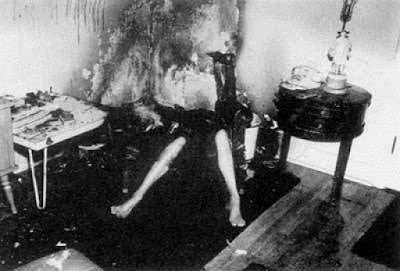
The Spontaneous Human Combustion of Mary Reeser on This Day in History


This Day In History: Mary Reeser's body was found by the police almost totally cremated where she sat on this day in 1951. Many believe this to be a case of spontaneous human combustion. SHC is when a body catches fire as a result of heat generated by internal chemical activity, but without evidence of an external source of ignition. 200 cases have been reported over the past 300 years. Spontaneous Human Combustion is not accepted as a real phenomenon by all scientists and often regarded as an urban legend and a pseudo-scientific concept.


In an 1823 book "Medical Jurisprudence," L. A. Parry cited certain commonalities among recorded cases of spontaneous human combustion included the following characteristics:

1: the victims are chronic alcoholics;
2: they are usually elderly females;
3: the body has not burned spontaneously, but some lighted substance has come into contact with it;
4: the hands and feet usually fall off;
5: the fire has caused very little damage to combustible things in contact with the body;
6: the combustion of the body has left a residue of greasy and fetid ashes, very offensive in odour.

Reeser's remains, which were largely ashes, were found among the remains of a chair in which she had been sitting. Only part of her left foot (which was wearing a slipper) and her backbone remained, along with her skull. Plastic household objects at a distance from the seat of the fire were softened and had lost their shapes. 

The FBI eventually declared that Reeser had been incinerated by the wick effect. As she was a known user of sleeping pills, they hypothesized that she had fallen unconscious while smoking and set fire to her nightclothes. "Once the body starts to burn," the FBI wrote in its report, "there is enough fat and other inflammable substances to permit varying amounts of destruction to take place. Sometimes this destruction by burning will proceed to a degree which results in almost complete combustion of the body." 

However, while the wick effect theory was accepted by FBI, it sounds almost like Spontaneous Human Combustion. Also, the FBI's conclusion had one critic in Dr. Wilton M. Krogman, a professor of physical anthropology at the University of Pennsylvania and an experienced fire researcher. He concluded, “I cannot conceive of such complete cremation without more burning of the apartment.” 


In a book called "The Beautiful Forever Tales" published in 1869, it mentions SHC far back in history: "The phenomenon of fire originating spontaneously in the body of animals, has been observed and recorded by the ancients. Roman historians mention that during the office of the Consuls Gracchus and Juventius a flame issued from the mouth of a bull without doing the animal any injury. Here the luminous appearance was evidently a phosphoric emanation. Peter Borelli describes the vomiting of flame by a woman at the point of death; and Thomas Bartholus records several similar cases. Ezekiel De Castro records a case in which fire issued from one of the vertebrata of the patient, and scorched the eyes of the attendants; the patient in question was the physician Alexandrina Megetius. We learn from Krantius that this spontaneous combustion was occasionally epidemic: during the wars of Godfrey of Boulogne a disorder broke out in the territory of Nevers whereby the patients were consumed by invisible fire. The only remedy found effectual was to cut off the limbs where the burning began, with a view to prevent the conflagration from spreading to the rest of the body.

Thomas Bartholin mentions the case of a poor woman of Paris who perished from spontaneous combustion, no part of the body remaining but the skull and fingers. John Henry Cahausen describes the burning of a Polish gentleman by flames which issued from his throat, and John Christ Sturmius mentions several cases; among others, a nobleman of Courtant, in which the patients were destroyed by flames issuing from their stomachs. According to John De Viana the perspiration of the wife of Doctor Treilos, physician to the Cardinal de Boga, Archbishop of Toledo, was of such an inflammable nature, that when her shifts were saturated with the exudation, and exposed to a current of air they spontaneously ignited, and shot forth flames like grains of gunpowder. Peter Borelli relates the case of a peasant whose under-clothing took fire, whether laid up in a box or exposed to the air, and whether wet or dry, as if it were made of patent fuse. The most remarkable case of spontaneous combustion on record is undoubtedly that of the Countess Cornelia Zangari and Bandi, of Casena, the greater part of her body was reduced to ashes, the legs only remaining untouched. The case is minutely described by the Reverend Joseph Bianchini. Hardly less extraordinary was the case of Grace Pitt, who fell a victim to this combustible state of body at Ipswich, being found one morning by her daughter, 'appearing like a block of wood, burning with a glowing fire, without flame.'"


Thursday, July 1, 2021

The Original Rock 'N' Roll Animal, Wolfman Jack, on This Day in History


This Day In History: The Original Rock 'N' Roll Animal, Wolfman Jack (Robert Weston Smith), died on this day in 1995 in North Carolina. He was only 57 when he died, and he is actually buried in the front yard of a house in Belvidere NC

He was one of the earliest syndicated Disc Jockeys during the golden age of Rock n Roll. Smith in 1963 played out of XERF-AM in Mexico across the border from Del Rio Texas. This station had a high-powered border blaster signal that could be picked up across most of the United States. In an interview with writer Tom Miller, Wolfman Jack described the reach of the XERF signal: "We had the most powerful signal in North America. Birds dropped dead when they flew too close to the tower. A car driving from New York to L.A. would never lose the station." Most of the border stations broadcast at 250,000 watts, five times the U.S. limit, meaning that their signals were picked up all over North America, and at night as far away as Europe and the Soviet Union. It was there at XERF that Smith developed his signature raspy style (with phrases like "Who's this on the Wolfman telephone?") and widespread fame. The border stations made money by renting time to Pentecostal preachers and psychics, and by taking 50 percent of the profit from anything sold by mail order. The Wolfman did pitches for dog food, weight-loss pills, weight-gain pills, rose bushes, and baby chicks. There was even a pill called Florex, which was supposed to enhance one's sex drive. "Some zing for your ling nuts", the Wolfman would say.

In 1971 the Mexican government decided that their Catholic citizens had enough of the Pentecostal preachers and that destroyed most of the revenue for the radio station.

Smith received a second life after the 1973 George Lucas movie, American Graffiti, and the financial success of American Graffiti provided him with a regular income for life. 

"The radio DJ with the distinctive voice was part of Lucas' teenage years in Modesto, California, and Lucas even considered making a documentary about him when he was a student at USC's film school. When American Graffiti made him a millionaire, Lucas paid the Wolfman a little extra for serving as the film's 'inspiration.'" ~Eric D Snider


He also appeared in the film's 1979 sequel More American Graffiti, though only through voice-overs. In 1978, he appeared as Bob "The Jackal" Smith in a made-for-TV movie Deadman's Curve based on the musical careers of Jan and Dean. Smith also appeared in several television shows as Wolfman Jack, including The Odd Couple, What's Happening!!, Vega$, Wonder Woman, Hollywood Squares, Married... with Children, Emergency! S5Ep5, and Galactica 1980.


He also hosted a 1976 Canadian variety television series, and he lent his voice to the Guess Who's "Clap for the Wolfman" and the Stampeder's 1975 hit "Hit the Road Jack" (both Canadian bands).

Wolfman Jack was inducted into the Radio Hall of Fame in 1996.