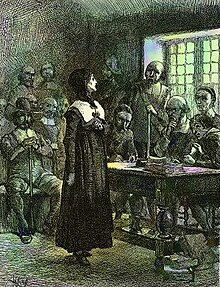
Anne Hutchinson was expelled from Massachusetts Bay Colony for religious dissent on this day in 1638.
Who was Anne Hutchinson?
Anne Hutchinson: The Spirit of Religious Liberty
Opinions of Anne Hutchinson have, shall we say, covered the waterfront.
In his masterful tome, Conceived in Liberty, 20th-century economist and libertarian historian Murray Rothbard cast her as a staunch individualist and the greatest threat to the “despotic Puritanical theocracy of Massachusetts Bay.”
John Winthrop, the 2nd, 6th, 9th, and 12th governor of the Massachusetts Bay Colony, thought she was a “hell-spawned agent of destructive anarchy” and “a woman of haughty and fierce carriage, a nimble wit and active spirit, a very voluble tongue, more bold than a man.”
The state of Massachusetts apparently agrees with Rothbard. A monument in the State House in Boston today calls her a “courageous exponent of civil liberty and religious toleration.” She was, in fact, the preeminent female crusader for a free society in 18th-century New England, for which she paid first with banishment and ultimately with her life.
The story is bound intimately to the “antinomian” or “free grace” controversy involving both religion and gender. It raged in Massachusetts for the better part of two years, from 1636 to 1638. Hutchinson was an unconventional, charismatic woman who dared to challenge church doctrine as well as the role of women in even discussing such things in a male-dominated society. In Saints and Sectaries: Anne Hutchinson and the Antinomian Controversy in the Massachusetts Bay Colony, historian Emery Battis wrote,
Gifted with a magnetism which is imparted to few, she had, until the hour of her fall, warm adherents far outnumbering her enemies, and it was only by dint of skillful maneuvering that the authorities were able to loosen her hold on the community.
“As I do understand it,” Hutchinson herself explained, “laws, commands, rules and edicts are for those who have not the light which makes plain the pathway. He who has God’s grace in his heart cannot go astray.”
As America’s first feminist, and a woman of conscience and principle, Anne Hutchinson planted seeds of libertarianism that would grow and help establish a new nation a little more than a century later.
In England where she was born in 1591, Hutchinson had followed the teachings of the dynamic preacher John Cotton, from whom she traced some of her anti-establishment ideas. When Cotton was compelled to leave the country in 1633, Hutchinson and her family followed him to New England. There she would live until her death just 10 years later, stirring up one fuss after another and serving as an active midwife and caregiver to the sick simultaneously. That she found the time to do all this while raising 15 children of her own is a tribute to her energy and passion.
Hutchinson organized discussion groups (“conventicles”) attended by dozens of women and eventually many men, too. This in itself was a bold move. It was empowering especially to the women, who were supposed to remain quiet and subordinate to their husbands, particularly in matters of religion and governance. But Hutchinson’s meetings were full of critical talk about the “errors” in recent sermons and the intolerant ways in which the men of Massachusetts ran the colony. Her influence grew rapidly and by all accounts, Boston became a stronghold of antinomianism while the countryside aligned with the establishment. It was only a matter of time before religious and gender differences spilled over into politics.
In 1636, Hutchinson and her antinomian, “free grace” allies such as Cotton, Reverend John Wheelwright, and Governor Henry Vale came under blistering attack by the orthodox Puritan clergy. In churches and public meetings, they were assailed as heretics and disturbers of the peace who threatened the very existence of the Puritan experiment in New England. Accusations of immoral sexual conduct, thoroughly unfounded, swirled in the flurry. Cotton was sidelined by the pressure. Wheelwright was found guilty of “contempt & sedition” for having “purposely set himself to kindle and increase” strife within the colony and was banished from Massachusetts. Vale was defeated for reelection and a Hutchinson enemy, John Winthrop, became governor in 1637. Despite initial wavering under the intense pressure, Hutchinson held firm.
In November 1637, Winthrop arranged for Hutchinson to be put on trial on the charge of slandering the ministers of Massachusetts Bay. He declared that she had “troubled the peace of the commonwealth and churches” by promoting unsanctioned opinions and holding unauthorized meetings in her home. Though she had never voiced her views outside of the conventicles she held, or ever signed any statements or petitions about them, Winthrop portrayed her as a coconspirator who had goaded others to challenge authority. Before the court, with Hutchinson present, he charged:
You have spoken divers things as we have been informed [which are] very prejudicial to the honour of the churches and ministers thereof, and you have maintained a meeting and an assembly in your house that hath been condemned by the general assembly as a thing not tolerable nor comely in the sight of God nor fitting for your sex.
The first day of the trial went reasonably well for her. One biographer, Richard Morris, said she “outfenced the magistrates in a battle of wits.” Another biographer, Eve LaPlante, wrote, “Her success before the court may have astonished her judges, but it was no surprise to her. She was confident of herself and her intellectual tools, largely because of the intimacy she felt with God.”
The second day didn’t go so well after a moment of high drama when Hutchinson cut loose with this warning:
You have no power over my body, neither can you do me any harm — for I am in the hands of the eternal Jehovah, my Saviour. I am at his appointment, the bounds of my habitation are cast in heaven, no further do I esteem of any mortal man than creatures in his hand, I fear none but the great Jehovah, which hath foretold me of these things, and I do verily believe that he will deliver me out of your hands. Therefore take heed how you proceed against me — for I know that, for this you go about to do to me, God will ruin you and your posterity and this whole state.
I do cast you out and deliver you up to Satan ... and account you from this time forth to be a Heathen and a Publican ... I command you in the name of Christ Jesus and of this Church as a Leper to withdraw yourself out of the Congregation.
The woman who rocked a colony was gone, but as Rothbard writes, “the spirit of liberty that she embodied and kindled was to outlast the despotic theocracy of Massachusetts Bay.”
As America’s first feminist, and a woman of conscience and principle, Anne Hutchinson planted seeds of libertarianism that would grow and help establish a new nation a little more than a century later.
For further information, see:
- “Sir Henry Vane: America’s First Revolutionary” by Sean Gabb
- “Individualist Feminism: The Lost Tradition” by Wendy McElroy
- Murray Rothbard’s Conceived in Liberty
- Emery Battis’s Saints and Sectaries: Anne Hutchinson and the Antinomian Controversy in the Massachusetts Bay Colony
- Francis J. Bremer’s Anne Hutchinson: Troubler of the Puritan Zion
- Eve LaPlante’s American Jezebel: The Uncommon Life of Anne Hutchinson, the Woman Who Defied the Puritans

Lawrence W. Reed
This article was originally published on FEE.org. Read the original article.