Showing posts with label conservative. Show all posts

Saturday, July 16, 2022

Barry Goldwater on This Day in History


The Republican convention selected Barry Goldwater as Presidential candidate on this day in 1964.

From Lawrence Reed:

Arizona native Barry Goldwater once visited a golf club on the East Coast that would not allow Jewish people on its links. When he was informed that he couldn’t play the 18 holes he came for, he famously responded, “Well, my father was Jewish but my mother was Episcopalian, so can I play nine holes?”

He despised stereotypes, collectivism, and groupthink in all forms and never shrank from saying so, no matter who it offended.

That was classic Goldwater in many ways. A successful businessman, author, and five-term US senator, he was well known for enlisting humor in the service of a powerful point. He believed all his life that each and every individual should be judged, as Martin Luther King put it so well, by “the content of his character.” He despised stereotypes, collectivism, and groupthink in all forms and never shrank from saying so, no matter who it offended.

The 1964 Goldwater campaign for president still resonates in my mind, though I was just eleven at the time. My father loved the guy. When I came home from government school one day and told him that all my teachers said Lyndon Johnson was the man to vote for, my dad instilled in me a healthy skepticism of classroom authority that’s only grown in the decades since.

The official slogan of the Goldwater campaign was: “In your heart, you know he’s right.” Democrats sneered in response, “In your guts, you know he’s nuts.” That was funny, but the policies they dumped on us when they beat Goldwater in the election were anything but. They said if the Arizonan were elected, we’d get a huge escalation in the Vietnam War; Johnson won and we got a huge escalation in the Vietnam War. They said if Goldwater won, the federal government wouldn’t care for people anymore; Johnson was elected and we ended up with a welfare state that broke families apart, trapped millions in lives of dead-end poverty, and foisted mountains of debt on generations yet unborn.

Barry Goldwater died 20 years ago, in 1998, at the age of 89. He lost a presidential election, but he fired up millions to the importance of things like limited government, rugged individualism, fealty to the Constitution, and sticking to principles. He thought of himself as a “conservative” (his best-known book, still a great read, The Conscience of a Conservative), but that was before the term “libertarian” came into wide use. I think today he might be more comfortable with the libertarian label, or perhaps “libertarian constitutionalist.”

Two decades after his passing, I can think of no better way to remember Barry Goldwater than to offer readers a selection of his own words:

It is a fact that Lyndon Johnson and his curious crew seem to believe that progress in this country is best served simply and directly through the ever-expanding gift power of the everlastingly growing Federal Government. One thing we all know, and I assure you I do: that’s a much easier way to get votes than my way. It always has been. It’s political Daddyism, and it’s as old as demagogues and despotism.

_____

I have little interest in streamlining government or in making it more efficient, for I mean to reduce its size. I do not undertake to promote welfare, for I propose to extend freedom. My aim is not to pass laws, but to repeal them. It is not to inaugurate new programs, but to cancel old ones that do violence to the Constitution, or that have failed their purpose, or that impose on the people an unwarranted financial burden. I will not attempt to discover whether legislation is ‘needed’ before I have first determined whether it is constitutionally permissible. And if I should later be attacked for neglecting my constituents’ ‘interests,’ I shall reply that I was informed that their main interest is liberty and that in that cause I am doing the very best I can.

_____

The legitimate functions of government are actually conducive to freedom. Maintaining internal order, keeping foreign foes at bay, administering justice, removing obstacles to the free interchange of goods—the exercise of these powers makes it possible for men to follow their chosen pursuits with maximum freedom. But note that the very instrument by which these desirable ends are achieved can be the instrument for achieving undesirable ends—that government can, instead of extending freedom, restrict freedom.”

_____

Surely the first obligation of a political thinker is to understand the nature of man. The Conservative does not claim special powers of perception on this point, but he does claim a familiarity with the accumulated wisdom and experience of history, and he is not too proud to learn from the great minds of the past. The first thing he has learned about man is that each member of the species is a unique creature. Man’s most sacred possession is his individual soul—which has an immortal side, but also a mortal one. The mortal side establishes his absolute differentness from every other human being. Only a philosophy that takes into account the essential differences between men, and, accordingly, makes provision for developing the different potentialities of each man can claim to be in accord with Nature. We have heard much in our time about ‘the common man.’ It is a concept that pays little attention to the history of a nation that grew great through the initiative and ambition of uncommon men. The Conservative knows that to regard man as part of an undifferentiated mass is to consign him to ultimate slavery.”

_____

Throughout history, government has proved to be the chief instrument for thwarting man’s liberty. Government represents power in the hands of some men to control and regulate the lives of other men. And power, as Lord Acton said, corrupts men. ‘Absolute power,’ he added, ‘corrupts absolutely.’”

_____

Those who seek absolute power, even though they seek it to do what they regard as good, are simply demanding the right to enforce their own version of heaven on earth. And let me remind you, they are the very ones who always create the most hellish tyrannies. Absolute power does corrupt, and those who seek it must be suspect and must be opposed. Their mistaken course stems from false notions of equality, ladies and gentlemen. Equality, rightly understood, as our Founding Fathers understood it, leads to liberty and to the emancipation of creative differences. Wrongly understood, as it has been so tragically in our time, it leads first to conformity and then to despotism.”

_____

The graduated tax is a confiscatory tax. Its effect, and to a large extent its aim, is to bring down all men to a common level. Many of the leading proponents of the graduated tax frankly admit that their purpose is to redistribute the nation's wealth. Their aim is an egalitarian society—an objective that does violence both to the charter of the Republic and the laws of Nature. We are all equal in the eyes of God but we are equal in no other respect. Artificial devices for enforcing equality among unequal men must be rejected if we would restore that charter and honor those laws.

_____

I would remind you that extremism in the defense of liberty is no vice. And let me remind you also that moderation in the pursuit of justice is no virtue!

Lawrence W. Reed
Lawrence W. Reed

Lawrence W. Reed is FEE's President Emeritus, Humphreys Family Senior Fellow, and Ron Manners Global Ambassador for Liberty, having served for nearly 11 years as FEE’s president (2008-2019). He is author of the 2020 book, Was Jesus a Socialist? as well as Real Heroes: Incredible True Stories of Courage, Character, and Conviction and Excuse Me, Professor: Challenging the Myths of ProgressivismFollow on LinkedIn and Like his public figure page on Facebook. His website is www.lawrencewreed.com.

This article was originally published on FEE.org. Read the original article.

Monday, March 21, 2022

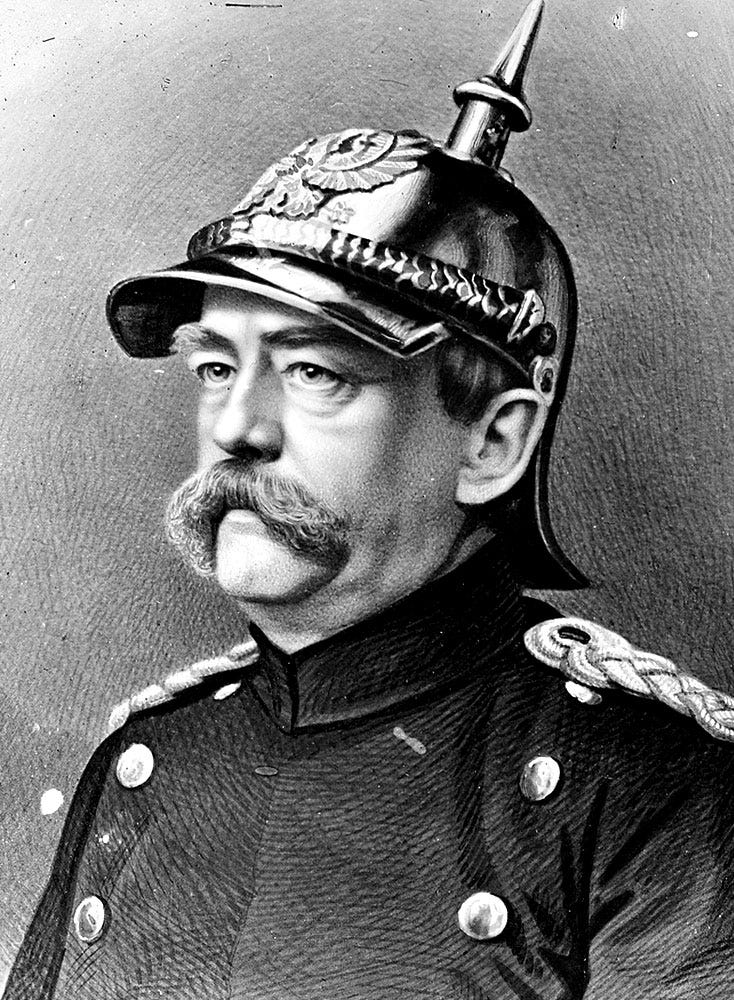
Otto von Bismarck on This Day in History


Otto von Bismarck was appointed as the first Chancellor of the German Empire on this day in 1871.

Bismarck masterminded the unification of Germany in 1871 and served as its first chancellor until 1890, in which capacity he dominated European affairs for two decades.

The "Iron Chancellor", as he came to be known, was instrumental in uniting Germany. He was a Conservative who hated Socialists, but in order to sway people away from the Socialism, he ended up adopting socialism and thereby creating the world first Welfare State in the modern world. Bismarck's social programs also helped to expand his power. His rule came to be known as the Second Reich.

"In the democratic countries, milder forms of statism were the rule. Most insidious of all was the form that had been invented in the 1880s, in Germany. There Otto von Bismarck, the Iron Chancellor, devised a series of old-age, disability, accident, and sickness insurance schemes, run by the state. The German liberals of the time argued that such plans were simply a reversion to the paternalism of the absolutist monarchies. Bismarck won out, and his invention — the welfare state — was eventually copied everywhere in Europe, including the totalitarian countries." Source2

"Bismarck explained to an American sympathizer the strategy behind these laws that guaranteed every German national health insurance, a pension, a minimum wage and workplace regulation, vacation, and unemployment insurance. 'My idea was to bribe the working classes, or shall I say, to win them over, to regard the state as a social institution existing for their sake and interested in their welfare,' he said." Source

Bismarck was also very quotable:

"Americans are the luckiest people on earth. They are surrounded by weak neighbors and fish."

"People never lie so much as after a hunt, during a war or before an election."

"Never believe anything in politics until it has been officially denied."

"A journalist is a person who has mistaken their calling."

"Politics ruins character."

"Only a fool learns from his own mistakes. The wise man learns from the mistakes of others."

"When you want to fool the world, tell the truth."

"One day the great European War will come out of some damned foolish thing in the Balkans (1888)."

"Laws are like sausages. It's better not to see them being made."

"Anyone who has ever looked into the glazed eyes of a soldier dying on the battlefield will think hard before starting a war."

Tuesday, February 8, 2022

The Revised Standard Version Bible on This Day in History


Buy on Ebay

This day in history: The first portion of the Revised Standard Version of the Bible was published on this day in 1946. According to Wikipedia, the RSV was "the first serious challenge to the popularity of the Authorized King James Version." This is incorrect. The first serious challenge to the popularity of the KJV came in 1881 with the publication of the English Revised Version, followed by the American Standard Version in 1901.

The Revised Version (RV) or English Revised Version (ERV) remains the only officially authorized and recognized revision of the King James Version in Great Britain, though you would be hard-pressed to find a copy to buy. The American Standard Version has received a second life of its own online. 

While the King James Version used the Divine Name "Jehovah" 4 times (Ex.6:3, Ps.83:18, Is.12:2, Is.26:4), the ERV used "Jehovah" 9 times and the ASV used the name almost 7000 times, the RSV went against the Hebrew text and removed all mention of the name. 


This however did not cause any controversy. What was deemed controversial was removing the word "virgin" in Isaiah 7:14 and replacing it with "young woman." Luther Hux, a pastor in Rocky Mount, North Carolina, announced his intention to burn a copy of the RSV during a sermon on November 30, 1952. This was reported in the press and attracted shocked reactions, as well as a warning from the local fire chief. On the day in question, he delivered a two-hour sermon entitled "The National Council Bible, the Master Stroke of Satan—One of the Devil's Greatest Hoaxes". After ending the sermon, he led the congregation out of the church, gave each worshipper a small American flag and proceeded to set light to the pages containing Isaiah 7:14. Hux informed the gathered press that he did not burn the Bible, but simply the "fraud" that the Isaiah pages represented. Hux later wrote a tract against the RSV entitled Modernism's Unholy Bible.

The controversy stemming from this rendering helped reignite the King-James-Only Movement within the Independent Baptist and Pentecostal churches. Furthermore, many Christians have adopted what has come to be known as the "Isaiah 7:14 litmus test", which entails checking that verse to determine whether or not a new translation can be trusted.

In the Revised Standard Version, a change was made in the usage of archaic English for second-person pronouns, "thou", "thee", "thy", and verb forms "art, hast, hadst, didst", etc. The KJV, RV, and ASV used these terms for addressing both God and humans. The RSV used archaic English pronouns and verbs only for addressing God, a fairly common practice for Bible translations until the mid-1970s.

For the New Testament, the RSV followed the latest available version of Nestle's Greek text, whereas the RV and ASV had used the Westcott and Hort Greek text, and the KJV had used the Textus receptus.

There are several different editions of the RSV Bible. Catholics have embraced the Catholic Edition (RSV-CE Ignatius Bible). The Common Bible: An Ecumenical Edition is supposed to be an edition of the RSV for all branches of Christendom. The RSV was also the basis of the Readers Digest Bible.

In 1989, the National Council of Churches released a full-scale revision to the RSV called the New Revised Standard Version (NRSV). It was the first major version to use gender-neutral language and thus drew more criticism and ire from conservative Christians than did its 1952 predecessor. For instance, at Matthew 4:4 and RSV has "Man shall not live by bread alone" the NRSV has "One does not live by bread alone."

As a result, Evangelicals produced their own Bible called the English Standard Version. Evangelicals also produced the New King James Version and the New American Standard Bible.

Several members of the Faculty of Dallas Theological Seminary complained in 1953 that the RSV Bible refused "to concede the full deity of Jesus Christ."

I'll let you be the judge:

Psalm 45:6 "Thy throne, O God, is for ever and ever" ASV
"Your divine throne endures for ever and ever" RSV

Micah 5:2 "But thou, Beth-lehem Ephrathah, which art little to be among the thousands of Judah, out of thee shall one come forth unto me that is to be ruler in Israel; whose goings forth are from of old, from everlasting." ASV
"But you, O Bethlehem Eph'rathah, who are little to be among the clans of Judah, from you shall come forth for me one who is to be ruler in Israel, whose origin is from of old, from ancient days." RSV

Romans 9:5 "...Christ, who is God over all, forever praised." New International Version
"God, who is over all be blessed for ever." RSV

Acts 20:28  "Be shepherds of the church of God, which he bought with his own blood." NIV
"be the shepherds of the church of God, which he obtained with the blood of his own Son." Revised Standard Version

See also the footnotes at Hebrews 1:8, Titus 2:13 and 2 Peter 1:1. 


Tuesday, February 1, 2022

Hollywood Conservative Clark Gable on This Day in History


This day in history: Clark Gable was born on this day [February 1] in 1901. Gable often referred to as "The King of Hollywood". He had roles in more than 60 motion pictures in multiple genres during a career that lasted 37 years, three decades of which was as a leading man. Gable died of a heart attack at the age of 59; his final on-screen appearance was as an aging cowboy in The Misfits, released posthumously in 1961. Despite his reluctance to play the role, Gable is best known for his Oscar-nominated performance in the Academy Award-winning best picture Gone with the Wind (1939).

Clark Gable was also one of many Republicans that dominated early Hollywood. Gable however kept quiet about his political views, and he even married a liberal Democratic activist, Carole Lombard, who cajoled him into supporting Franklin D. Roosevelt and his New Deal. "While it may seem as though Hollywood has always been liberal, it hasn’t. Very few people today realize that at one point in the development of American cinema, conservatives ruled the movie-making industry. Even today, conservative celebrities make successful movies for their millions of fans. Santa Monica College Professor Larry Ceplair, co-author of 'The Inquisition in Hollywood,' wrote that during the ‘20s and ‘30s, most studio heads were conservative Republicans who spent millions of dollars to block union and guild organizing. Likewise, the International Alliance of Theatrical Stage Employees, the Moving Picture Machine Operators, and the Screen Actors Guild were all headed by conservatives, as well." Source

Other movie stars that were Republicans were: Ginger Rogers, James Cagney, Fred Astaire, Loretta Young, Jane Russell, James Stewart, Lou Costello, Charlton Heston, William Holden, John Wayne, Bing Crosby, Bob Hope, Pat Boone, Gary Cooper, Frank Sinatra (he endorsed Ronald Reagan), Barbara Stanwyck, Shirley Temple, Hedda Hopper, Ronald Reagan (of course), Walter Brennan, Gloria Swanson, Efrem Zimbalist Jr., Doris Day, Eva Gabor, Steve McQueen, Jerry Lewis, Jane Wyman, Claudette Colbert, Betty Grable, Mickey Rooney, Rosalind Russell, Red Skelton, Robert Mitchum, Cesar Romero, Joan Crawford, Jackie Gleason, Ethel Merman, Walter Pidgeon, William Powell, Agnes Moorehead, Glenn Ford, Buster Keaton, Fred MacMurray, Dean Martin, Lillian Gish, Yvonne De Carlo, Fay Wray, Maureen O'Hara and Lionel Barrymore to name but a few.

There are many Libertarian celebrities as well, such as Clint Eastwood, Tom Selleck, Gene Simmons, Kurt Russell, Penn & Teller, Raquel Welch, Denis Leary, John Malkovich, Christina Ricci, Keanu Reeves, Drew Carey, Frank Zappa, Vince Vaughn, Kelly Clarkson, Trey Parker and Matt Stone, Gary Oldman, Dwight Yoakam etc. 

Thursday, January 20, 2022

Anti-Communist W. Cleon Skousen on This Day in History


The Naked Communist on Ebay

This Day in History: American conservative author W. Cleon Skousen was born on this day in 1913. A notable anti-communist and supporter of the John Birch Society, Skousen's works involved a wide range of subjects including the Six-Day War, Mormon eschatology, New World Order conspiracies, and parenting. His most popular works are The Five Thousand Year Leap and The Naked Communist.

In his book The Naked Communist Skousen lists 45 steps that Communists used to destroy a society.

Among those are:

Promote the United Nations as the only hope for mankind.

Capture one or both of the political parties of the United States.

Get control of the schools. Soften the curriculum.

Infiltrate the press. Get control of editorial writing, policy making positions, book reviews, and assignments.

Gain control of key positions in radio, TV and motion pictures.
    
Infiltrate and gain control of big business.
    
Infiltrate and gain control of labor unions.
    
Discredit the Constitution by calling it inadequate, old-fashioned, out of step with modern needs.
    
Discredit the American Founding Fathers. Present them as selfish aristocrats.
    
Eliminate prayer or any phase of religious expressions in schools that it violates “separation of church and state.”
    
Break down cultural standards of morality by promoting pornography and obscenity in books, magazines, motions pictures, radio and TV.
    
Present degeneracy and promiscuity as normal, natural, healthy.
    
Infiltrate the churches ad replace revealed religion with social religion. Discredit the Bible and emphasize the need for intellectual maturity which does not need a religious crutch.
    
Grant recognition and admission of Red China to the United Nations.
    
Permit free trade between all nations regardless of whether or not items could be used for war.
    
Provide America aid to all nations regardless of communist domination.
    
U.S. acceptance of coexistence as a only alternative to atomic war.
   
Use student riots to ferment public protests.
    
Eliminate all laws governing obscenity by calling them censorship and a violation of free speech and free press.
    
Belittle all forms of American culture and discourage the teaching of American history on the ground that it was only a minor part of the big picture.

The main subject of the book is an alleged communist plot to overcome and control all of the world's governments through the implementation of social progressivism and by undermining American foreign policy through the promotion of internationalism and pacifism. The early chapters of the book cover the philosophy of Marxist and Soviet communism as well as some of the history of communist power in various countries including the Soviet Union and Cuba.
Reception

The book has been highly discussed by American conservatives Glenn Beck and Ben Carson, the latter of whom stated, "The Naked Communist lays out the whole progressive plan. It is unbelievable how fast it has been achieved."


Monday, November 29, 2021

The Libertarian C.S. Lewis on This Day in History


Today in history: C.S. Lewis was born on this day in 1898.

David V. Urban writes:

Most of us are familiar with C. S. Lewis and his enduringly popular Chronicles of Narnia, his Space Trilogy, his various works of Christian apologetics such as Mere Christianity, and his natural law classic, The Abolition of Man. But only a small fraction of Lewis' readers are aware that Lewis, for all his personal distaste for politics, fits soundly within the classical liberal and libertarian tradition of limited government and individual freedom.

Lewis' libertarian views spring from his distrust in human nature.

Thankfully, in the past decade, several scholars have produced works that highlight Lewis' libertarian views.

Two of the most helpful discussions of Lewis' libertarianism are offered by David J. Theroux, C. S. Lewis on Mere Liberty and the Evils of Statism and Justin Buckley Dyer and Micah J. Watson's C. S. Lewis on Politics and the Natural Law. My own discussion draws significantly from both these sources.

Distrust of Human Nature
First, we must recognize that Lewis' libertarian views spring from his distrust in human nature, a distrust grounded firmly in Lewis' Christian belief system. This is specifically true regarding the doctrine of humanity's fall and enduring sinfulness.

Lewis begins his Spectator essay Equality by pronouncing, "I am a Democrat because I believe in the Fall of Man." He specifically contrasts his philosophical motivations for democracy (as opposed to monarchy) with "people like Rousseau, who believed in democracy because they thought mankind so wise and good that everyone deserved a share in the government."

Rather, Lewis argues, "The real reason for democracy is just the reverse. Mankind is so fallen that no man can be trusted with unchecked power over his fellows. Aristotle said that some people were only fit to be slaves. I do not contradict him. But I reject slavery because I see no men fit to be masters."
Lewis believed that since humanity was corrupted by sin, it was a grave mistake to consolidate too much power into one person.

Significantly, Lewis explicitly includes himself among the unworthy would-be rulers. He writes, "I don't deserve a share in governing a hen-house, much less a nation." Lewis also believed that fallen human nature could undermine democracy.

In Screwtape Proposes a Toast, Lewis specifically cautions against democracy's tendency to foster envy and punish individual achievement.

Lewis Compared to Madison and Bastiat
Lewis believed that because humanity was corrupted by sin, it was a grave mistake to consolidate too much power into one person or a small group. In this sense, Lewis' concerns resemble those which motivated James Madison in Federalist 51 to argue for the separation of governments and powers. Because of "human nature," writes Madison, men are not "angels," and therefore "Ambition must be made to counteract ambition."

Similarly, Lewis' understanding of how corrupted human nature necessarily corrupts government leaders resembles that of Frédéric Bastiat, who writes in The Law:
If the natural tendencies of mankind are so bad that it is not safe to permit people to be free, how is it that the tendencies of these organizers are always good? Do not the legislators and their appointed agents also belong to the human race? Or do they believe that they themselves are made of a finer clay than the rest of mankind?
The Natural Law Tradition
Lewis' firm belief in human moral imperfection was a central aspect of his overall adherence to the natural law tradition, which holds that human conduct should be based on a set of unchanging moral principles.

Lewis' own writings display a belief in limited government and a distrust of government-enforced morality.

As Dyer and Watson observe and as Lewis' English Literature of the Sixteenth Century demonstrates, one great natural law influence of Lewis was the Anglican clergyman Richard Hooker. But Dyer and Watson also stress Lewis' indebtedness to John Locke, whose classical liberalism stood in contrast to Thomas Hobbes' "statist solution" for resolving civil strife.

Dyer and Watson wrote that "Locke's project was to limit government to the protection of individual natural rights." They note that "Locke explicitly tied" this belief to Hooker's natural law teachings even as they observe that Locke, unlike many in the classical natural law tradition, deemphasized "government's perfecting role."

Against Theocracy and Technocracy
Reflecting Locke's influence, Lewis' own writings display a belief in limited government and a distrust of government-enforced morality, a distrust again grounded in Lewis’ convictions regarding fallen humanity. In particular, Lewis was distrustful of theocracy and its abuses wrought by sanctimonious self-justifications. In his posthumously discovered "A Reply to Professor Haldane," Lewis writes:
I believe that no man or group of men is good enough to be trusted with uncontrolled power over others. And the higher the pretensions of such power, the more dangerous I think it to the rulers and to the subjects. Hence, theocracy is the worst of all governments . . . the inquisitor who mistakes his own cruelty and lust of power and fear for the voices of Heaven will torment us infinitely because he torments us with the approval of his own conscience and his better impulses appear to him as temptations.
But Lewis' fear of theocracy was exceeded by his fear of a moralistic scientific technocracy, a system Lewis believed a much greater threat to his day and age. In his 1959 letter to Chicago newspaperman Dan Tucker, Lewis writes:
I dread government in the name of science. That is how most tyrannies come in. In every age the men who want us under their thumb, if they have any sense, will put forward the particular pretension which the hopes and fears of that age render most potent. They "cash in." It has been magic, it has been Christianity. Now it will certainly be science.
In both these pieces, Lewis makes clear his concerns that a ruling elite will try to exert power over the populace as a whole by using the pretense of superior knowledge and moral, supernatural, and/or scientific authority.

Not surprisingly, Lewis also articulates such apprehensions in his writings published during World War II, a period that saw significant expansion of government power throughout Europe and America.

In The Abolition of Man, Lewis highlights his concerns about the machinations of seemingly benevolent but ultimately totalitarian scientific bureaucracy that would seek to make obsolete church, family, and virtuous self-government. And in the final book of his Space Trilogy, That Hideous Strength, Lewis depicts a group of intellectual elites who attempt to use science to supplant the natural order.

Lewis' larger concern was to decry state intrusion upon matters of personal morality.

State-Enforced Morality
Buckley and Watson also highlight how Lewis' beliefs regarding state enforcement of morality resemble the classical liberal convictions of John Stuart Mill and his harm principle, articulated in On Liberty, that "the only purpose for which power can be rightfully exercised over any member of a civilized community, against his will, is to prevent harm to others."

For Lewis, the harm principle manifests itself specifically regarding the controversial topics of divorce and homosexuality. For, despite Lewis' beliefs regarding both matters, he did not think the state should render either divorce or homosexual practice illegal. Rather, Lewis' larger concern was to decry state intrusion upon matters of personal morality.
In a 1958 letter, Lewis writes:
No sin, simply as such should be made a crime. Who the deuce are our rulers to enforce their opinion of sin on us? . . . Government is at its best a necessary evil. Let's keep it in its place." In an earlier letter addressing homosexuality--which was not decriminalized in the UK until 1967--Lewis writes that criminalizing homosexual practice helps "nothing" and "only creates a blackmailer's paradise. Anyway, what business is it of the State's?
Addressing Great Britain's then-severe restrictions against divorce, Lewis in Mere Christianity warns Christian voters and members of Parliament against trying "to force their views on the rest of the community by embodying them in the divorce laws."

Quite simply, Lewis writes, people who are not Christians "cannot be expected to live Christian lives." Addressing marriage in the same paragraph, Lewis advocated for an explicit distinction between church and state. He writes: There ought to be two distinct kinds of marriage: one governed by the State with rules enforced on all citizens, the other governed by the Church with rules enforced by her on her own members. The distinction ought to be quite sharp so that a man knows which couples are married in a Christian sense and which are not.

In light of Lewis' statements on these matters, certain scholars have speculated that Lewis would stand on the contemporary matter of same-sex marriage. Norman Horn suggests that Lewis would propose an approach to same-sex marriage that would emphasize freedom of association and would reflect the distinction between church and state that he made in Mere Christianity.

With this distinction in mind, we may suggest that Lewis' objections regarding same-sex marriage would be more directed toward the practices of Christian churches than state legalization.

At the same time, in light of Dyer and Watson's observation that, for Lewis, "The first purpose of limited government is to safeguard the sanctity of the Church," we may also surmise that Lewis would oppose any government mandate that would penalize churches or individual Christians that would refuse to participate in same-sex marriage ceremonies. For Lewis, any such mandate would be another manifestation of the state tyrannically enforcing morality and violating its appropriate limits.
David V. Urban
David V. Urban
David V. Urban is Professor of English at Calvin College. His earlier article on Shakespeare's problematic Henry V appears in Liberty Matters. He is a member of the FEE Faculty Network.
This article was originally published on FEE.org. Read the original article.