Showing posts with label ehrlich. Show all posts

Tuesday, July 11, 2023

Today is World Population Day

Today is World Population Day. World Population Day is an annual event, observed on July 11 every year, which seeks to raise awareness of global population issues.

But, is overpopulation a problem? From the late Walter Williams:

#47 – “The Solution to Overpopulation Is Population Control”

According to an American Dream article, “Al Gore, Agenda 21 and Population Control,” there are too many of us and it has a negative impact on the earth. Here’s what the United Nations Population Fund said in its annual State of the World Population Report for 2009, “Facing a Changing World: Women, Population and Climate”: “Each birth results not only in the emissions attributable to that person in his or her lifetime, but also the emissions of all his or her descendants. Hence, the emissions savings from intended or planned births multiply with time.... No human is genuinely ‘carbon neutral,’ especially when all greenhouse gases are figured into the equation. Therefore, everyone is part of the problem, so everyone must be part of the solution in some way.... Strong family planning programmes are in the interests of all countries for greenhouse-gas concerns as well as for broader welfare concerns.” (For more on this topic, see "How a Free Market Deals with Overpopulation.")

Thomas Friedman agrees in his New York Times column “The Earth is Full” (June 8, 2008), in which he says, “Population growth and global warming push up food prices, which leads to political instability, which leads to higher oil prices, which leads to higher food prices, and so on in a vicious circle.”

In his article “What Nobody Wants to Hear, but Everyone Needs to Know,” University of Texas at Austin biology professor Eric R. Pianka wrote, “I do not bear any ill will toward people. However, I am convinced that the world, including all humanity, WOULD clearly be much better off without so many of us.”

However, there is absolutely no relationship between high populations, disaster, and poverty. Population-control advocates might consider the Democratic Republic of Congo’s meager 75 people per square mile to be ideal while Hong Kong’s 6,500 people per square mile is problematic. Yet Hong Kong’s citizens enjoy a per capita income of $43,000 while the Democratic Republic of Congo, one of the world’s poorest countries, has a per capita income of $300. It’s no anomaly. Some of the world’s poorest countries have the lowest population densities.

Planet Earth is loaded with room. We could put the world’s entire population into the United States, yielding a density of 1,713 people per square mile. That’s far lower than what now exists in all major U.S. cities. The entire U.S. population could move to Texas, and each family of four would enjoy more than 2.1 acres of land. Likewise, if the entire world’s population moved to Texas, California, Colorado, and Pennsylvania, each family of four would enjoy a bit over two acres. Nobody’s suggesting that the entire earth’s population be put in the United States or that the entire U.S. population move to Texas. I cite these figures to help put the matter into perspective.

Let’s look at some other population density evidence. Before the collapse of the Soviet Union, West Germany had a higher population density than East Germany. The same is true of South Korea versus North Korea; Taiwan, Hong Kong, and Singapore versus China; the United States versus the Soviet Union; and Japan versus India. Despite more crowding, West Germany, South Korea, Taiwan, Hong Kong, Singapore, the United States, and Japan experienced far greater economic growth, higher standards of living, and greater access to resources than their counterparts with lower population densities. By the way, Hong Kong has virtually no agriculture sector, but its citizens eat well.

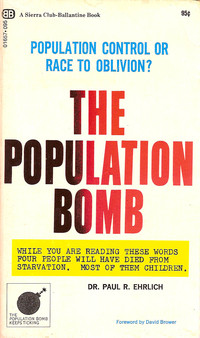
One wonders why anyone listens to doomsayers who have been consistently wrong in their predictions — not a little off, but way off. Professor Paul Ehrlich, author of the 1968 bestseller The Population Bomb, predicted major food shortages in the United States and that by “the 1970s ... hundreds of millions of people are going to starve to death.” Ehrlich forecasted the starvation of 65 million Americans between 1980 and 1989 and a decline in U.S. population to 22.6 million by 1999. He saw England in more desperate straits: “If I were a gambler, I would take even money that England will not exist in the year 2000.”

By a considerable measure, poverty in underdeveloped nations is directly attributable to their leaders heeding the advice of western “experts.” Nobel laureate and Swedish economist Gunnar Myrdal said (1956), “The special advisors to underdeveloped countries who have taken the time and trouble to acquaint themselves with the problem ... all recommend central planning as the first condition of progress.” In 1957 Stanford University economist Paul A. Baran advised, “The establishment of a socialist planned economy is an essential, indeed indispensable, condition for the attainment of economic and social progress in underdeveloped countries.”

Topping off this bad advice, underdeveloped countries sent their brightest to the London School of Economics, Berkeley, Harvard, and Yale to be taught socialist nonsense about economic growth. Nobel laureate economist Paul Samuelson taught them that underdeveloped countries “cannot get their heads above water because their production is so low that they can spare nothing for capital formation by which the standard of living could be raised.” Economist Ranger Nurkse describes the “vicious circle of poverty” as the basic cause of the underdevelopment of poor countries. According to him, a country is poor because it is poor. On its face this theory is ludicrous. If it had validity, all mankind would still be cave dwellers because we all were poor at one time and poverty is inescapable.

Population controllers have a Malthusian vision of the world that sees population growth outpacing the means for people to care for themselves. Mankind’s ingenuity has proven the Malthusians dead wrong. As a result we can grow increasingly larger quantities of food on less and less land. The energy used to produce food, per dollar of GDP, has been in steep decline. We’re getting more with less, and that applies to most other inputs we use for goods and services.

Ponder the following question: Why is it that mankind today enjoys cell phones, computers, and airplanes but did not when King Louis XIV was alive? After all, the necessary physical resources to make cell phones, computers, and airplanes have always been around, even when cavemen walked the earth. There is only one reason we enjoy these goodies today but did not in past eras. It’s the growth in human knowledge, ingenuity, and specialization and trade — coupled with personal liberty and private property rights — that led to industrialization and betterment. In other words human beings are immensely valuable resources.

What are called overpopulation problems result from socialistic government practices that reduce the capacity of people to educate, clothe, house, and feed themselves. Underdeveloped nations are rife with farm controls, export and import restrictions, restrictive licensing, price controls, plus gross human rights violations that encourage their most productive people to emigrate and stifle the productivity of those who remain. The true antipoverty lesson for poor nations is that the most promising route out of poverty to greater wealth is personal liberty and its main ingredient, limited government.

Summary

  • There is no relationship between high populations, disaster, and poverty.
  • By a considerable measure, poverty in underdeveloped nations is directly attributable to their leaders heeding the advice of western “experts” who champion repressive, redistributive and anti-private property “solutions.”
  • What are called overpopulation problems result from socialistic government practices that reduce the capacity of people to educate, clothe, house, and feed themselves.
  • For further information, see:

“Billions for a Misconception” by Lawrence W. Reed: http://tinyurl.com/qy5lp6z

“Overpopulation: The Perennial Myth” by David Osterfeld: http://tinyurl.com/k2ymv6k

“China’s One-Child Disaster” by Wendy McElroy: http://tinyurl.com/pc59th5

“The Real Population Problem” by James Peron: http://tinyurl.com/msk3v4q

“The Population Bomb ... Defused” by R. Cort Kirkwood: http://tinyurl.com/m4pha9f

If you wish to republish this article, please write editor@fee.org.

Walter E. Williams
Walter E. Williams

Walter Williams served on the faculty of George Mason University in Fairfax, Virginia as John M. Olin Distinguished Professor of Economics since 1980. He was the author of more than 150 publications that have appeared in scholarly journals. Learn more about him here.

This article was originally published on FEE.org. Read the original article.

Monday, May 29, 2023

Doomsayer Paul Ehrlich on This Day in History


This Day in History: Paul Ehrlich was born on this day in 1932. Paul Ehrlich is a biologist who wrote The Population Bomb in 1968, predicting that hundreds of millions of people would die of starvation during the 1970s because the earth's inhabitants would multiply at a faster rate than world's ability to supply food.

From Peter Jacobsen:

CBS recently featured infamous doomsayer Paul Ehrlich on their long-running show 60 Minutes. In his segment, Ehrlich tries to convince viewers we’re on a fast track to an environmental disaster of existential proportions, particularly when it comes to animal extinctions.

"In ten years all important animal life in the sea will be extinct,” Ehrlich said. “Large areas of coastline will have to be evacuated because of the stench of dead fish."

But that quote isn’t from the 60 Minutes appearance.

The problem is he said that back in 1970. And he’s saying the exact same thing in the year of our Lord 2023.

Ehrlich has been singing this same song for nearly 60 years. In his 1968 book, The Population Bomb, Ehrlich announced to the world that the 21st century would be one of poverty and mass starvation brought about by overpopulation.

He famously claimed that England would no longer exist in the year 2000 because of environmental disasters caused by overpopulation, and his biggest claim to fame is losing a bet to the late economist Julian Simon about the increasing abundance of resources.

On Twitter, Ehrlich is unhappy that people are ignoring his awards and homing in on his stupendous mistakes.

The last line of his Tweet, that he’s made no basic mistakes, is wrong as well. We know this is true, because Ehrlich always makes mistakes that go in the same direction. He always over-predicts environmental crises and never under-predicts them.

This systematic error is indicative of a basic error. For example, if you always show up five minutes late to everything despite an intention to show up on time, it must be the case that you are making some basic mistake. Maybe your clock is 5 minutes slow, maybe you’ve underestimated your commute, or maybe you take longer to get ready than you think. It’s not just random chance because if it were random you’d also be 5 minutes early sometimes.

Similarly, Ehrlich has made the most basic mistake of all, which is at the root of all his other mistakes.

I’m not going to go through the details of Ehrlich being wrong about extinction woes here, because other articles have successfully highlighted how peer-reviewed research acknowledges the failure of the sorts of estimates Ehrlich relies on.

Another thing that works against Ehrlich is, again, he’s made these same claims before and they didn’t bear out.

But the biggest issue with Ehrlich is that he does make a basic mistake—one that Julian Simon tried to explain to him for many years.

Ehrlich sees humans as mouths to feed in a literal and metaphorical sense. To Ehrlich, humans are consumers, not much different than the animal populations he’s used to studying.

But humans are different in that they can use their creative capacity to reshape and create their environments to their liking in unparalleled ways. In Simon’s words, “Human beings are not just more mouths to feed, but are productive and inventive minds.”

The earliest incarnation of Ehrlich’s concerns about the environment were that we would run out of food, land, and other natural resources.

But to paraphrase Simon, resources come out of the human mind—not the ground. Consider oil. What causes us to treat oil as a valuable commodity worthy of our pursuit rather than some gross black liquid? Human ingenuity.

The ability to convert the black liquid into things like heat, transportation, and food distribution for millions of people was created via humans.

And humans can increase the supply of supposedly fixed resources through innovation. Doubling the fuel efficiency of cars effectively doubles the amount of oil available for driving. We also develop new techniques for extracting previously unattainable oil. These sort of processes are why Ehrlich and many scientists over the years have tried and failed to predict “peak oil” estimates.

Ehrlich frequently blames the Green Revolution in agriculture for confounding his predictions about mass starvation. The problem? The Green Revolution was the result of the very human minds Ehrlich was blaming for the ongoing disaster. A smaller population means fewer minds to produce new ideas, and less demand to compensate individuals for those ideas.

Because Ehrlich consistently focuses on the cost human beings bring to the table but never the benefit, he is systematically incorrect in his predictions.The fact that Ehrlich constantly overpredicts disaster and never underpredicts it is evidence of this basic systematic error.

In response to his failures, Ehrlich has said it’s unlikely that another innovation like the Green Revolution can occur. But why? Ehrlich failed to predict the first Green Revolution, so why would we expect he would be able to predict a second massive innovation?

At this point readers may argue that Ehrlich’s most recent interview is a different type of issue. In the past he was wrong about the abundance of resources, but now he’s talking about species extinctions. How can human ingenuity solve that?

Human creativity is not limited to simple commodities. Anything that humans value can be protected and sustained through creative ways.

One claim made by those concerned about extinctions is that eliminating biodiversity will destroy, for example, molds, fungi, and other organisms beneficial for humans. Penicillin is a primary example of a mold of this type. Imagine if there was an organism which could do as much good for humans as Penicillin but went extinct before we discovered it.

But humans are now on the cusp of being able to create these sorts of organisms ourselves. Gene editing research and technology has put scientists in the position of essentially creating new organisms which could fulfill the role of a theoretically extinct mold. Innovation outpaces destruction.

Other concerns involve consideration for animals who may become extinct. Concerns for these animals are expressed both because of the benefit they bring to humans (think bees) or for their own sake (rhinos).

Are humans powerless to use innovation to stop these problems? Again, no.

The Property and Environment Research Center (PERC) illustrates this well with the story of white rhinos. In 1900, only about 20 white rhinos remained on earth. The few that remained existed in a game reserve.

But in 1991, something changed. PERC explains:

“Before 1991, all wildlife in South Africa was treated by law as res nullius or un-owned property. To reap the benefits of ownership from a wild animal, it had to be killed, captured, or domesticated. This created an incentive to harvest, not protect, valuable wild species—meaning that even if a game rancher paid for a rhino, the rancher could not claim compensation if the rhino left his property or was killed by a poacher.”

Starting in 1991, ownership of white rhinos has been legally upheld. As a result, white rhino populations have soared. There are close to 20,000 white rhinos today with a general increase in population over the last 20 years.

On the other hand, black rhinos—which live primarily in countries with weaker environmental property rights institutions—have declined in population from 100,000 to around 6,000 today.

Giving someone the right to own animals and sell them provides an incentive to protect against poachers and overexploitation. Ranchers systematically slaughter cattle for money, but we don’t have any concern about cow extinction because market incentives encourage private individuals to maintain the populations for the future.

Human ingenuity, given the proper institutions which protect property and liberty, will continue to win out over environmental catastrophe.

Until Ehrlich understands that human creativity is a fundamentally different topic of study from his own, his basic mistake will continue to produce the sorts of mistakes which earned Julian Simon $576.07 against him.

If no one listened to Ehrlich’s doomsaying, this could be just a funny joke. Sadly, Paul Ehrlich isn’t just bad at forecasting the future. Ehrlich explicitly advocated for the use of forms of coercion if necessary to curb the population “problem” in his 1968 book. In his chapter “What Needs to Be Done?” Ehrlich said,

“A good example of how we might have acted can be built around the [Dr.] Chandrasekhar incident I mentioned earlier. When we suggested sterilizing all Indian males with three or more children, he should have encouraged the Indian government to go ahead with the plan. We [the United States] should have volunteered logistic support in the form of helicopters, vehicles, and surgical instruments. We should have sent doctors to aid in the program by setting up centers for training para-medical personnel to do vasectomies. Coercion? Perhaps, but coercion in a good cause (emphasis added).”

This is tyrannical.

Unfortunately, many countries listened to rhetoric similar to Ehrlich’s. In the 1970s China began its one child policy which is responsible for countless forced sterilizations and abortions. The architect of China’s policy utilized work from The Club of Rome, an anti-population think tank and intellectual fellow-travelers of Ehrlich.

Note, I’m not saying Ehrlich created these policies (though he may have liked to based on his comments), but being one of the loudest intellectuals stoking fears of overpopulation and calling for coercion in an era where some of the biggest human rights violations of this kind occurred certainly merit him some culpability.

The same anti-population pandemonium led to the establishment of the United Nations Fund for Population Activities (UNFPA) Award which was awarded to the coercive population programs of China and India.

The echoes of this sort of policy even persist into recent times. As recently as the 1990s, the Peruvian government facilitated its own coercive sterilization program.

So these ideas aren’t just wrong. They are actively harmful when applied. But we don’t have to let them be. Opponents of anti-human ideas can pick up where Julian Simon left off and improve the intellectual conversation by combatting doomsayers.

I encourage interested readers to check out the recent symposium on Julian Simon I co-edited with professor Louis Rouanet in the Review of Austrian economics. The pieces in the issue show Simon’s research program is alive and well.

For readers more interested in books, I recommend Superabundance by Gale Pooley and Marian Tupy as well as their work on the Simon Project.

And Simon’s original magnum opus, The Ultimate Resource, holds up well today and is available for free (albeit in not-so-reader-friendly form) on his website.

Julian Simon’s ultimate claim was that human innovation would cause material conditions to continue to improve so long as freedom and private property were preserved. It’s not clear that academic ideas will also follow this trend, but it doesn’t seem unreasonable to think so.

I certainly hope ideas and discourse will continue to improve, and, if so, we may one day reach a future where Ehrlich’s ideas are extinct from reasonable minds and powerful institutions.

Peter Jacobsen
Peter Jacobsen

Peter Jacobsen teaches economics and holds the position of Gwartney Professor of Economics. He received his graduate education at George Mason University.

This article was originally published on FEE.org. Read the original article.