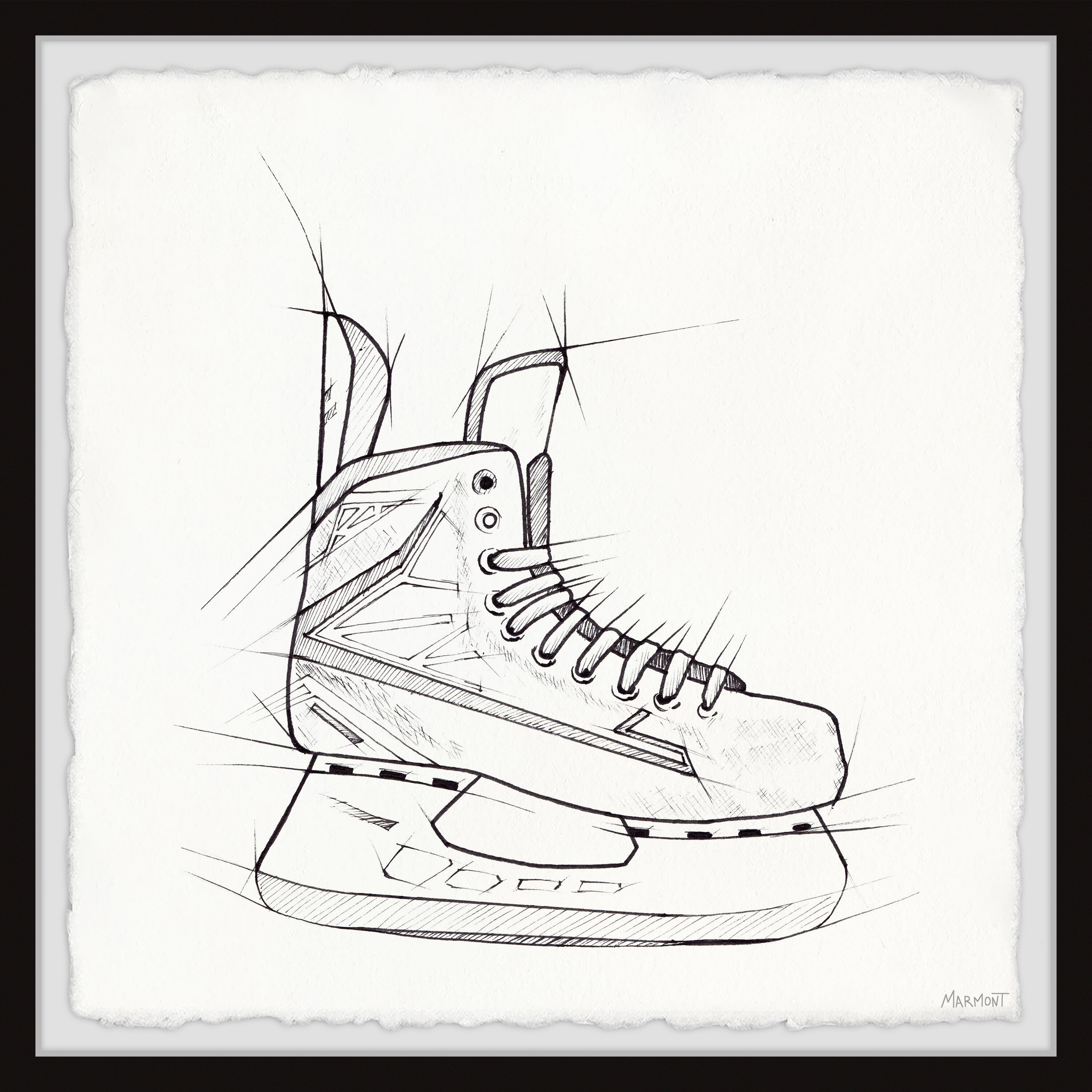
This Day in History: Benjamin Edward "Teddy" Balkind, age 16, was a high school student from Connecticut who died after suffering an injury to his neck during a junior varsity ice hockey game on this day in 2022. A hockey player for St. Luke's School, Balkind died after he fell during a game and was accidentally hit by another player, who was unable to stop in time. The other player's skate blade cut Balkind's neck, and he died following an emergency operation.
A Swedish hockey player, Bengt Akerblom was killed in 1995 during an exhibition game when he had his carotid arteries cut by a skate. A requirement for all ice hockey players to wear a neck guard was introduced in Sweden after that.
In 2016, a 16 year old Russian hockey player named Alexander Orekhov passed away after being hit in the neck with a puck. "The shot that hit Orekhov struck him with enough force that it damaged the carotid artery and broke several bones. Orekhov collapsed on the ice and suffered cardiac arrest. He was resuscitated and taken to a local hospital, at which point he was put into a medically induced coma. After nearly three weeks in a coma, however, Orekhov passed away." Source
This Day in History: The Great One, Wayne Gretzky, was born on this day in 1961 in Brantford Ontario. He has been called the greatest hockey player ever by many sportswriters, players, the NHL itself, and by The Hockey News, based on extensive surveys of hockey writers, ex-players, general managers and coaches. Gretzky is the leading goal scorer, leading assist producer and leading point scorer in NHL history, and garnered more assists in his career than any other player scored total points. He is the only NHL player to total over 200 points in one season, a feat he accomplished four times. In addition, Gretzky tallied over 100 points in record 16 professional seasons, 14 of them consecutive, also a record. At the time of his retirement in 1999, he held 61 NHL records: 40 regular season records, 15 playoff records, and 6 All-Star records.
One has to wonder if the month he was born contributed to Wayne Gretsky's success. "In his book Outliers, Malcolm Gladwell discusses the odd distribution of birth months among NHL players. Because youth players are registered in leagues based on their year of birth, the biggest and strongest players tend to be those born in the first few months of the year. This selection process starts as early as age 8, and the effect persists more than a decade later in junior hockey in Canada." Source
"In Canada, the eligibility cutoff for age-class hockey programs is Jan. 1. Canada also takes hockey really seriously, so coaches start streaming the best hockey players into elite programs, where they practice more and play more games and get better coaching, as early as 8 or 9. But who tends to be the "best" player at age 8 or 8? The oldest, of course -- the kids born nearest the cut-off date, who can be as much as almost a year older than kids born at the other end of the cut-off date. When you are 8 years old, 10 or 11 extra months of maturity means a lot. So those kids get special attention. That's why there are more players in the NHL born in January and February and March than any other months." Source
"There were 158 total players at that time in the NHL born between 1980 and 1990 in January, February or March and just 97 born in October, November or December. Those players, per the Gladwell theory, get short-shrift in Canadian youth hockey because they’re too young … and then get docked by some when it’s draft time because they’re older than other eligible peers." Source