Showing posts with label prohibition. Show all posts

Wednesday, January 17, 2024

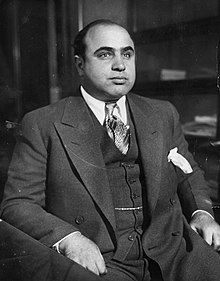
Mob Boss Al Capone on This Day in History


This day in history: American gangster and businessman Al Capone was born on this day in 1899. 

Also on this day in history: Alcohol Prohibition began in the United States on this day in 1920 as the Volstead Act went into effect.

These two events would become intertwined. As people were denied what they wanted, Al Capone saw an opportunity to provide alcohol to the people and he filled the void that the government had created. "Federal authorities estimated that in 1927, Al Capone’s illegal liquor operations were generating about $60 million in total revenue a year—about $873 million today." Source

Capone eventually went to prison for tax evasion, but he may not the villain in his story. His captor, Eliot Ness, "represented the state. He was enforcing an unjust law - Prohibition - and using another unjust law - the income tax - to do it. Capone stood for our freedom to drink." Source


Saturday, October 22, 2022

Bank Robber Baby Face Nelson on This Day in History


This day in history: Bank robber Baby Face Nelson was killed on this day in 1934. Nelson got his start in the criminal gangs when he was employed to bootleg alcohol throughout the Chicago suburbs. Alcohol was illegal thanks to Prohibition.

At the beginning of Prohibition, the Reverend Billy Sunday stirred audiences with this optimistic prediction:

"The reign of tears is over. The slums will soon be a memory. We will turn our prisons into factories and our jails into storehouses and corncribs. Men will walk upright now, women will smile and children will laugh. Hell will be forever for rent."

That was far from the truth. The golden age of bank robbers like Baby Face Nelson in the 1930's can be linked to Woodrow Wilson, the man who gave us both the Federal Reserve (which led to the great depression) and Prohibition. Organized crime got its first foothold in American life thanks to the lucrative black market in liquor. Overall crime increased by 24 percent during the first two years of Prohibition. "In fact, a study of South Carolina counties that enforced Prohibition versus those who didn’t found a whopping 30 to 60 percent increase in homicides in the counties that enforced the law." ~Brian Miller

"Prohibition did not achieve its goals. Instead, it added to the problems it was intended to solve and supplanted other ways of addressing problems. The only beneficiaries of Prohibition were bootleggers, crime bosses, and the forces of big government. Carroll Wooddy concluded that the 'Eighteenth Amendment . . . contributed substantially to the growth of government and of government costs in this period [1915-32].'" Source

Wednesday, January 12, 2022

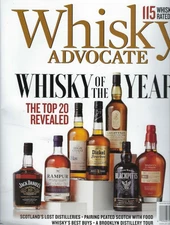
Whisky King Hiram Walker on This Day in History


Buy on Ebay for $9.99

This day in history: Hiram Walker died on this day in 1899. Hiram Walker was an American entrepreneur and founder of the Hiram Walker and Sons Ltd. distillery in Windsor, Ontario, Canada.

Hiram Walker founded his distillery in 1858 in Detroit. He first learned how to distill cider vinegar in his grocery store in the 1830s before moving on to whisky and producing his first barrels in 1854. However, with the Prohibition movement gathering momentum and Michigan already becoming "dry," Walker decided to move his distillery across the Detroit River to Windsor, Ontario. 

Walker began selling his whisky as Hiram Walker's Club Whisky, in containers that were "clearly marked" and he used a process to make his whisky that was vastly different from all other distillers.

It became very popular, angering American distillers, who forced the US government to pass a law requiring that all foreign whiskeys state their country of origin on the label. From this point forward, Hiram Walker's Canadian Club whisky was Canada's top export whisky. He established and maintained the company town that grew around his distillery, exercising planning and control over every facet of the town, from public works to religious services to police and fire control.

The Hiram Walker & Sons Distillery remained in the Walker family until 1926 when they sold it to Harry C. Hatch. Canadian Club whisky is still produced at the distillery site Walker founded. The company has gone through several owners and is now part of Pernod Ricard. The Canadian Club brand is owned by Beam Suntory, a subsidiary of Suntory Holdings of Japan.

As for the spelling of the drink, it is generally spelled “whiskey”—with an e—in the United States and Ireland. It is spelled “whisky”—without the e—in Scotland and Canada, which are both well known for their whisk(e)ys.

Most Canadian whiskies are blended multi-grain liquors containing a large percentage of corn spirits, and are typically lighter and smoother than other whisky styles. When Canadian distillers began adding small amounts of highly-flavorful rye grain to their mashes, people began demanding this new rye-flavored whisky, referring to it simply as "rye". Today, as for the past two centuries, the terms "rye whisky" and "Canadian whisky" are used interchangeably in Canada and (as defined in Canadian law) refer to exactly the same product, which generally is made with only a small amount of rye grain.

Canadian Club is still one of the top 10 best selling whisky's in the world, the top ten being:

1) Jack Daniels
2) Jim Beam
3) Jameson
4) Crown Royal (also Canadian)
5) Suntory Kakubin (including Highball)
6) Black Nikka
7) Suntory Torys (including Highball)
8) Maker’s Mark
9) Canadian Club
10) Seagram’s 7 Crown

Sunday, December 5, 2021

Alcohol Prohibition on This Day in History


This day in history: The Twenty-first Amendment to the United States Constitution was ratified on this day in 1933. The Twenty-first Amendment to the United States Constitution repealed the Eighteenth Amendment to the United States Constitution, which had mandated nationwide prohibition on alcohol. The Twenty-first Amendment is unique among the 27 amendments of the U.S. Constitution for being the only one to repeal a prior amendment. However, to this day there are still 83 counties in the United States where the sale of alcohol is completely prohibited. 

My state of North Carolina does not allow alcohol sales between 2am and 7am Monday through Saturday or before 12pm on Sundays, though you can now buy beer after 10am now on Sundays. 

There are many strange liquor laws across America (hello Utah) and even in Canada, and they can all be traced back to Prohibition. "You look at any regulatory structure in North America and if it was examined in a global perspective, you’d look at it in stunned disbelief, like ‘What is going on here?’ It really does go back to the Prohibition mentality of control, and the slow loosening of control over the years." ~Wine lawyer Mark Hicken

Alcohol prohibition also gave us a powerful mob and Las Vegas. "Prohibition built The Mob. The Mob built Vegas. Without organized crime, there would be no Las Vegas Strip, casinos probably wouldn’t run nearly as efficiently, and it’s likely that the city never would have become a glamorous tourist destination at all." Source

Prohibition was also responsible for the major expansion of the Ku Klux Klan. The law “provided a way for the Klan to legitimize its 100% Americanist mission — it could target the drinking of those they perceived to be their enemies...One notorious example occurred in 1923-24 in southern Illinois’ Williamson County, where the Klan mobilized hundreds of volunteers to raid saloons and roadhouses. Hundreds of people were arrested and more than a dozen killed." Source

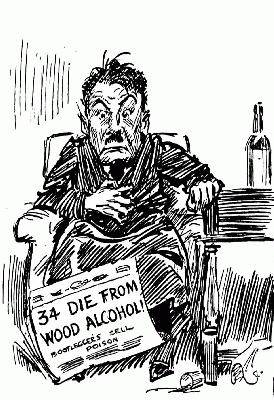
Prohibition showed us that Government is more interested in out compliance than our health. To prevent bootleggers from using industrial ethyl alcohol to produce illegal beverages, the federal government ordered the poisoning of industrial alcohols. In response, bootleggers hired chemists who successfully renatured the alcohol to make it drinkable. As a response, the Treasury Department required manufacturers to add more deadly poisons, including the particularly deadly methyl alcohol, consisting of 4 parts methanol, 2.25 parts pyridine base, and 0.5 parts benzene per 100 parts ethyl alcohol. New York City medical examiners prominently opposed these policies because of the danger to human life. As many as 10,000 people died from drinking denatured alcohol before Prohibition ended. New York City medical examiner Charles Norris believed the government took responsibility for murder when they knew the poison was not deterring consumption and they continued to poison industrial alcohol (which would be used in drinking alcohol) anyway. Norris remarked: "The government knows it is not stopping drinking by putting poison in alcohol ... [Y]et it continues its poisoning processes, heedless of the fact that people determined to drink are daily absorbing that poison. Knowing this to be true, the United States government must be charged with the moral responsibility for the deaths that poisoned liquor causes, although it cannot be held legally responsible."

There are 14 countries where alcohol consumption is illegal: Yemen, United Arab Emirates (In Sharja), Sudan, Somalia, Saudi Arabia, Pakistan, Mauritania, Maldives, Libya, Kuwait, Iran, some states in India, Brunei and Bangladesh. 

See also Alcoholic & Narcotic History of the World - 60 Books on CDrom (or to download)