Showing posts with label beer. Show all posts

Tuesday, October 17, 2023

The London Beer Flood on This Day in History


This day in history: The London Beer Flood occurred on this day in 1814. The London Beer Flood was an accident at Meux & Co's Horse Shoe Brewery, London. It took place when one of the 22-foot-tall wooden vats of fermenting porter burst. The escaping liquid dislodged the valve of another vessel and destroyed several large barrels: between 128,000 and 323,000 imperial gallons of beer were released in total.

The resulting wave of porter destroyed the back wall of the brewery and swept into an area of slum dwellings known as the St Giles rookery. Eight people were killed, five of them mourners at the wake being held by an Irish family for a two-year-old boy. The coroner's inquest returned a verdict that the eight had lost their lives "casually, accidentally and by misfortune". The brewery was nearly bankrupted by the event; it avoided collapse after a rebate from HM Excise on the lost beer. The brewing industry gradually stopped using large wooden vats after the accident. The brewery moved in 1921, and the Dominion Theatre is now where the brewery used to stand. Meux & Co went into liquidation in 1961.



Wednesday, June 1, 2022

Scotch Whisky on This Day in History


This Day in History: On this day (June 1) in 1495, a monk named John Tor introduced Scotch Whisky for the first time. Catholic monks have for centuries blessed the world with different varieties of the so-called "demon alcohol." They gave us champagne (Dom Pérignon was the name of a monk), Chartreuse, Brandy, Rompope and they started the California wine industry. Though beer had been around for thousands of years, it was monks that perfected beer to the quality we enjoy today. Propino tibi.

"Equally impressive is the religious contribution to distilled spirits. Whiskey was invented by medieval Irish monks, who probably shared their knowledge with the Scots during their missions. Chartreuse is widely considered the world’s best liqueur because of its extraordinary spectrum of distinct flavors and even medicinal benefits. Perfected by the Carthusian order almost 300 years ago, the recipe is known by only two monks at a time. The herbal liqueur Bénédictine D.O.M. is reputed to have been invented in 1510 by an Italian Benedictine named Dom Bernardo Vincelli to fortify and restore weary monks. And the cherry brandy known as Maraska liqueur was invented by Dominican apothecaries in the early 16th century." Source


Thursday, March 17, 2022

The Death of Saint Patrick on This Day in History


This Day in History: St. Patrick's Day died on this day in 461 A.D., or so legend has it. Did you know that St. Patrick wasn't Irish, in fact some would argue that he wasn't sufficiently Catholic either. "He was not a messenger of the pope, but of Christ. He went to Ireland of his own accord, and established a church independent of Rome. Churches on the model of the great apostle were established in France and Germany, and were persecuted on the continent as in Ireland. In A. D. 602, the Irish Columbanus was ordered to leave France by a council to which he wrote, pleading for liberty of conscience; and five centuries after the time of Saint Patrick, Saint Bernard reproached the Irish for being Pagans, unconnected with Rome, because every little town had its independent bishop; and it was not until 1148 that Rome obtained a secure foothold in Ireland, when the clergy suicided their independence, and sacrificed themselves upon the altar of Rome. Irishmen worship the Virgin Mary. Not so with Patrick. A glorious hymn remains as composed by him the day previous to his controversy with the Irish prince, but not a word in it to Mary; all his beautiful aspirations, all his warm affections, all his victorious hopes, are to and from Christ alone." ~Justin Dewey Fulton 1887

As such, Saint Patrick could be called a proto-Protestant. 

Patrick was a slave born in either England, Scotland or Wales around 386 A.D. St Paddy is said to have banished snakes from the Emerald Isle, however, Ireland has never really been home to snakes...it's just too cold. The snakes could have been a metaphor for the pagan Druids.

Patrick is not really a "Saint" as he was never canonized as such.

Did you know: There are 35 million U.S. residents with Irish ancestry. This number is more than seven times the population of Ireland itself.

Your odds of finding a four-leaf clover are about 1 in 10,000.

St. Patrick's Day once was a dry holiday, as up until the 1970s, pubs were closed on that day. 

In traditional Irish folk tales, there are no female leprechauns.

The Irish were sneered upon in early America. "There’s actually a term for anti-Irish prejudice: Hibernophobia. You can see it expressed in commonly-known “Irish need not apply” clauses in job advertisements from 19th century America." Source


Sunday, December 5, 2021

Alcohol Prohibition on This Day in History


This day in history: The Twenty-first Amendment to the United States Constitution was ratified on this day in 1933. The Twenty-first Amendment to the United States Constitution repealed the Eighteenth Amendment to the United States Constitution, which had mandated nationwide prohibition on alcohol. The Twenty-first Amendment is unique among the 27 amendments of the U.S. Constitution for being the only one to repeal a prior amendment. However, to this day there are still 83 counties in the United States where the sale of alcohol is completely prohibited. 

My state of North Carolina does not allow alcohol sales between 2am and 7am Monday through Saturday or before 12pm on Sundays, though you can now buy beer after 10am now on Sundays. 

There are many strange liquor laws across America (hello Utah) and even in Canada, and they can all be traced back to Prohibition. "You look at any regulatory structure in North America and if it was examined in a global perspective, you’d look at it in stunned disbelief, like ‘What is going on here?’ It really does go back to the Prohibition mentality of control, and the slow loosening of control over the years." ~Wine lawyer Mark Hicken

Alcohol prohibition also gave us a powerful mob and Las Vegas. "Prohibition built The Mob. The Mob built Vegas. Without organized crime, there would be no Las Vegas Strip, casinos probably wouldn’t run nearly as efficiently, and it’s likely that the city never would have become a glamorous tourist destination at all." Source

Prohibition was also responsible for the major expansion of the Ku Klux Klan. The law “provided a way for the Klan to legitimize its 100% Americanist mission — it could target the drinking of those they perceived to be their enemies...One notorious example occurred in 1923-24 in southern Illinois’ Williamson County, where the Klan mobilized hundreds of volunteers to raid saloons and roadhouses. Hundreds of people were arrested and more than a dozen killed." Source

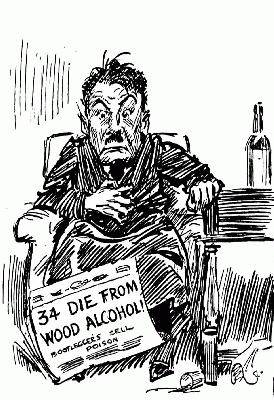
Prohibition showed us that Government is more interested in out compliance than our health. To prevent bootleggers from using industrial ethyl alcohol to produce illegal beverages, the federal government ordered the poisoning of industrial alcohols. In response, bootleggers hired chemists who successfully renatured the alcohol to make it drinkable. As a response, the Treasury Department required manufacturers to add more deadly poisons, including the particularly deadly methyl alcohol, consisting of 4 parts methanol, 2.25 parts pyridine base, and 0.5 parts benzene per 100 parts ethyl alcohol. New York City medical examiners prominently opposed these policies because of the danger to human life. As many as 10,000 people died from drinking denatured alcohol before Prohibition ended. New York City medical examiner Charles Norris believed the government took responsibility for murder when they knew the poison was not deterring consumption and they continued to poison industrial alcohol (which would be used in drinking alcohol) anyway. Norris remarked: "The government knows it is not stopping drinking by putting poison in alcohol ... [Y]et it continues its poisoning processes, heedless of the fact that people determined to drink are daily absorbing that poison. Knowing this to be true, the United States government must be charged with the moral responsibility for the deaths that poisoned liquor causes, although it cannot be held legally responsible."

There are 14 countries where alcohol consumption is illegal: Yemen, United Arab Emirates (In Sharja), Sudan, Somalia, Saudi Arabia, Pakistan, Mauritania, Maldives, Libya, Kuwait, Iran, some states in India, Brunei and Bangladesh. 

See also Alcoholic & Narcotic History of the World - 60 Books on CDrom (or to download)