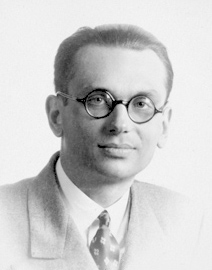
This Day in History: Austrian-American logician and mathematician Kurt Godel died on this day in 1978. Godel developed an obsessive fear of being poisoned and refused to eat food prepared by anyone but his wife. When she became ill and was hospitalized, he starved to death. Godel weighed 65 pounds when he died of "malnutrition and inanition caused by personality disturbance."
Godel's obsessive fear of being poisoned is what you call a persecutory delusion. A persecutory delusion is a common type of delusional condition in which the affected person believes that harm is going to occur to oneself by a persecutor, despite a clear lack of evidence. The person may believe that they are being targeted by an individual or a group of people. Persecution delusions are very diverse in terms of content and vary from the possible, albeit improbable, to the completely bizarre.
This Day in History: Fifty-eight people were killed in two separate airline crashes on this day in 1970. A Faucett Airlines DC-4 disappeared in Peru while en route from Trujillo to Juanjui. Earlier, a DC-3, described as the only aircraft owned by Polynesian Airlines, crashed on takeoff from Apia Faleolo airport, killing all 27 passengers and three crew in its attempt to fly to Pago Pago.
The first fatal aviation accident was the crash of a Rozière balloon near Wimereux, France, on June 15, 1785, killing the balloon's inventor, Jean-François Pilâtre de Rozier, and the other occupant, Pierre Romain. The first involving a powered aircraft was the crash of a Wright Model A aircraft at Fort Myer, Virginia, in the United States on September 17, 1908, injuring its co-inventor and pilot, Orville Wright, and killing the passenger, Signal Corps Lieutenant Thomas Selfridge.
The first aircraft accident in which 200 or more people died occurred on March 3, 1974, when 346 died in the crash of Turkish Airlines Flight 981. As of April 2020, there have been 33 aviation incidents in which 200 or more people died.
The top 10 countries with the highest number of fatal civil airliner accidents from 1945 to 2021 are the United States, Russia, Canada, Brazil, Colombia, UK, France, Indonesia, Mexico, and India. The UK is noted to have the highest number of air crashes in Europe, with a total of 110 air crashes within the time period, and Indonesia is the highest in Asia at 104, followed by India at 95.
The largest loss of life on board a single-aircraft is the 520 fatalities in the 1985 Japan Airlines Flight 123 accident, the largest loss of life in multiple aircraft in a single accident is the 583 fatalities in the two Boeing 747's that collided in the 1977 Tenerife airport disaster, while the largest loss of life overall in a collective incident is the 2,996 fatalities in the coordinated terrorist destruction of airplanes and occupied buildings in the 2001 September 11 attacks.
This Day in History: Jimmy Carter was inaugurated as the 76th Governor of Georgia at the age of 46 on this day in 1971. A relatively obscure Georgia state senator and operator of a peanut-growing business, Carter failed in a 1966 bid for the Democratic party nomination for Governor, but succeeded in 1970. Slightly more than six years later, the obscure Governor Carter would become the 39th President of the United States.
"Carter gets a very bad rap, particularly from libertarians and conservatives, but it's not entirely clear why. It has something to do with 'malaise' and lack of 'leadership.' And the Carter administration surely had its blunders, particularly on foreign policy. But Carter also oversaw major (and under-appreciated) foreign policy successes, such as the SALT II nuclear weapons reductions, the Camp David Accords ending the Egypt-Israel conflict, and the removal of US nuclear weapons from Korea...To fight stagflation, Carter appointed tight-money advocate Paul Volker to head the Federal Reserve Board, and Volker pulled the brakes on inflationary monetary policy — hard. It solved inflation but sent the economy into a painful correction that probably cost Carter reelection. And despite his personal big government sympathies, Carter's most lasting legacy is as the Great Deregulator. Carter deregulated oil, trucking, railroads, airlines, and beer." fee.org
So why do people hate Carter so much? Gene Healy suggests that it’s a case of perception over reality: "Carter-bashers seem obsessed with style over substance: that Mr. Rogers sweater, the 'malaise' speech, Carter’s sanctimonious, unlovable public persona — the way he seemed to personify national decline.
People want the illusion of control: a comforting, competent father-protector at the helm of our national destiny — and Carter couldn’t fake that role as well as most presidents before or since. Liberals downgrade the Carter presidency as one short on transformative visions: It brought no New Deals, no New Frontiers.
Instead, at its best, the Carter legacy was one of workaday reforms that made significant improvements in American life: cheaper travel and cheaper goods for the middle class. Ironically enough, the president you’d never want to have a beer with brought you better beer — and much else besides."
"Jimmy Carter may have been the last Jeffersonian to be president. A recent article in the Washington Post labeled him the “Un-Celebrity President.” In either case, Carter is a reflection of a people and a place. He is the most authentic man elected president since Calvin Coolidge, and like Coolidge a true Christian gentleman.
At the very minimum, Carter represented the Founders’ vision for a republican executive. He walked to his inaugural, refused to have 'Hail to the Chief' played while he boarded Air Force One or Marine One, carried his own luggage, and when soundly defeated by Ronald Reagan went home to Plains, Georgia to the same two bedroom rancher he built in 1961. He’s never left...Carter was never a political thug who would sink to purchasing votes for power. He was probably too nice for Washington. That should be a badge of honor." lewrockwell.com
This Day in History: "Today in 1569 the very first English lottery was drawn at St. Paul’s Cathedral in London. (Queen) Elizabeth’s bank account was running dry, and she could have either raised taxes, or held a lottery to fill it back up again. She decided to go with the lottery – the first ever national lottery. The tickets were ten shillings each, beyond the means of an ordinary person, which makes it different from a modern lottery, where tickets are often priced low enough so that low income people can afford them. This lottery was targeted to the upper class, and it became a status symbol in society to have bought a ticket. The first prize was 5000 pounds, which was enormous....To encourage more people to buy tickets, everyone who bought a ticket was promised, 'freedom from arrest from all crimes other than murder, felonies, piracy, and treason.' So it was literally a get out of jail free card." Source
"According to one scholar, the first lottery used to raise government revenue and offer a cash prize was held in Florence, Italy, in 1530. Soon France picked up on this innovative means of raising money, and the British crown adopted the lottery in 1569. By the 1700s, lotteries were a popular way to raise money for all sorts of projects and were seen less as a sinful pastime than a civic duty. In the early 18th century, The Independent reports, the Archbishop of Canterbury lent his good name to lotteries funding the British Museum and Westminster Bridge." Source
This Day in History: Salvator Disi, 62, was decapitated on this day in 2019 while using a power cart to jump start a helicopter in Hernando County, Florida. Its unexpected up-and-down motion caused the rotor blades to strike him.
This kind of fatality is rare, but it does happen. A woman, while on vacation in Las Vegas, exited a tour helicopter while the blades were still spinning. Her hat blew off because of the down wash from the blades. She frantically tried to retrieve her hat and while doing so she ran into the tail rotors. She was killed instantly.
One British man was decapitated by a helicopter tail rotor while "taking a selfie" earlier this year. Source
The most famous case of decapitation by helicopter blades happened on the set of the Twilight Zone movie in 1982. They were filming at night in difficult terrain and three people were killed (two were decapitated) when the pilot couldn’t control the helicopter during the simulated explosions going on all around him. One was actor Vic Morrow and the other two were children he was holding at the time. It was a stupid, senseless accident all because the director wanted a night shot. The children were on set in violation of child labor laws as well.
This Day in History: Apple CEO Steve Jobs introduced the original iPhone at a Macworld keynote in San Francisco on this day in 2007.
From Barry Brownstein:
Steve Jobs was a great visionary. But just how far did his vision extend? If you examine the history of the iPhone, it turns out his vision didn’t extend as far as we might think.
In his book Digital Minimalism, computer science professor Cal Newport reveals that the original vision Jobs had for the iPhone was an iPod that could make calls. At the time, iPods were ubiquitous; with the iPhone, you’d no longer need to carry two devices—a phone and an iPod.
In his 2007 keynote introducing the iPhone, Jobs began by saying, “Every once in a while, a revolutionary product comes along that changes everything.” Apple aimed to make the iPhone “way smarter than any mobile device has ever been and stupid easy to use.” Listening to his talk, it’s clear that Jobs had only a partial view of all that would change.
As Newport observes, Jobs thought he had built a better iPod:
Accordingly, when Jobs demonstrated an iPhone onstage during his keynote address, he spent the first eight minutes of the demo walking through its media features, concluding: “It’s the best iPod we’ve ever made!”
Newport points out that Jobs was also “enamored of the simplicity with which you could scroll through phone numbers, and the fact that the dial pad appeared on the screen instead of requiring permanent plastic buttons.”
“The killer app is making calls,” Jobs exclaimed during his keynote.
At about 13 minutes into his presentation, Jobs introduced, to tepid applause, a rear-facing camera. The first iPhone had no video recording capability, and it was not until the iPhone 4 that a front-facing camera was introduced. No one in the audience that day imagined the role smartphones would play in the social media revolution.
Not until he was about 31 minutes into his presentation did Jobs demo text messages. At about 36 minutes he highlighted, to more tepid applause, the phone’s Safari web browser and integration with Google Maps.
In short, neither Jobs nor the audience had the vision to anticipate what would become the dominant uses for the phone.
Isn’t that extraordinary? Jobs was Apple’s greatest cheerleader. He was said to “cast spells” on audiences, and yet there was mere tepid applause for what was truly revolutionary—a powerful minicomputer in a handheld device at a fraction of the cost of a much larger device a mere generation ago.
Fast forward a mere seven years. Bret Swanson noted that “the computing power, data storage capacity, and communications bandwidth of an iPhone in 2014 would have cost at least $3 million back in 1991.”
In short, neither Jobs nor the audience had the vision to anticipate what would become the dominant usesfor the phone. The real revolution would unfold. Jobs and the audience could mostly see what was already known and most visible—an iPod that made calls.
Newport confirmed Jobs’s limited vision by speaking with one of the iPhone’s developers:
To confirm that this limited vision was not some quirk of Jobs’s keynote script, I spoke with Andy Grignon, who was one of the original iPhone team members. “This was supposed to be an iPod that made phone calls,” he confirmed. “Our core mission was playing music and making phone calls.” As Grignon then explained to me, Steve Jobs was initially dismissive of the idea that the iPhone would become more of a general-purpose mobile computer running a variety of different third-party applications. “The second we allow some knucklehead programmer to write some code that crashes it,” Jobs once told Grignon, “that will be when they want to call 911.”
We’ve Just Started
In his seminal work The Constitution of Liberty, Nobel laureate F.A. Hayek challenges our assumptions about how civilization develops:
Man did not simply impose upon the world a pattern created by his mind. His mind is itself a system that constantly changes as a result of his endeavor to adapt himself to his surroundings. It would be an error to believe that, to achieve a higher civilization, we have merely to put into effect the ideas now guiding us.
Hayek continued, “If we are to advance, we must leave room for a continuous revision of our present conceptions and ideals which will be necessitated by further experience.”
Jobs probably never read Hayek, but shortly after 21 minutes into the presentation, Jobs wryly smiles and says, “We’ve just started.”
Little did Jobs know.
Did Jobs direct consumers or did consumers direct Apple as their use of text messaging and mobile browsing began to dwarf the use of the iPhone as a better iPod? Hayek explained that human reason cannot stand outside of experience:
The conception of man deliberately building his civilization stems from an erroneous intellectualism that regards human reason as something standing outside nature and possessed of knowledge and reasoning capacity independent of experience.
“The mind can never foresee its own advance” is one of Hayek’s most quoted lines. Hayek adds, “Though we must always strive for the achievement of our present aims, we must also leave room for new experiences and future events to decide which of these aims will be achieved.”
Politicians Know Nothing of the Future
If Steve Jobs couldn’t imagine how the use of his iPhone would morph, he was smart in learning from what users would teach him. And if he were ever tempted to impose his will, the 2008 introduction of Android with an open-source operating system would have disabused him of such folly. Android’s open-source operating system allowed for rapid innovation.
Every day, evidence of how society advances is overlooked by voters and politicians. Many people, voters and politicians alike, imagine the mind can foresee its own advance. Voters rally behind politicians claiming to know just what society needs to advance and promising to lead us step-by-step into their envisioned future. Little do voters understand how little politicians can “foresee.”
The future is largely unforeseeable. For that reason, Hayek explains, liberty is essential to advancing civilization:
Liberty is essential in order to leave room for the unforeseeable and unpredictable; we want it because we have learned to expect from it the opportunity of realizing many of our aims. It is because every individual knows so little and, in particular, because we rarely know which of us knows best that we trust the independent and competitive efforts of many to induce the emergence of what we shall want when we see it.
“We rarely know which of us knows best,” so why would we want to vote for politicians who proclaim they do?
It is no shortcoming of Steve Jobs that he could not foresee the advances made possible by the iPhone. Politicians couldn’t even conceive of an iPhone.
Because each of us has a limited view of the future, Hayek instructs us that “the case for individual freedom rests chiefly on the recognition of the inevitable ignorance of all of us concerning a great many of the factors on which the achievement of our ends and welfare depends.”
Dee Hock, the legendary founding CEO of Visa, fostered innovation to grow a global credit card company by decentralizing control around simple rules. Hock led from this belief: “From no more than dreams, determination, and the liberty to try, quite ordinary people consistently do extraordinary things.”
The case for liberty is hidden in plain sight in our phones and a million other things our lives depend on.
Barry Brownstein is professor emeritus of economics and leadership at the University of Baltimore. He is the author of The Inner-Work of Leadership. To receive Barry's essays subscribe at Mindset Shifts.
This article was originally published on FEE.org. Read the original article.
This day in history: On this day in 1964, LBJ (Lyndon B. Johnson) declared a "War on Poverty." 22 trillion dollars have been spent on this "war" and more people are now dependent on Government and less self-sufficient than before.
Poverty researcher Michael D. Tanner remarked on the War on Poverty and its programmatic legacies:
"Throwing money at the problem has neither reduced poverty nor made the poor self-sufficient. Instead, government programs have torn at the social fabric of the country and been a significant factor in increasing out-of-wedlock births with all of their attendant problems. They have weakened the work ethic and contributed to rising crime rates. Most tragically of all, the pathologies they engender have been passed on from parent to child, from generation to generation."
"The stated goal of the War on Poverty is not just to raise living standards but also to make America’s poor more self-sufficient and to bring them into the mainstream of the economy. In that effort the war has been an abject failure, increasing dependency and largely severing the bottom fifth of earners from the rewards and responsibilities of work…The expanding availability of antipoverty transfers has devastated the work effort of poor and lower-middle income families. By 1975 the lowest-earning fifth of families had 24.8% more families with a prime-work age head and no one working than did their middle-income peers. By 2015 this differential had risen to 37.1%…The War on Poverty has increased dependency and failed in its primary effort to bring poor people into the mainstream of America’s economy and communal life. Government programs replaced deprivation with idleness, stifling human flourishing."
FDR, who I rarely agree with once wisely stated:
“The lessons of history, confirmed by evidence immediately before me, show conclusively that continued dependence upon relief induces a spiritual and moral disintegration to the national fiber. To dole out relief . . . is to administer a narcotic, a subtle destroyer of the human spirit.”



.jpg/220px-JimmyCarterPortrait_(cropped).jpg)


