Showing posts with label disappearance. Show all posts

Sunday, February 12, 2023

The Mysterious Disappearance of an Iron Butterfly on This Day in History


This Day in History: Philip Taylor Kramer, bassist for the psychedelic rock group, Iron Butterfly, disappeared on this day in 1995.

Kramer turned out to be something of a genius. He left Iron Butterfly and obtained a degree in aerospace engineering, he worked on the MX missile guidance system for a contractor of the US Department of Defense and later in the computer industry on fractal compression, facial recognition systems, and advanced communications. Kramer co-developed SoftVideo based on fractal compression and he also claimed to work on a transmission project that would result in faster-than-light speed communications. Like his father before him, Kramer set out to discredit Albert Einstein's theories.

From Steph Young: "'Chaos is perfect order!' Kramer had announced prior to his disappearance, 'I was able to decipher the code – it was heavily encrypted. People are going to want what I’m working on. We have to get off the planet…' that in the days before he disappeared, he had been supposedly working on perfecting a top-secret 30-year-old formula that he and his father believed would disprove Einstein and change the course of history. The formula was based on a theory that linked faster-than-light communications. ‘It was a kind of gravitational vibration wilder than anything seen on Star Trek. It was, he believed, worth billions, and then, one day, he disappeared, leaving behind a web of suspicion, intrigue and conspiracy theories more elaborate than anything since the grassy knoll.’ The Washington post asked; ‘Is Kramer trapped by his own technological wizardry, imprisoned somewhere in cyberspace?’ Many people believe that when Kramer vanished he entered another realm. On February 12th, 1995, he’d driven to LA Airport where he was due to pick up a business colleague and his wife. However, after approximately 45 minutes, he got back into his car and left the airport without waiting for his colleague to arrive. He stopped after a while and made a series of strange telephone calls. He called a former band member and good friend, Ron Bushy, and said to him, 'I’ll see you on the other side.' Then he called the police and said, 'This is Philip Taylor Kramer. I’m going to kill myself. And I want everyone to know O.J Simpson is innocent. THEY did it.' Then he disappeared." Source

On May 29, 1999, Kramer's Ford Aerostar minivan and skeletal remains were found by photographers looking for old car wrecks to shoot at the bottom of Decker Canyon near Malibu, California. However, his father never believed he killed himself and is quoted as saying "Taylor had told me a long time before there were people bothering him. They wanted what he was doing and some of them threatened him. He once told me that if I ever say I'm gonna kill myself, don't you believe it one bit. I'll be needing help."

The History and Mystery of Alchemy is now available on Amazon...and it is only 99 cents.

Thursday, January 26, 2023

The Disappearance of the Beaumont Children on This Day in History


This Day in History: Jane Nartare Beaumont, Arnna Kathleen Beaumont and Grant Ellis Beaumont, collectively known as the Beaumont children, were three Australian siblings who disappeared from Glenelg Beach near Adelaide, South Australia, on 26 January 1966 (Australia Day) in a suspected abduction and murder. At the time of their disappearance they were aged nine, seven and four years, respectively.

Police investigations revealed that, on the day of their disappearance, several witnesses had seen the children on and near Glenelg Beach in the company of a tall man with fairish to light-brown hair and a thin face with a sun-tanned complexion and medium build, aged in his mid-thirties. Confirmed sightings of the three children occurred at the Colley Reserve and at Wenzel's cake shop on Moseley Street, Glenelg. Despite numerous searches, neither the children nor their suspected companion were located.

The case received extensive police and media attention in Australia and across the globe, quickly attracting numerous suspects, hoaxes and theories. The disappearance is widely credited with causing a change in Australian lifestyles, since parents began to believe that their children could no longer be presumed to be safe when unsupervised in public. The regular and widespread attention given to the case, its significance in Australian criminal history and the fact that the mystery of the children's disappearance has never been explained has led to the story being of continuous public interest more than half a century on. As of 2018, a $1 million reward has been offered for information related to the cold case by the South Australian government.

Monday, January 16, 2023

The McCulkin Murders On This Day in History


This Day in History: The McCulkin Murders happened on this day (January 16) in 1974. The McCulkin murders were the murders of Barbara McCulkin (34) and her two daughters, Vicki (13) and Leanne (11), in Queensland, Australia.

Their bodies were never located.

The victims disappeared from their home in Highgate Hill, a suburb of Brisbane, Queensland. The daughters had been across the street attending a neighbour’s 10th birthday party, returning around 10:30 pm. Their mother had remained at home relaxing and drinking in the company of two men who had arrived in a distinctive coupe.

The McCulkins were reported missing by their estranged husband/father two days later. Investigations revealed an orange 2-door Valiant Charger had been seen in the driveway. Further, the family cats were locked inside, the beds had not been slept in, and the lights and other electrical items remained on. The overall police response was slow and ineffective and the case quickly turned cold.

On 2 April 1980, Vincent O'Dempsey, the owner of the Charger and a criminal acquaintance of the husband, and Garry Dubois, were charged with their abduction and murder. The case, however, fell apart due to insufficient evidence.

After a tipoff to Crime Stoppers, in October 2014, the pair were finally charged again based on information that the victims had been tied up, driven to bushland, raped, strangled, and buried. On 28 November 2016, Dubois (then aged 69) was found guilty of the murders. On 26 May 2017, O'Dempsey (then aged 78) was also found guilty of murder. Both were sentenced to life imprisonment on 1 June 2017.

The next day, Queensland Attorney-General Yvette D'Ath announced that the state government would re-open the coronial inquest into the March 1973 Whiskey Au Go Go fire. Another related case was the 23 February 1973 firebombing of Torino’s Nightclub, an insurance scam organised by Dubois on O’Dempsey’s orders. Justice Peter Applegarth said "it was clear Barbara McCulkin knew enough about each of the pair's roles in the nightclub bombings at the time for them to want to silence her."

Wednesday, December 28, 2022

The Mystery of the Grimes Sisters on This Day in History


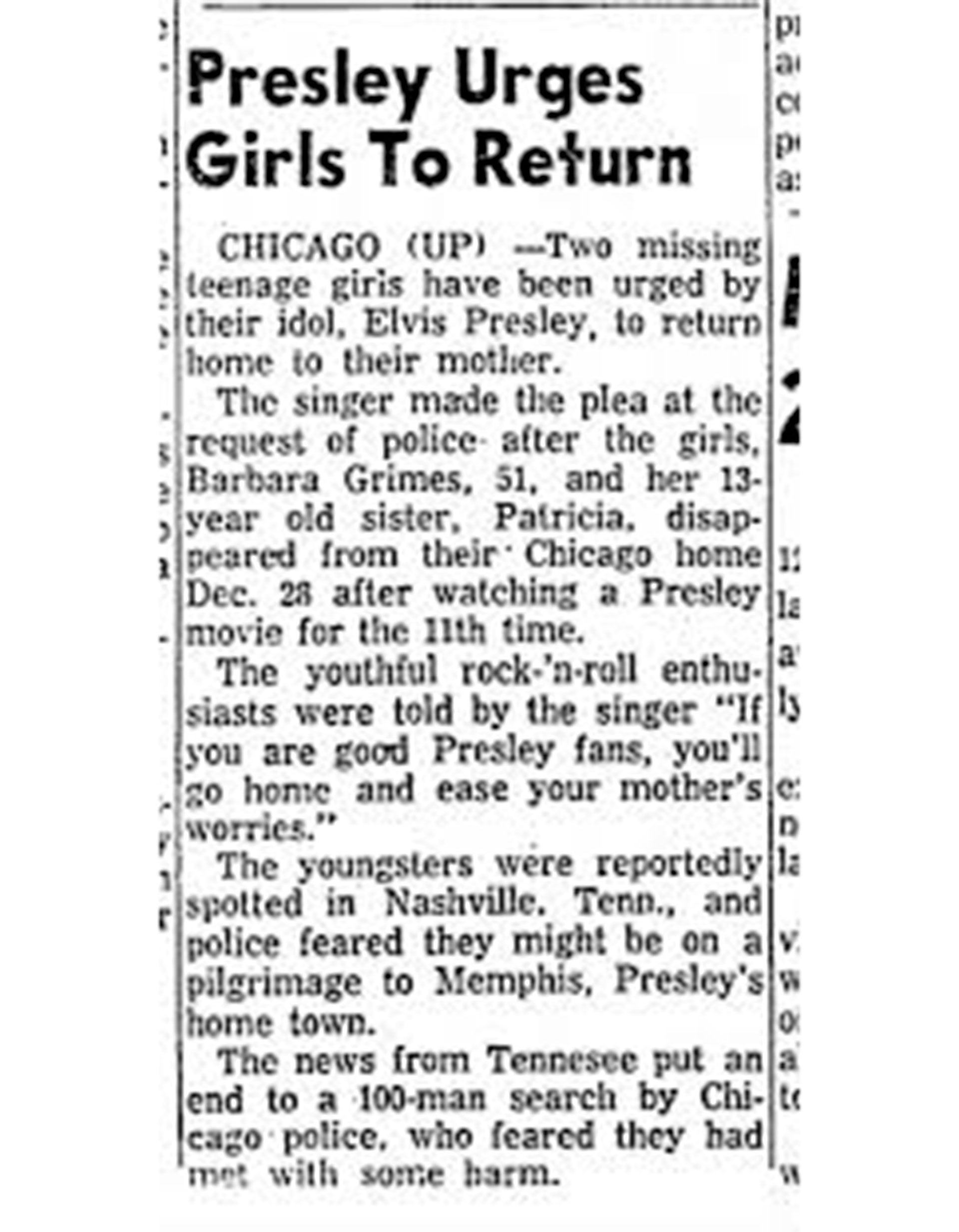
This Day in History: Barbara and Patricia Grimes—aged 15 and 12, disappeared on this day in 1956. The two sisters went to see the Elvis Presley film Love Me Tender at the Brighton Park theater at around 7:30 p.m. They were big Elvis fans so they stayed for the second screening of Love Me Tender, which meant that they would be getting back home at around 11:45 p.m.

"They disappeared while traveling from the Brighton park movie theater to their home at McKinley park which was about a mile and a half in distance. Their disappearance initiated one of the largest missing persons investigations in the history of Chicago. A city wide search was in place for these 2 girls. Rivers and canals were searched, door-to-door searches, and flyers were being put out looking for these young girls. Many teenagers said that they saw the 2 girls get in a car driven by a young man that looked like Elvis Presley." Source

The girls' nude bodies were discovered alongside a deserted road in Willow Springs on January 22, 1957.

Although the sisters' autopsy reports concluded they had been murdered within five hours of their last confirmed sighting, and that both girls had died of secondary shock, numerous individuals attested to having seen the girls alive in the weeks between the night of December 28 and the subsequent discovery of their bodies.

The murder of the Grimes sisters has been described by authors as a crime that "shattered the innocence" of Chicago. This case is also acknowledged as one of the most labor-intensive missing person and murder investigations in Cook County, and remains one of Chicago's most infamous cold cases.


Sunday, October 9, 2022

The Boy on the Milk Carton on This Day in History

This Day in History: Etan Patz was born on this day in 1972. Etan Patz was an American boy who disappeared on his way to his school bus in the SoHo neighborhood of Lower Manhattan in 1979. His disappearance helped launch the missing children movement, which included new legislation and new methods for tracking down missing children. Several years after he disappeared, Patz was one of the first children to be profiled on the "photo on a milk carton" campaigns of the early 1980s. In 1983, President Ronald Reagan designated May 25—the anniversary of Etan's disappearance—as National Missing Children's Day in the United States.

"The New York Post writes that Etan's body has never been found. In 2019, his parents decided to permanently leave their SoHo home, 40 years after his disappearance. They had never moved or changed their phone number, just in case their son returned." Source 

In 2012, a Pedro Hernandez confessed to killing the boy, however, the police at that time had no physical evidence to corroborate his confession.

Friday, September 23, 2022

The Mysterious Disappearance of David Lang on this Day in History


This Day in History: David Lang mysteriously disappeared on this day in 1880. David Lang was a farmer who lived near Gallatin, Tennessee. On September 23, 1880 David Lang vanished into thin air while walking through a field near his home. His wife, children, and two people who were passing by in a buggy all witnessed his disappearance.

Frank Edwards wrote of this in his book Stranger Than Science:

"David Lang had not taken more than half a dozen steps when he disappeared in full view of all those present. Mrs. Lang screamed. The children, too startled to realize what had happened, stood mutely. Instinctively, they all ran toward the spot where Lang had last been seen a few seconds before. Judge Peck and his companion, the Judge's brother-in-law, scrambled out of their buggy and raced across the field. The five of them arrived on the spot of Lang's disappearance almost simultaneously. There was not a tree, not a bush, not a hole to mar the surface. And not a single clue to indicate what had happened to David Lang.

The grownups searched the field around and around, and found nothing. Mrs. Lang became hysterical and had to be led screaming into the house. Meanwhile, neighbors had been altered by the frantic ringing of a huge bell that stood in the side yard, and they spread the alarm. By nightfall scores of people were on the scene, many of them with lanterns. They searched every foot of the field in which Lang had last been seen a few hours before. They stamped their feet on the dry hard sod in hope of detecting some hole into which he might have fallen -- but they found none.

David Lang was gone. He had vanished in full view of his wife, his two children, and the two men in the buggy. One second he was there, walking across the sunlit field, the next instant he was gone."

Over time, the grass around where Lang had disappeared turned yellow in a fifteen-foot diametric circle, leading to the belief that some form of energy had mysteriously transported him away.

Seven months later his children were said to have heard their father's voice imperceptibly calling out for help as they played near the spot of his disappearance. They never heard that voice again.

In the effort to debunk this story, the tale only becomes stranger. 

Ambrose Bierce, though largely forgotten now, was a popular author in the late 1800's. Many believe that the story of David Lang was lifted from Bierce's short story, "The Difficulty of Crossing a Field" published in 1893. Or did Bierce steal the story of Lang's disappearance? 

What makes this whole story stranger is that Ambrose Bierce, like the man in his story, and like David Lang...mysteriously disappeared himself. To this day, no one knows what happened to him.

The story does not end there. In 1999 an opera was composed called "The Difficulty of Crossing a Field." This opera was based on Ambrose Bierce's short story. The composer's name is DAVID LANG!. 

Wikipedia writes about this piece, "Also in 1999, Lang and playwright Mac Wellman based their opera The Difficulty of Crossing a Field on a short story by Ambrose Bierce, about an Alabama planter named Williamson who purportedly vanished while walking across a field in 1854. (Bierce's story reoccurs in urban-legend form, in which, coincidentally, the vanished man is often given the name David Lang.)"


Sunday, December 12, 2021

The Mysterious Disappearance of Dorothy Arnold on This Day in History


This day in history: American socialite and heiress Dorothy Arnold mysteriously disappeared in New York on this day in 1910. 

On the morning of December 12, 1910, Arnold informed her mother that she was going shopping for a dress. Mary Francis offered to go with her daughter, but Dorothy declined the offer, telling her mother she would call her if she found a suitable dress. According to the Arnold family, Dorothy had approximately $25–30 cash in her possession (approximately $694 to $833 in today's money). 

She went to one store to buy chocolates, and then another store to buy a book. The clerks who waited on Arnold in both stores later said that she was courteous and did not exhibit any unusual behavior.

Outside the bookstore, Arnold ran into a friend named Gladys King who recalled that the two spoke briefly about Marjorie's upcoming debutante party and that Arnold seemed to be in good spirits. King then excused herself to meet her mother for lunch. She recalled that Arnold told her she was going to walk home through Central Park. 

There were no published reports of Dorothy Arnold actually buying a dress.

By the early evening, Arnold had failed to return home for dinner. As she never missed meals without informing her family, the Arnolds became worried. They began calling Arnold's friends to find her whereabouts but no one had seen her. 

Fearing that their daughter's disappearance would draw unwanted media attention and could become socially embarrassing, the Arnold family didn't report Dorothy's disappearance to the police for weeks. It is speculated that the family was influenced by the 1909 disappearance of Adele Boas, a 13 year old girl who was reported missing from Central Park and later found to have run away to Boston. She later returned home. The Boas family, also prominent New Yorkers, were scandalized and shamed in the newspapers after the incident.

In an attempt to keep the incident out of the press, the Arnold family quietly contacted John S. Keith, a family friend and lawyer, the morning following Dorothy's disappearance. Keith arrived at the family home and searched Arnold's bedroom. He discovered that except for the outfit she was wearing, all of Arnold's clothes and other personal belongings were in her room. Keith also found personal letters with foreign postmarks in her desk, two folders for transatlantic ocean liners on the desk, and burned papers in the fireplace. The burned papers were presumed to be the rejected manuscripts Arnold submitted to McClure's magazine. Over the following weeks, Keith visited jails, hospitals and morgues in New York City, Philadelphia and Boston, but did not find any sign of Arnold. After Keith's search proved fruitless, he suggested that the Arnold family hire Pinkerton detectives to investigate.

The Pinkertons theorized that she may have eloped. 

By the end of January 1911, the NYPD said they still believed that Arnold was alive and would return on her own accord. Arnold's family, however, said they had come to believe that she was dead. Around this time, Francis Arnold told the press that he believed from the start that his daughter had been attacked and killed while walking home through Central Park and that her body had been thrown into the Central Park Reservoir. He cited two clues, which he would not publicly disclose, that confirmed his suspicions.

Police dismissed his theory because in the days leading up to Arnold's disappearance, the temperature in New York City had dropped to 21 degrees Fahrenheit and the reservoir had frozen solid. The police searched Central Park anyway but found no trace of Dorothy Arnold. When the reservoir thawed that spring, police searched the water but did not find a body.

Numerous theories and rumors regarding Arnold's disappearance continued. One theory was that Arnold had slipped on an icy sidewalk, struck her head and was in a hospital with total amnesia. 

Some of Arnold's family members and friends also said they believed that Arnold had committed suicide because of a failed relationship.

One of the more widespread rumors was that Arnold had become pregnant, had sought an abortion, had died during or after the botched procedure, and had been secretly buried or cremated. This rumor gained some credibility when, in early April 1916, an illegal abortion clinic operating out of the basement of a home in Bellevue, Pennsylvania was raided by police. The clinic was run by Dr. C.C. Meredith and became notoriously known as "The House of Mystery," after numerous women from the area went missing after visiting the clinic. One of the doctors who worked at the clinic, Dr. H.E. Lutz, testified to the New York County District Attorney that Dr. Meredith told him that Arnold had died there after experiencing complications from an abortion. Dr. Lutz claimed that, like many of the women who had undergone abortions at the clinic and died, her body was burned in the furnace.

While the district attorney said he believed that Arnold had died at the clinic, Francis Arnold said he thought the story was "...ridiculous and absolutely untrue." The Arnold family lawyer John S. Keith later told the media that two months after Dorothy Arnold disappeared, he got a tip from an attorney in Pittsburgh that she was in a local sanatorium. Keith and two other detectives traveled to Pittsburgh but discovered that the woman was not Arnold.

In April 1916, a convicted felon named Edward Glennoris claimed that he was paid $250 to bury the body of a young woman in December 1910. Further investigation proved his claim was false.

Years after Arnold disappeared, numerous alleged sightings from all over the U.S. were still being reported. Police continued to investigate the reports, but all proved to be false. The Arnold family also continued to receive letters from women claiming to be Dorothy Arnold. These were also investigated and also proved to be false. One such letter came from an attorney in California who claimed that Arnold was living as "Ella Nevins" in Los Angeles, a claim that her father disputed.

The case gained attention again on April 8, 1921, when "during a lecture in New York, Captain John H. Ayers of the Bureau of Missing Persons claimed that Dorothy Arnold's fate had been known to the Bureau and her family for some time. Ayers refused to elaborate and would not say if Arnold was alive or dead." The following day, Ayers claimed that he was misquoted and denied that Arnold's fate was known.

In the weeks following his daughter's disappearance, Francis Arnold spent approximately $250,000 trying to find his daughter. He continued to maintain that he believed Dorothy had been kidnapped and murdered on the day she disappeared or shortly thereafter.

"According to the National Missing and Unidentified Persons (NamUS) database, which is funded by the U.S. Department of Justice, more than 600,000 persons of all ages go missing every year, and approximately 4,400 unidentified bodies are recovered every year." Source