This day in history: On this day in 1959, Christine and Cliff Walker and their two children were murdered at their home in Osprey, Florida. The case is still unsolved.
Authorities believe that 24-year-old Christine Walker arrived at the family's farm home around 4 pm on Saturday, December 19, 1959, where she was raped, then murdered by gunshot. Her husband Cliff, 25, then arrived with their 3-year-old son Jimmie and 1-year-old daughter Debbie. Cliff was ambushed and killed by gunshot. Jimmie and Debbie were then murdered. Jimmie was shot, and Debbie was shot in addition to being drowned in the bathtub. The actual cause of death is unknown, and she could have been shot in the bathtub. News stories noted there were gifts around the Christmas tree.
Physical evidence left at the scene included a bloody cowboy boot, a cellophane strip from a Kool cigarette wrapper, and a fingerprint on the bathtub faucet handle.
A serial killer named Emmett Monroe Spencer confessed to the murders, but the confession was discredited by Sarasota County Sheriff Ross Boyer, who labeled Spencer a pathological liar. Spencer's confession was "determined to be cleverly constructed from real murders written up in newspapers and true-crime novels that he liked to read." In 1994, a bartender in Stroudsburg, Pennsylvania contacted the Sarasota County Sheriff's Office, claiming that one of her customers had boasted of killing the Walker family; this tip was never verified.
Police never identified a motive, and 587 people were suspects at one time or another.
In 2012, the Sarasota County Sheriff's Office began investigating possible links between the Walker family murders and Perry Smith and Richard "Dick" Hickock, who had been convicted and executed for the 1959 murders of the Clutter family in Holcomb, Kansas. The Clutter murders were the topic of Truman Capote's 1965 best-selling true crime book In Cold Blood. While that book devoted several pages to the Walker case, it dismissed a possible connection to Hickock and Smith, asserting that the two men had an alibi for that day.
In August 2013, the Sarasota County Sheriff's office announced they were unable to find a match between the DNA of either Perry Smith or Richard Hickock with the samples in the Walker family murder.
This day in history: 25 year-old Diane Maxwell, a phone operator for Southwestern Bell, was found raped and killed in a shack in Houston, Texas on this day in 1969.
On December 14, 1969, Diane Maxwell was walking to her job as a phone operator for Southwestern Bell, but never made it to the building. Later that day, a man by the name of William Bell noticed a man walking away from a shack. When Bell came to look in the shack, he found the raped, dead body of Maxwell and immediately notified police.
However, the case remained unsolved due to the lack of computer technology. In 1986, 17 years after the incident, investigators reopened the case, but could not solve it. The case remained closed until July 2003, 33 years after the murder was committed. A batch of forensics they had performed in 1969 was found by Houston police, who located James Ray Davis, a lifetime criminal. Davis was last convicted of kidnapping a young girl and was suspected to be the perpetrator of the Maxwell rape and murder. DNA evidence confirmed that he did rape her. Davis was convicted of first degree murder (the robbery, rape, and kidnapping statute of limitations had expired) shortly afterward, and was sentenced to life without parole.
In 2008, the case was featured in the Forensic Files episode "Brotherly Love" (see above).
This day in history: On this day in 1969, 22-year-old graduate student Betsy Aardsma was murdered by a single stab wound inside the Pattee Library at the Pennsylvania State University (Penn State) in University Park, Pennsylvania.
Though Aardsma's murder remains officially unsolved, local investigative journalists and two independent authors have published testimony and reports which strongly indicate Penn State geology professor Richard Haefner may have been responsible for her death, which has been described by one author as Pennsylvania's most infamous unsolved murder.
The evidence indicating Haefner's guilt of Aardsma's murder is circumstantial. Haefner was never charged with her murder, and died in 2002.
Aardsma's murder ultimately became a major factor in the creation of a university police force at Penn State. The years prior to her death had seen an increase in both violent crime, sexual assaults, and raucous student protests at the university, which had only a campus patrol to provide immediate law and order. Her death epitomized the need for increased public safety measures on the university campus, and a university police force was established in the early 1970s.
This day in history: On this day in 1969, the fully clothed body of a white female was located in a dense bushland off Mulholland Drive in Los Angeles, California by a 15-year-old boy who had been birdwatching. The victim had died of multiple stab wounds—predominantly inflicted to her neck—approximately two days before her body was discovered dumped in the ravine at the side of the drive. A tree branch had prevented her body from rolling fully down the ravine and into a 699-foot-deep canyon, and her body lay against this branch just 15 ft down the ravine.
In total, the victim had been stabbed 157 times.
The body had been informally known as "Sherry Doe" and officially as "Jane Doe 59."
In June 2015, the body had finally been identified as Reet Silvia Jurvetson, a Swedish-born Estonian-Canadian woman.
This day in history: The world's first Internet murder happened on this day in 1999. Bruce Miller was found dead at his junkyard in Mt. Morris, Michigan on November 8, 1999, killed by a 20 gauge shotgun. His wife Sharee Miller, convinced her online lover Jerry Cassaday to kill him (before later killing himself) was convicted of the crime.
The trial made national headlines; Miller's life was profiled on A&E American Justice, Investigation Discovery's Deadly Women and on the Oxygen Channel's true crime series Snapped. The case was the subject of a book, Fatal Error, by Kansas City Star reporter Mark Morris and Paul Janczewski. A television movie produced by Lifetime Television titled Fatal Desire, starring Eric Roberts and Anne Heche, was based on the case. There also was an episode on Forensic Files about this case ("Web of Seduction", season 8, episode 24). The case was covered in a 2017 episode of Murderous Affairs titled "Dead Silence." Miller also admitted her crimes to the show "2020" in February 2022. This case was also covered in an episode of Murder, Mystery & Makeup by Bailey Sarian.
This Day in History: One-year-old Antonio Santiago was murdered on this day in 2013, during an attempted robbery in Brunswick, Georgia. As Santiago and his mother, Sherry West, were returning home from the post office, they were confronted by two youths, 15-year-old Dominique Lang and 17-year-old De'Marquise Elkins. Elkins, who had previously shot another victim he tried to rob, pointed a gun at West and demanded money. When she did not comply he fired two .22-caliber bullets, one of which grazed her head, and the other of which went through her leg. He then shot Santiago in the face, killing him. The murder received national as well as international attention due to the victim's young age.
Lang pleaded guilty to attempted armed robbery, and was sentenced to eight years of probation. Elkins was tried and convicted in August 2013 and sentenced to life in prison without parole. He did not receive the death penalty because he was under 18 at the time of the crime. Several of Elkins's relatives were also convicted of, and pleaded guilty to, charges related to covering up the crime.
This Day in History: On this day in 2011, Brittany Norwood crushed her co-worker Jayna Murray's skull and severed her spinal cord in a brutal 2011 attack now known as the "Lululemon murder."
Statements by police officials and testimony during the trial indicated that on the evening of the murder, Murray and Norwood checked each others' bags for unpaid merchandise, a routine security procedure at Lululemon and other retail stores. Murray found a pair of pants in Norwood's bag, and called their manager after she left the store. The manager said she would deal with it in the morning. A few minutes later, Norwood called Murray to say she'd forgotten something, and asked Murray to return to the store and let her in. When Murray arrived, Norwood attacked her, moved her car, then staged the scene to look like a robbery, putting on a pair of men's shoes to track blood across the floor; tossing mops, broom, and chairs around the store; and finally cutting herself and binding her own wrists and ankles with zipties.
This crime was so savage that Jayna Murray had no fewer than 331 injuries on her body that came from at least five different weapons.
In January of 2012, Brittany Norwood was sentenced to life in prison for first degree murder.
This Day in History: "One of the darkest days in Connecticut history occurred today in 1780, as 19-year-old Revolutionary War deserter Barnett Davenport brutally murdered his employer and his entire family in what many historians recognize as the first documented mass murder in American history." Source
"To a casual historian, the name Barnett Davenport may seem obscure or even innocuous. But the bearer of that name became one of the most significant killers of whom you've never heard – when he was only 19. Years before the US met its first serial killers, Davenport became the the country's first mass murderer. He ferociously beat and killed multiple members of a family who had employed him, including their young granddaughter, leaving the victims as well as the rest of the living family members to burn as he escaped. His horrific actions on one cold night in 1780 changed the way people thought about crime and criminals at that time." Source
"Barnett Davenport was found guilty of murder and arson. He was sentenced to 40 lashes and to hang at Gallow’s Lane at Litchfield, CT, on May 8, 1780...Barnett Davenport’s brutal murder of the Mallory family ushered in a new era for the American justice system and the fledgling nation’s collective psyche in general. Having never dealt with a crime like this previously, no one knew quite how to handle it.
Colonial Americans were taught, and believed, that criminals were sinners who had lost their way and needed to be guided back to the flock. But after witnessing a crime as heinous and depraved as this, they had to consider the possibility that some criminals were so evil they were beyond redemption." Source
This day in history: Glenis Carruthers, a student teacher, was strangled to death on Clifton Down in Bristol, England, after leaving her 21st birthday party on this day (January 18) in 1974.
"In January 1974, 20-year old Glenis Carruthers, from Amersham in Buckinghamshire, drove with her friend Sandra Hardyman from Bedford College, where they were both third-year students, to Sandra’s hometown of Bristol, to attend a party being held in honor of Sandra’s 21st birthday. The party took place at Sandra’s family home on Worcester Crescent in the Clifton area of the city, a quiet and affluent region with a large student population. There were around 40 people of all ages in attendance, including grandparents, parents and Sandra’s friends. Around 10pm, Glenis left the party for unknown reasons without telling anyone....The reasons for Glenis leaving the party remain a mystery.
After leaving the party, Glenis took a short walk through dark streets; there was an energy crisis in the UK at the time due to Prime Minister Edward Heath’s ongoing disputes with miners, which led to rolling power cuts, with many homes and businesses being lit with emergency generators and candles. This meant around half of all streetlights were not operational at the time, and the areas around the party and nearby Bristol Zoo, not well lit at the best of times, were plunged into near total darkness. Glenis’ father would later say 'I am now convinced that but for the absence of street lighting Glenis would have been alive today.' After walking around 0.4 miles (a distance which would typically take only about 7 minutes) Glenis came upon a grassy area by the entrance to Bristol Zoo Gardens, with a nearby telephone booth. It was here that Glenis was murdered.
Around 16,000 people have been interviewed in relation to Glenis’ murder, but no suspects were ever identified. The case was reopened in 2010 by a cold case review team, but no new leads have developed." Source
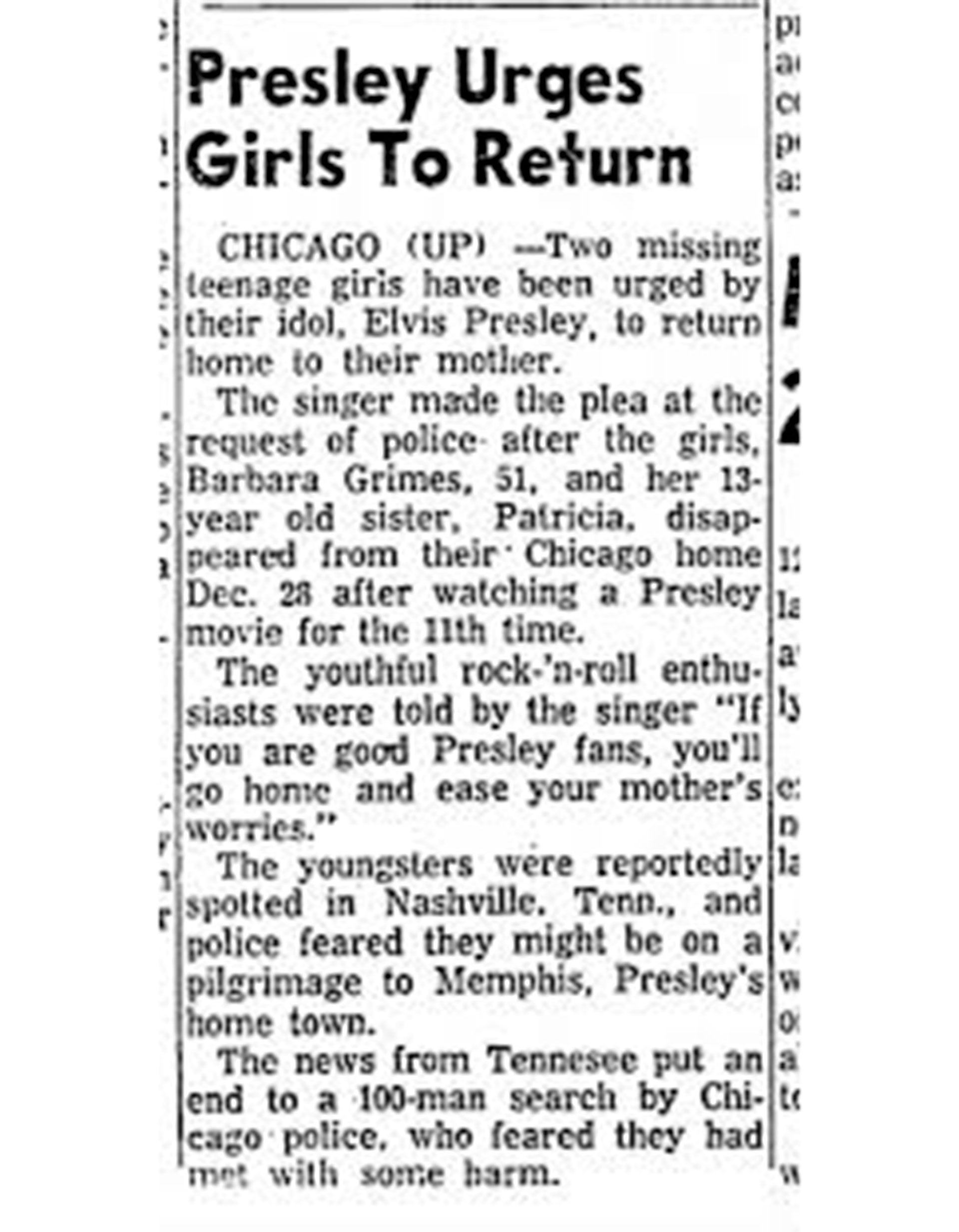
This Day in History: Barbara and Patricia Grimes—aged 15 and 12, disappeared on this day in 1956. The two sisters went to see the Elvis Presley film Love Me Tender at the Brighton Park theater at around 7:30 p.m. They were big Elvis fans so they stayed for the second screening of Love Me Tender, which meant that they would be getting back home at around 11:45 p.m.
"They disappeared while traveling from the Brighton park movie theater to their home at McKinley park which was about a mile and a half in distance. Their disappearance initiated one of the largest missing persons investigations in the history of Chicago. A city wide search was in place for these 2 girls. Rivers and canals were searched, door-to-door searches, and flyers were being put out looking for these young girls. Many teenagers said that they saw the 2 girls get in a car driven by a young man that looked like Elvis Presley." Source
The girls' nude bodies were discovered alongside a deserted road in Willow Springs on January 22, 1957.
Although the sisters' autopsy reports concluded they had been murdered within five hours of their last confirmed sighting, and that both girls had died of secondary shock, numerous individuals attested to having seen the girls alive in the weeks between the night of December 28 and the subsequent discovery of their bodies.
The murder of the Grimes sisters has been described by authors as a crime that "shattered the innocence" of Chicago. This case is also acknowledged as one of the most labor-intensive missing person and murder investigations in Cook County, and remains one of Chicago's most infamous cold cases.
This Day in History: On November 21, 1987, 19-year-old Kathy Bonney was killed by her father Tom in Camden County, North Carolina. The case gained media attention not only due to the brutal manner in which the killing had been carried out, but also because Tom Bonney pleaded not guilty by reason of insanity on the grounds that he had dissociative identity disorder and that an evil personality state was in control at the time of the killing. The book Deadly Whispers by Ted Schwarz, a television movie of the same name and an episode of Swamp Murders are based on the case.
On November 21, 1987, some time after 7 p.m., Tom Bonney left the family home with his daughter Kathy, ostensibly to look at a truck which was for sale. Kathy's sister Susan saw Tom and Kathy in the car at a nearby 7-Eleven store and driving away soon after. Bonney drove across the North Carolina state border; he would later state that the killing had taken place in North Carolina. According to his defense attorneys, an argument between father and daughter over her lover ensued, in which Kathy swore at her father and reached for a gun he carried in his vehicle, which went off. Her comments caused him to have a flashback to his childhood, and a personality referred to as “Demian” took control of him. Tom Bonney shot his daughter 27 times and dumped her body alongside the Dismal Swamp Canal.
After about two hours Tom Bonney returned home alone and asked if anyone knew where Kathy was. Susan went out to the 7-Eleven store to look for Kathy; Tom Bonney did not participate in the search.
A jury found Tom Bonney guilty of first-degree murder on November 25, 1988, after a seven-week trial, and sentenced him to death on November 30.
Bonney appealed the verdict, and the North Carolina Supreme Court voided the death sentence on June 12, 1991, although the murder conviction was upheld.
Bonney was eventually sentenced to life in prison by Camden County Superior Court on October 16, 2007.
This Day in History: A mass murder event occurred on this day in 1961 aboard the Bluebelle. Bluebelle was a 60-foot twin-masted sailing ketch based out of Fort Lauderdale, Florida.
"On November 8, 1961, the ship set sail with the Duperrault family safely on board. One Julian Harvey was the captain of the vessel, and he had brought his wife Mary Dene along for the ride too. For four days, then, the trip went just as the Duperraults had planned." Source
Late one night on the return voyage, Harvey allegedly killed his wife, Dr. and Mrs. Duperrault, and two of the children, Brian and Renee.
It is believed Harvey planned to kill his wife to collect on her $20,000 double indemnity insurance policy, but he was observed by Dr. Duperrault, and then had to kill him and his family who may have witnessed his murder. Harvey scuttled (deliberately sunk) the boat and departed in a dinghy.
There was one survivor, 11-year-old Terry Jo Duperrault. She had been rescued at sea three and a half days after the incident, having drifted upon a small cork dinghy without food, water or shelter for approximately 82 hours.
Terry Jo's survival led to her becoming known within international media as the "Sea Waif" and the "Sea Orphan".
Julian Harvey would eventually commit suicide days later.
This Day in History: Sylvia Likens succumbed to her injuries on this day in 1965.
Sylvia Marie Likens (January 3, 1949 – October 26, 1965) was an American teenager who was tortured and murdered by her caregiver, Gertrude Baniszewski, many of Baniszewski's children, and several of their neighborhood friends. This abuse incrementally lasted for three months before Likens died from her extensive injuries and malnourishment on October 26, 1965, in Indianapolis, Indiana.
Likens was increasingly neglected, belittled, sexually humiliated, beaten, starved, lacerated, and dehydrated by her tormentors. Her autopsy showed 150 wounds across her body, including several burns, scald marks and eroded skin. Through intimidation, her younger sister, Jenny, was occasionally forced to participate in her mistreatment. The official cause of her death was determined to be a homicide caused by a combination of subdural hematoma and shock, complicated by severe malnutrition.
Gertrude Baniszewski, her oldest daughter, Paula, her son, John, and two neighborhood youths, Coy Hubbard and Richard Hobbs, were all tried and convicted in May 1966 of neglecting, torturing, and murdering Likens. At the defendants' trial, Deputy Prosecutor Leroy New described the case as "the most diabolical case to ever come before a court or jury" and Gertrude's defense attorney, William C. Erbecker, described Likens as having been subjected to acts of "degradation that you wouldn't commit on a dog" before her death.
After eight hours of deliberation, the jury found Gertrude Baniszewski guilty of first-degree murder. She was sentenced to life imprisonment but was released on parole in 1985. Paula was found guilty of second-degree murder and was released in 1972; Hobbs, Hubbard, and John were found guilty of manslaughter and served less than two years in the Indiana Reformatory before being granted parole on February 27, 1968.
The torture and murder of Sylvia Likens is widely regarded by Indiana citizens as the worst crime ever committed in their state and has been described by a senior investigator in the Indianapolis Police Department as the "most sadistic" case he had ever investigated in the 35 years he served with the Indianapolis Police.
Valerie Percy, 21, daughter of U.S. Senate candidate Charles H. Percy, was murdered in the family mansion in the Chicago suburb of Kenilworth, Illinois on this day in 1966. She had been stabbed to death in her bed. Percy would win election to the Senate in November, but nobody would ever be charged with the murder, and the crime would remain unsolved at the time of his death 45 years later. In 2014, a new book on the murder would identify the late William Thoresen III, who lived with his wealthy family less than two blocks from the Percy home, as the likely suspect. Ironically, Thoresen suffered a fate similar to that of Miss Percy, murdered while lying in his bed.
Also, Secretary-General of the United Nations, Dag Hammarskjöld, was killed in a plane crash on this day in 1961. New evidence supports a theory that the pioneering U.N. secretary general was assassinated.
"Questions surrounded the crash from the first. For one thing, writes Susan Williams in her 2011 book Who Killed Hammarskjold?, the British high commissioner at Ndola, Lord Alport, showed little concern after the U.N. plane failed to land at its scheduled time, instead insisting that Hammarskjold had decided to go elsewhere. Then there was the fact that search for the plane’s wreckage and crash site didn’t begin for hours after the crash, though witnesses had reported seeing a great flash in the sky soon after midnight.
Local residents in the area had seen a second plane in the sky that night, but their testimony was discounted or ignored by colonial authorities, the Guardian reported in 2011. The crash’s sole survivor, U.N. security officer Harold Julien, also spoke before he died of an explosion on board the plane, but the authorities assumed he was too ill and sedated to be taken seriously.
Two days after Hammarskjold's death, former U.S. President Harry Truman insinuated to reporters that the U.N. leader had been assassinated, saying he 'was on the point of getting something done when they killed him. Notice that I said _when they killed him._'" Source
There is also evidence suggesting the plane was shot down. A CIA report claimed the KGB was responsible.
This day in history: A young American woman named Grace Brown was drowned by her boyfriend, Chester Gillette, on Big Moose Lake, New York, after she told him she was pregnant on this day in 1906.
The events and trial of the suspect attracted national newspaper attention.
Brown's life has inspired such fictional treatments as Theodore Dreiser's 1925 novel An American Tragedy, and Jennifer Donnelly's 2003 novel A Northern Light. The murder was analyzed and explored in two non-fiction books, both published in 1986: Adirondack Tragedy: The Gillette Murder Case of 1906, written by Joseph W. Brownell and Patricia A. Wawrzaszek, and Murder in the Adirondacks: An American Tragedy Revisited, by Craig Brandon.
"On July 11, 1906, Miss Brown, 20, climbed into a boat with her boyfriend, Chester Gillette. They rowed onto Big Moose Lake in the Adirondacks, where Mr. Gillette bludgeoned Miss Brown with a tennis racket and pushed her overboard, knowing she could not swim. After her bruised body was plucked from the water the next day, an autopsy showed she was several months pregnant. The police also found her desperate letters to Mr. Gillette, 23, saying she knew he was dating other women, and was terrified he would run off." Source
Gillette’s trial in the village of Herkimer was the biggest the area had ever known, drawing reporters from around the country and made front-page news all over. The trial lasted three weeks, and resulted in a guilty verdict for Gillette for the premeditated murder of Brown; he was sentenced to death. The New York Court of Appeals affirmed the conviction, and Governor Charles Evans Hughes refused to grant clemency.
Gillette was executed on March 30, 1908, in Auburn Correctional Facility by electrocution.
28 year-old bartender Kitty Genovese was murdered on this day in 1964. Two weeks after the murder, the New York Times published an article erroneously claiming that 38 witnesses saw or heard the attack, and that none of them called the police or came to her aid.
The incident prompted inquiries into what became known as the bystander effect, or "Genovese syndrome", and the murder became a staple of U.S. psychology textbooks for the next four decades. However, researchers have since uncovered major inaccuracies in the New York Times article. Police interviews revealed that some witnesses had attempted to call the police.
In 2007, an article in the American Psychologist found "no evidence for the presence of 38 witnesses, or that witnesses observed the murder, or that witnesses remained inactive". In 2016, the Times called its own reporting "flawed", stating that the original story "grossly exaggerated the number of witnesses and what they had perceived".
Tyler Curtis at FEE wrote an interesting article on this:
In the first part of Seinfeld’s finale, Jerry and his friends Elaine, George, and Kramer witness a carjacking. Instead of intervening to protect the victim, they stand by laughing and filming the incident. They don’t even contact the police. When a cop finally does show up, however, the group finds themselves under arrest for violating something called the “Good Samaritan law,” a statute that requires onlookers to assist others in an emergency situation.
What Is the Bystander Effect?
The Good Samaritan law was fictional, of course, but it was based on a legitimate societal concern. If, for example, there’s a mugging, an assault, a rape, or someone suffers a heart attack, can private citizens be trusted to take action without being compelled by law? Many believe they cannot. One of the reasons for this lack of faith is the so-called “bystander effect.”
The Bystander Effect is a social-psychological phenomenon in which an individual feels discouraged from helping a victim if there are other individuals nearby. The more people present, so the theory goes, the less likely it is that any of them will step in. This is because each witness experiences what psychologists call a “diffusion of responsibility.” If an individual believes another person will intervene, he may not feel responsible for doing so. And if nobody intervenes at all, a bystander may feel free to go along with the crowd, thus absolving himself of personal responsibility altogether.
How Real Is the Bystander Effect?
Research into the bystander effect began in earnest after the brutal rape and murder of Kitty Genovese in 1964. Initial reporting by TheNew York Times held that 38 witnesses watched the attack but did not intervene or even call the police. The story was widely circulated in the media, but later research revealed that it was mostly false. Far fewer people witnessed the attack than was first reported, at least one of the witnesses did contact the police, and some of the witnesses only heard screams but could not actually see the murderer or his victim.
Far from discouraging individuals from helping, the presence of bystanders actually increased the probability that someone would intervene.
Nonetheless, the psychology profession has maintained that the bystander effect is a common issue and is supposedly bolstered by decades of scientific experimentation. However, new research suggests that the situation is much more complicated than previously assumed. After reviewing more than 200 videos of real-life altercations in which bystanders were present, a recent study revealed that at least one bystander intervened 91 percent of the time. Far from discouraging individuals from helping, the researchers concluded, the presence of bystanders actually increased the probability that someone would intervene, precisely the opposite of what the theory of the bystander effect would predict.
A multitude of previous studies has yielded similar results. As Brit Garner notes in a video for SciShow Psych,
A 2011 meta-analysis of more than 50 studies also showed that if the situation is dangerous, like if the perpetrator is still there, people are more likely to help if there are bystanders.
In other words, having an audience encourages heroism.
Cultural Cynicism and Personal Virtue
Despite these findings, if you ask the average person, they will probably tell you that people cannot be trusted to help others during an emergency. This perception seems to be based on anecdotal evidence, not empirical evidence. Writing at the Daily Collegian, Lauren Sointu listed a couple of instances in which internet users observed horrific attacks on live video and yet did nothing. Sointu declared,
Countless other instances like this happen every day, and most of the time, as ‘digital bystanders,’ we do nothing.
No evidence was cited to back up this assertion.
Of course, it would be unreasonable to assume that bystanders will offer help during a crisis 100 percent of the time. But as the most recent study of real-life attacks demonstrates, bystanders will intervene more often than not. So why are people so cynical about this?
It may have to do with what psychologists Amos Tversky and Daniel Kahneman called the availability heuristic:
[P]eople estimate the probability of an event or the frequency of a kind of thing by the ease with which instances come to mind…[B]ecause it is recent, vivid, gory, distinctive, or upsetting — people will overestimate how likely it is in the world.
When a person is attacked on the street and onlookers do not take action, this naturally infuriates us, but it also makes us believe that it’s more common than it actually is.
In reality, when faced with an emergency situation, most people will at least attempt to help those in need. And they will do so even when the danger is not immediately in front of them. Every year, millions of people donate billions of dollars to charity. Some donate their blood, some their organs, and others donate their time and labor. They do this not for recognition or special plaudits, nor because they are forced to by some law or government agency but because they’ve chosen to follow the biblical injunction to love their neighbors.
Standing behind bars after refusing to assist the man being carjacked, George Costanza asked rhetorically, “Why would we want to help people?” Perhaps he should have consulted the Good Samaritan.
Tyler Curtis works as a lender at a community bank in Missouri. He also holds an undergraduate degree in Economics from the Missouri University of Science and Technology.
This article was originally published on FEE.org. Read the original article.
This day in history: 26 year-old Mark Gleeson died on this day in 1996 while trying to cure his sleeping. In order to cure his snoring, the burly maintenance worker shoved tampons up his nose and taped them there so they wouldn't come out. He died from suffocation, with sleeping pills adding to his breathing difficulties.
Snoring can be deadly, but that is usually because the person doing the snoring ends up getting killed. According to a news story in 2008 in the Calgary Sun, it was reported that Kevin Martin, a man irritated by another man’s snoring in a homeless shelter led to a fist fight which resulted in the death of the man who was allegedly snoring.
One Chinese university student in 2010 stabbed his sleeping roommate to death because he snored too much.
A prisoner in Dublin killed his cellmate in 2000 because of his snoring.
Also in Ireland, after 26 years of marriage, Sylvia O'Doyle shot her husband because of his snoring.
A woman killed her boyfriend in Bishopville, South Carolina in 2007 because of snoring. She shot him three times.
Old West outlaw John Wesley Hardin once killed a man because of his snoring.
In 2019, a Florida woman shot her boyfriend because he was snoring too loudly.
In 2018, it was reported that Enrique Leyva, 47, smothered 92-year-old Veronica Ivins with a pillow in New York City because of her snoring.
Perhaps these deaths could have been avoided with an anti-snoring t-shirt. Since snoring mostly occurs with people sleeping on their back, you can actually buy shirts with pockets sewn onto the back of the t-shirt where you place tennis balls in those pockets so that the wearer will have an uncomfortable awakening if they try to flip on their back.
This day in history: Jonelle Matthews disappeared near Greeley, Colorado on this day in 1984. The 12 year-old's remains were discovered on July 24, 2019, by construction workers putting in a new pipeline 15 miles from her home.
While the search was going on, Steve Pankey, a former Idaho governor candidate, made himself a person of interest by making allegedly incriminating statements and also discussing information about the crime the police had withheld from the public. Once Jonelle’s remains were discovered in 2019, the police accused and arrested Pankey for the murder. Source
Steven Pankey, a youth pastor, started acting strange following the disappearance of Jonelle Matthews. Pankey's ex-wife, Angela Hicks, said they went on a trip on December 22 to visit family members. She also said this trip was unexpected. Hicks said they returned to Greeley on December 26 and that Pankey took an unusual interest in the disappearance. She said that on their return trip, Pankey "uncharacteristically listened to the radio, searching for news of the girl's disappearance". She also said that after their return, Pankey forced her to read to him newspaper articles concerning the case. According to the 2020 indictment statement, shortly following their return to Greeley, Pankey started digging in their yard. At about that time, a car stored on their property caught fire and the burned car "was disposed of at a salvage yard".
A few months following Jonelle's disappearance, Pankey attended a church service where a minister claimed that Jonelle would be found safe. Hicks claimed to have heard Pankey muttering in response, accusing the minister of being a false prophet. In 2008, Pankey's son was murdered. At his son's funeral, Hicks reportedly heard Pankey say, "I hope God didn't allow this to happen because of Jonelle Matthews."
The police announced that Pankey had long been a suspect in the case. Pankey repeatedly claimed to have knowledge of the crime and had asked "for immunity in exchange for information". The criminal indictment said that he "intentionally inserted himself in the investigation many times over the years claiming to have knowledge of the crime which grew inconsistent and incriminating over time". Pankey had claimed that on the evening of Jonelle's abduction, a rake was used to cover up tracks left in the snow. He also claimed to have watched students walking home from the middle school which Jonelle attended.
Pankey gave an interview to the Times-News and said he was being framed by the police because of his sexuality, identifying himself as a "celibate homosexual". In 2018, Pankey had campaigned for the position of governor of Idaho. His campaign website said that Pankey has studied criminal justice.
Steve Pankey is being held at the Weld County Jail on a $5 million cash-only bond.
Today in History: The Hope Diamond was donated to the Smithsonian Institution by New York diamond merchant Harry Winston on this day (December 10) in 1958. The Hope Diamond is one of the most famous jewels in the world, with ownership records dating back almost four centuries. It is worth between $200–$350 million USD. The Hope Diamond is also said to be under a curse. An article entitled "Hope Diamond Has Brought Trouble To All Who Have Owned It" appeared in the Washington Post in 1908. A New York Times article appeared in 1911 gave a list of supposed cases of ill-fortune:
Jacques Colet bought the Hope Diamond from Simon Frankel and died by suicide.
Prince Ivan Kanitovski bought it from Colet but was killed by Russian revolutionists.
Kanitovski loaned it to Mlle Ladue who was "murdered by her sweetheart."
Simon Mencharides, who had once sold it to the Turkish sultan, was thrown from a precipice along with his wife and young child.
Sultan Hamid gave it to Abu Sabir to "polish" but later Sabir was imprisoned and tortured.
Diamond guardian Kulub Bey was hanged by a mob in Turkey.
A Turkish attendant named Hehver Agha was hanged for having it in his possession.
Tavernier, who brought the stone from India to Paris was "torn to pieces by wild dogs in Constantinople."
King Louis gave it to Madame de Montespan whom later he abandoned.
Nicholas Fouquet, an "Intendant of France", borrowed it temporarily to wear it but was "disgraced and died in prison."
A temporary wearer, Princess de Lamballe, was "torn to pieces by a French mob."
Jeweler William Fals who recut the stone "died a ruined man."
William Fals' son Hendrik stole the jewel from his father and later died by suicide.
Some years (after Hendrik) "it was sold to Francis Deaulieu, who died in misery and want."
The Hope Diamond is also blamed for the beheadings of Louis XVI and Marie Antoinette and the rape and mutilation of the Princesse de Lamballe during the French Revolution.
Some however believe that the stories are fabricated to enhance the stone's mystery and appeal, since increased publicity usually raised the gem's value and newsworthiness (though one wonders why anyone would buy a gem that would lead to their demise.)
The legend of the curse includes deaths of numerous other characters who had been previously unknown: Diamond cutter Wilhelm Fals, killed by his son Hendrik, who stole it and later committed suicide; Francois Beaulieu, who received the stone from Hendrik but starved to death after selling it to Eliason; a Russian prince named Kanitowski, who lent it to French actress Lorens Ladue and promptly shot her dead on the stage, and was himself stabbed to death by revolutionaries; Simon Montharides, who sold the diamond, was hurled over a precipice with his family. However, the existence of only a few of these characters has been verified historically, leading researchers to conclude that most of these persons are fictitious.
Other famous cursed jewels are The Black Prince's Ruby, the Koh-i-Noor diamond on Queen Elizabeth's crown ["he who owns this diamond will own the world, but will also know all its misfortunes. Only God or woman can wear it with impunity"], the Delhi Purple Sapphire, the Sancy Diamond, Elizabeth's Taylor's La Peregrina Pearl, and The Black Orlov, The Regent Diamond [which brought Napoleon down].
Today in History: The "Toy Box Killer" David Parker Ray was born on this day (November 6) in 1939. He was called the “Toy Box Killer” because of his soundproofed truck trailer that he converted into a torture chamber which he referred to as his “toy box.” Once in his truck, Ray subjected his female victims to horrific torture. It is believed that he may have killed 60 people this way.
The "Toy Box" was actually quite expensive to set up. "To create his trailer, Ray allegedly spent upwards of $100,000 on torture devices and tools. Reportedly, Ray constructed elaborate contraptions to confine his victims, such as a fur-lined coffin and a makeshift pillory. He also crafted devices to electrocute his victims and others to hold them in place. In addition to medical instruments and sex toys, Ray’s box contained elaborate locks and pulleys to prevent his captives from escaping." Source
Ray appears to have had his daughter, Glenda Jean Ray, and Dennis Roy Yancy help him in his crimes. This makes one wonder why so many killers have three names: Gary Leon Ridgway, John Wayne Gacy, Paul John Knowles, Henry Lee Lucas, James Earl Ray, John Wilkes Booth, Lee Harvey Oswald, Mark David Chapman, Jared Lee Loughner, Wade Michael Page, James Eagan Holmes, Herman Webster Mudgett (Henry Howard Holmes or H. H. Holmes), James Francis Ray, Carl Eugene Watts, John Arthur Ackroyd, Stephen Wayne Anderson, William Dale Archerd, John Eric Armstrong, Arthur Gary Bishop, Oscar Ray Bolin, Gary Ray Bowles, Charles Anthony Boyd, Robert Eugene Brashers, Michael Bear Carson, Alfred Leonard Cline, Jessie Lee Cooks, Andrew David Edwards, Bobby Jack Fowler, William Clyde Gibson, David Alan Gore, Ricky Lee Green, Anna Marie Hahn, Dewayne Lee Harris, Bobby Joe Long, Lee Boyd Malvo, John Allen Muhammed, Gordon Stewart Northcott, Andrey Romanovich Chikatilo etc.
Another thing to ponder is why are so many serial killers born in November? A recent study found 26 serial killers were born in November, compared with an average of nine for other months. Derrick Bird, the Cumbria Killer was born on November, as was Ted Bundy, Charles Manson, Belle Gunness, Dennie Nilsen (the British Jeffrey Dahmer), Kristen Gilbert (the Angel of Death), Charles Starkweather, Carl Eugene Watts and Rosemary West.
Did you know: Most serial killers were born in the 1940s and 1950s.