Showing posts with label martyrs. Show all posts

Saturday, July 9, 2022

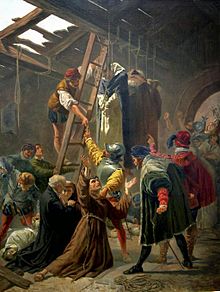
The Martyrs of Gorkum on This Day in History


This day in history: 19 Dutch Catholic clerics were hanged on this day (9 July) in 1572 in the town of Brielle by militant Dutch Calvinists during the 16th-century religious wars—specifically, the Dutch Revolt against Spanish rule, which developed into the Eighty Years' War.

It is easy to reflect on the bad things that Catholics have done throughout the ages, but when the tables were turned, the Protestants were often just as blood-thirsty. "During their imprisonment, the priests were tortured, subjected to countless indignities, and offered their freedom if they would deny the Real Presence of Christ in the Eucharist and the primacy of the pope. Despite a letter from Prince William of Orange ordering their release and protests from the magistrates of Gorkum, the men were thrown half-naked into the hold of a ship on July 6, and taken to Briel to be killed in the presence of a Protestant nobleman, Admiral Lumey, who was noted for his hatred of Catholicism. Their bodies, mutilated both before and after death, were callously thrown into a ditch." Source

Sabine Baring-Gould remarked on this in his Lives of the Saints: "The execution was done so carelessly that they were long in expiring. The cord supported one only by the chin, another had it in his mouth, and bit it like a bridle. Nicasius did not die till after the suu had risen. Before they were cold, the soldiers hacked the bodies and mutilated them in the most horrible manner. They fixed their noses, ears, and hands on their casques, or hung them over their pikes, and threw the bleeding morsels in the faces of the people who came to see the sight. The soldiers made the curious pay to enter the grange and feast their eyes on the horrible objects within. As the fat of those who have been hung was superstitiously believed to be useful in various diseases, the butchers cut up Jerome, who was fat, and extracted all the lard they could from his body, and sold it to quacks for the fabrication of unguents. On the roth, two ditches were dug, the bodies cast into them. There they remained till 1615, when they were exhumed and translated to Brussels. Portions of the relics have been given to many churches in Belgium."

Monday, June 27, 2022

Burned at the Stake on This Day in History

This day in history: The thirteen Stratford Martyrs were burned at the stake near London for their Protestant beliefs on this day in 1556. This day in history: The thirteen Stratford Martyrs were burned at the stake near London for their Protestant beliefs on this day in 1556. The executions were said to have been attended by a crowd of 20,000. According to John Foxe, "eleven men were tied to three stakes, and the two women loose in the midst without any stake; and so they were all burnt in one fire".

Death by burning has a long history as a form of public capital punishment, and many societies have employed it as a punishment for and warning against crimes such as treason, heresy and witchcraft.

The first recorded case of heretics being burnt in Western Europe in the Middle Ages occurred in 1022 at Orléans. Civil authorities burned persons judged to be heretics under the medieval Inquisition. Burning heretics had become customary practice in the latter half of the twelfth century in continental Europe, and death by burning became statutory punishment from the early 13th century. Death by burning for heretics was made positive law by Pedro II of Aragon in 1197. In 1224, Frederick II, Holy Roman Emperor, made burning a legal alternative, and in 1238, it became the principal punishment in the Empire. In Sicily, the punishment was made law in 1231, whereas in France, Louis IX made it binding law in 1270.

As some in England at the start of the 15th century grew weary of the teachings of John Wycliffe and the Lollards, kings, priests, and parliaments reacted with fire. In 1401, Parliament passed the De heretico comburendo act, which can be loosely translated as "Regarding the burning of heretics." Lollard persecution would continue for over a hundred years in England. The Fire and Faggot Parliament met in May 1414 at Grey Friars Priory in Leicester to lay out the notorious Suppression of Heresy Act 1414, enabling the burning of heretics by making the crime enforceable by the Justices of the peace. John Oldcastle, a prominent Lollard leader, was not saved from the gallows by his old friend King Henry V. Oldcastle was hanged and his gallows burned in 1417. Jan Hus was burned at the stake after being accused at the Roman Catholic Council of Constance (1414–18) of heresy. The ecumenical council also decreed that the remains of John Wycliffe, dead for 30 years, should be exhumed and burned. (This posthumous execution was carried out in 1428.)

Burning was also used during the witch-hunts of Europe, although hanging was the preferred style of execution in England and Wales. The penal code known as the Constitutio Criminalis Carolina (1532) decreed that sorcery throughout the Holy Roman Empire should be treated as a criminal offence, and if it purported to inflict injury upon any person the witch was to be burnt at the stake. In 1572, Augustus, Elector of Saxony imposed the penalty of burning for witchcraft of every kind, including simple fortunetelling. From the latter half of the 18th century, the number of "nine million witches burned in Europe" has been bandied about in popular accounts and media, but has never had a following among specialist researchers. Today, based on meticulous study of trial records, ecclesiastical and inquisitorial registers and so on, as well as on the utilization of modern statistical methods, the specialist research community on witchcraft has reached an agreement for roughly 40,000–50,000 people executed for witchcraft in Europe in total, and by no means all of them executed by being burned alive. Furthermore, it is solidly established that the peak period of witch-hunts was the century 1550–1650, with a slow increase preceding it, from the 15th century onward, as well as a sharp drop following it, with "witch-hunts" having basically fizzled out by the first half of the 18th century.