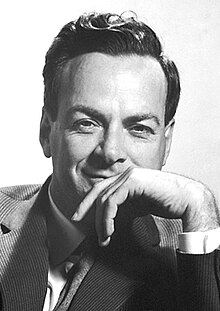
This day in history: American physicist and engineer Richard Feynman was born on this day in 1918.
From Leisa Miller:
Richard Feynman was one of the greatest physicists of the 20th century. He worked on the Manhattan Project during WWII, helped uncover the cause of NASA’s Challenger tragedy, and received the Nobel Prize for his work in quantum physics. A set of his lectures are available on Youtube – and they’re extremely approachable even for non-physicists.
I first heard about this dude while listening to the Great Courses’ Particle Physics for Non-Physicists. His name kept coming up, so naturally I had to Google him. I discovered that he had published an autobiography based on some conversations he had with a friend. The book is called Surely You’re Joking, Mr. Feynman!, and I ended up downloading it on Audible.
If you’re an academic with a resume the size of Feynman’s, I can’t help but assume you must have been an obsessive, humorless geezer. But as it turns out, Feynman was a character. The guy had a huge personality and a habit of getting into trouble. His book was thoroughly entertaining.
But the thing that delighted me most about the book was Feynman’s way of interacting with the world. He was a fun-loving guy, and everything he did was because he was curious about why things worked the way they did.
Feynman as a Tinkerer
When he was a kid, Feynman was really fascinated by radios. He played with voltages and frequencies and took apart electronics in his room all the time, sometimes even starting electrical fires (that he kept from his parents of course). Like most parents, his had a habit of “sending him outside to play” when he’d rather be tinkering and playing in his own way. But still, he tinkered on.
Gradually, he became known around his town as a bit of a handyman. At the age of 12 or so, he frequently found one-off jobs fixing people’s radios. Business was steady, even though he was doing this during the Great Depression. He gave everything a shot even when he wasn’t sure he’d be successful.
But it wasn’t just tinkering and repairing electronics that he learned in his life. After he’d already established himself as an apt physicist and professor, he learned to draw. He took lots of lessons from different people and practiced so much that he got pretty good. Really good, in fact. He was stubborn about his artwork being seen for itself and not as “a surprisingly nice drawing by a world-renowned physicist,” so instead of signing his work with his name, he used the pen name “Ofey.” He ended up selling several pieces of his art.
Feynman wasn’t all success though. He went through several bouts of depression, burnout, and imposter syndrome in his life. During one of these bouts, while bemoaning his inability to come up with any new ideas in his field, he had an insight into what was inhibiting his creativity:
Then I had another thought: Physics disgusts me a little bit now, but I used to enjoy doing physics. Why did I enjoy it? I used to play with it. I used to do whatever I felt like doing — it didn’t have to do with whether it was important for the development of nuclear physics, but whether it was interesting and amusing for me to play with. When I was in high school, I’d see water running out of a faucet growing narrower, and wonder if I could figure out what determines that curve. I found it was rather easy to do. I didn’t have to do it; it wasn’t important for the future of science; somebody else had already done it. That didn’t make any difference: I’d invent things and play with things for my own entertainment.
In the end, he decided to forget about proving himself or being brilliant. He resolved himself to just playing with physics for fun and thinking about inconsequential problems. This approach ended up soothing his burnout. And led him straight to the work that got him a Nobel Prize.
Feynman as a Role Model
The thing that I picked up from all of Feynman’s anecdotes and shenanigans is that his success stemmed from the way that he interacted with the world. Everything was interesting and fun to him. He was carefree and curious. And ultimately, he saw everything as a game. A game where the rules are knowable, yet not quite known.
I see a lot of people give advice to youngins like me about following our passions. “Do what you love,” they say. “Do what comes naturally. Do what you already have a knack for.”
But after reading Richard Feynman’s autobiography, I would rather follow the advice, “Make everything a game.”
Whatever you want to do or improve on can be turned into a game. You might not know the rules at first, but if you take up a playful attitude and persist, you’ll eventually uncover them. And once you know the rules, you can practice and play until you win.
When he lost his touch, Feynman used this “everything is a game” mindset to set himself back on the right path.
Feynman wasn’t born knowing how radios worked. He fiddled with them and learned the hard way. He stuck with his odd hobby even when his family badgered him, and even while the economy was sour. He didn’t have an innate talent for drawing either. He practiced and practiced until he got to a level where people wanted to buy his work. He taught himself how to draw (and many other things) as a grown man who had already established himself as “someone else.” And even when he lost his touch and felt like a downright loser, Feynman used this “everything is a game” mindset to set himself back on the right path.
Whether you want to learn something concrete like how to play the ukulele or how to run a business, or an abstract process like how to live a happy life, turn the whole endeavor into a game. Uncover the rules. Practice. And then play to win and achieve your goals. That’s how the great physicist Richard Feynman would have done it.
Reprinted from the author's personal blog.
Leisa Miller was a marketing coordinator at FEE. Driven by a desire for adventure, she moved to Warsaw, Poland in 2015 to work for a serial entrepreneur she met on the internet. 15 months and several hundred pierogi later, she came back to the States to hone her marketing skills at a tech startup in Charleston, South Carolina, before eventually making her way to Atlanta and joining the FEE team. In her free time, Leisa enjoys listening to 20th century classical music, learning languages, preparing Gongfu style tea, and swing dancing. You can follow her writing and personal projects on her website.
This article was originally published on FEE.org. Read the original article.


