Showing posts with label bible. Show all posts

Saturday, October 12, 2024

Steven T. Byington (and his Bible) on This Day in History


This day in history: Steven T. Byington died on this day in 1957. Byington was a Christian Anarchist and a Bible translator. The Watchtower society bought the rights to his Bible in 1972. The book "So Many Versions" remarks on the association below: 

"While this translation is completely independent from the NWT, we made a comparison of the two. Since it is published by the Jehovah's Witnesses, we were especially interested in those passages where the characteristic biases of the NWT [New World Translation] were evident. In the BLE [Bible in Living English], "Jehovah" is used in the OT but is not found in the NT. The word "God" is capitalized when referring to Jesus Christ, e.g., in John 1:1; 1:18; 6:45; 10:33. Where the NWT added the article "the" in brackets in Titus 2:13 and 2 Peter 1:1 and "other" in Colossians 1:16, 17, this translation does not, so that Jesus Christ can be identified with God in these passages. Furthermore, by its punctuation in Romans 9:5 it has clearly identified Christ as God: "Whose are the fathers, and from whom in the way of flesh comes the Christ, he who is over everything, God blessed forever-Amen!"
The designation "Holy Spirit" is capitalized, contrary to the NWT, and the words "cross" and "crucify" are used instead of "torture stake" and "impale." The only apparent reason for the Witnesses' publishing this translation is the translator's use of "Jehovah" for God's name in the OT, unless they also want to tone down the idiosyncrasies of their own translation." So Many Versions by Sakae Kubo and Walter F. Specht

Reply: Much of the above is over-stated. I fail to see where Christ is identified as God at Romans 9:5, and a clear understanding of the other Scriptures listed and its context removes any divinity from Christ, specifically at John 1:18: "Nobody ever has seen God; an Only Born God, he who is in the Father's bosom, he gave the account of him." A God that is "born" is definitely held as separate from that God that cannot be seen.

Consider also other Scriptures that waters down the deity of Christ:

"I will be what I will be" Ex 3:14
"God is your throne forever" Psalm 45:6
"Jehovah framed me first in line" Prov 8:22
"his origin being from of old, from ancient days." Micah 5:2
"they will look at the one they stabbed to death" Zech 12:10
Acts 20:28 footnote points to "the Lord's church"
"let all God's angels do him reverence" Heb 1:6
"God is your throne forever and ever." Heb 1:8
"firstborn of all creation" Col 1:15
"did not regard equality with God a prize" Php 2:6
"the beginning of God's creation" Rev 3:14

Byington had high sights set for his Bible in his Translator's Preface:

"It is customary for the preface of a new translation of the Bible to say that this translation is to be used only for certain limited purposes, and for most purposes the old version, or a conservative revision of it, should still be preferred. I say the contrary: I sincerely recommend that my translation be used in preference to the old for all purposes, under all circumstances where mine is available. I do not say, observe, that mine is better than any other that can or will be made; neither do I say that it is probable that mine will become everybody's Bible. What I have more right to expect, and what I am bound to be content with, is that when a Bible is made which shall be everybody's Bible, my work will have contributed part of the material which will go into it; what I am here recommending is that when a choice is to be made between mine and the old version, and a version better than either is not available, mine be chosen rather than the old."

It also ranked more accurate than the New American Standard Bible according to Colwell's apparatus:
See http://newworldtranslation.blogspot.com/2017/10/the-new-world-translation-is-best-new.html

Byington's Bible also has some very interesting renderings and makes for a pleasant read:

"The Scriptures say that God 'has put eternity into our minds.'
(Ecclesiastes 3:11)

"wild parties," Galatians 5:19-21

"Foolishness is bliss to a brainless man, but an intelligent man will
go straight." Proverbs 15:21

"A man's ignorance muddles his affairs and he flies out against
Jehovah." (Proverbs 19:3)

"I did not flinch from . . . teaching you publicly and from house to
house."-ACTS 20:20

"So I would have younger ones marry, bear children, keep house, not
give the opponent any opening toward abusive talk."-1 Timothy 5:11-
14, Byington.

"Then I will turn the lips of all the peoples clean, that they may
all call on Jehovah's name and cooperate in his service." Zeph 3:9

"There is no thumbing your nose at God." Gal 6:7, 8

"Jehovah will exterminate slippery lips, tongues that make great propositions" Psalm 12:3
Saturday, May 4, 2024

Bible Translator Charles Bray Williams on This Day in History


This day in history: Bible translator Charles Bray Williams died on this day in 1952. C.B. Williams should not to be confused with Bible translator Charles K. Williams.

Williams graduated from Wake Forest University in Winston-Salem NC, and was a Baptist minister. 

Williams stated, "Our aim is to make this greatest book in the world readable and understandable by the plain people."

Some have noted that there are many similarities between Williams New Testament and Goodspeed's New Testament (one of the greatest New Testament translations ever produced).

Here are some comparisons:

Revelation 5:10 "and have made them a kingdom of priests for our God, and they are to reign over the earth." Goodspeed

"and have made them a kingdom of priests for our God; and they will rule over the earth." Williams

While "over" is a better translation, most Bible use the word "on".

John 10:38  "But if I am doing so, even if you will not believe me, believe the deeds, that you may come to know and continue to know that the Father is in union with me and I am in union with the Father." Williams

"But if I am doing them, then even if you will not believe me, believe the things I do, in order that you may realize and learn that the Father is in union with me, and I am in union with the Father." Goodspeed

Both Goodspeed and Williams use the phrase "in union with" many times.

John 8:58 "Jesus said to them, 'I tell you, I existed before Abraham was born!'" Goodspeed

"Then Jesus said to them, 'I most solemnly say to you, I existed before Abraham was born.'" Williams

This is a better translation than the traditional "I am" as the "Greek at John 8:58 fits an idiom described by grammarian Kenneth McKay as the “Extension from Past”, which occurs when a present tense verb is “used with an expression of either past time or extent of time with past implications.” (A New Syntax of the Verb in New Testament Greek: An Aspectual Approach), p. 41, 42 (Source)

However, Williams was much more conservative/fundagelical in many passages.

For instance at John 1:1 where Goodspeed has "the Word was divine",  Williams goes overboard with the horrible rendering of "the Word was God Himself."

At John 1:18, where it should read, "No man hath seen God at any time; an only begotten god, who is in the bosom of the Father, he hath declared him", Williams has, "No one has ever seen God; the only son, Deity Himself, who lies upon His Father's breast, has made him known." 

Where Goodspeed would use "homage" in places like Matthew 2:2, Williams reverted back to the word "worship,"

Additionally, Williams insisted on continuous action of a Greek verb made Mark 1:5 sound like the people were being repeatedly baptized, "And people from all over Judea and everybody in Jerusalem kept on going out to him and being baptized by him in the Jordan River, confessing their sins."


Friday, December 1, 2023

New Testament Scholar N.T. Wright on This Day in History


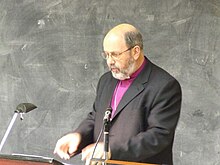
This day in history: Nicholas Thomas Wright FRSE was born on this day in 1948. N. T. Wright (or Tom Wright) is an English New Testament scholar, Pauline theologian and Anglican bishop. He was the bishop of Durham from 2003 to 2010. He then became research professor of New Testament and Early Christianity at St Mary's College in the University of St Andrews in Scotland until 2019, when he became a senior research fellow at Wycliffe Hall at the University of Oxford.

If you're a Bible collector like myself, then you know N.T. Wright for his criticism of the New International Version Bible. He wrote:

"In this context, I must register one strong protest against one particular translation. When the New International Version was published in 1980, I was one of those who hailed it with delight. I believed its own claim about itself, that it was determined to translate exactly what was there, and inject no extra paraphrasing or interpretative glosses. This contrasted so strongly with the then popular New English Bible, and promised such an advance over the then rather dated Revised Standard Version, that I recommended it to students and members of the congregation I was then serving. Disillusionment set in over the next two years, as I lectured verse by verse through several of Paul's letters, not least Galatians and Romans. Again and again, with the Greek text in front of me and the NIV beside it, I discovered that the translators had another principle, considerably higher than the stated one: to make sure that Paul should say what the broadly Protestant and evangelical tradition said he said. I do not know what version of scripture they use at Dr Piper's church. But I do know that if a church only, or mainly, relies on the NIV it will, quite simply, never understand what Paul was talking about." Wright, N. T. (2009). Justification : God's Plan and Paul's Vision. Downers Grove, Illinois: IVP Academic. pp. 51–52. ISBN 978-0-8308-3863-9.

This criticism is echoed by many others.

James Barr, in Modern English Bible Versions as a Problem for the Church_ Quarterly  Review/Fall 1994 writes:

"But this was not the end of the story. If on the one hand the conservative acceptance of the RSV as usable betokened a certain willingness to work along with the main currents of Christendom, there still existed the impulse to evangelical separatism, the unwillingness to do anything or accept anything that was not totally and purely "evangelical." The most important manifestation of this latter tendency is the so-called NIV, or New International Version, (New Testament, 1973; whole Bible, 1978).
The preface to this version begins with one of the most whopping falsehoods ever to be written into a Bible version by a group of 'Bible believers' such as the promoters of the version were, for it says that the people who worked on the version came from many denominations and this 'helped to safeguard the translation from sectarian bias.' The contrary is the case; the NIV was a sectarian project from the beginning. It was, as it itself says, planned by committees of the Christian Reformed Church and the National  Association of Evangelicals. The name International, as is well known to anyone experienced in the literature, is a code word meaning 'acceptable for conservatives and fundamentalists.' The reason for the existence of the NIV is not, and never was, that it was in any way better, or had better principles of translation, or better scholarship behind it, or that it had solved the problem of style as between archaic 'biblical' style and conversational "modern" style. Its reason for existence was purely and simply that it was produced by and for evangelicals and for them only."

One website, Poor and Misleading Translation in the New International Version (NIV) documents each error. It starts off by saying: "The...NIV translators, in many of the passages that challenged their doctrines and belief in inerrancy,...change(d) the Bible itself — altering the offending words and phrases to say what they think it ought to have said. In most cases of mistranslated NIV passages, there is a clear 'problem' with the original text related either to doctrine or to biblical inerrancy."


Saturday, June 10, 2023

Kenneth Taylor, the Creator of the "Living Bible" on This Day in History


This Day in History: Kenneth N. Taylor died on this day in 2005. Kenneth Nathaniel Taylor was an American publisher and author, better known as the creator of The Living Bible and the founder of Tyndale House, a Christian publishing company, and Living Bibles International. The Living Bible sold more than 40 million copies and was translated into more than 100 languages.

The problem with the Living Bible is that it is not a real Bible, it is a paraphrase. 

"The word 'paraphrase' is used quite commonly in English for restating something in other words. In Bible translation, a paraphrase has the same primary goal as a dynamic equivalence translation -- that is, to make the meaning as plain and understandable as possible for the reader. The idea of making a Bible paraphrase is based upon the notion that the Bible's own phrasing is too difficult for the average reader. In a paraphrase, the translator is able to remove difficult rhetoric, harmonize passages with one
another, and draw out implications for the reader. It is a perfect opportunity to make the Bible consistent with the translator's own theology.

For these reasons, a paraphrase should never be mistaken for a Bible. It should not be packaged as a Bible, sold as a Bible, or used in place of a Bible. It should pass under the name of its author, as a commentary or interpretation of the Bible. When, instead, it is handled as if it is a Bible translation, and the author's name is left off of the title page as if he or she had no role in determining the contents of the book, a terrible deception is happening." Truth in Translation by Jason Beduhn

Taylor acknowledged this in his preface: "There are dangers in paraphrases as well as values. For whenever the author’s exact words are not translated from the Greek, there is a possibility that the translator, however honest, may be giving the English reader something that the original writer did not mean to say. This is because a paraphrase is guided not only by the translator’s skill in simplifying but also by the clarity of his understanding of what the author meant and by his theology. For when the Greek is not clear, then the theology of the translator is his guide, along with his sense of logic, unless perchance the translation is allowed to stand without any clear meaning at all. The theological lodestar in this book has been a rigid evangelical position."

Michael Marlowe criticized this work, saying that it was "the dumbing-down of the Biblical text to a grade-school level" done "in keeping with the linguistic and educational trends of the time." He adds that "very few scholars have given any encouragement to its [The Living Bible] use, and most have either ignored it or have strictly warned against it." Moreover, he claims that the text of The Living Bible contains "venturesome interpretations that no scholar is likely to approve" and that "[i]n several places Taylor brazenly wrests the scripture so as to conform it to Arminian teachings about salvation."

The Living Bible has made some interesting choices in wording. An early edition had "You son of a bitch" at 1 Samuel 20:30.
Also:
"I am just some drunken bum" 1 Samuel 1:16
"You illegitimate bastard" John 9:34
"Come to bed with me my, darling." 2 Samuel 13:11
"The Reluctant Dragon" Isaiah 30:7
"Israeli" at Exodus 9:4;12:34;14:20;19:1 etc. 
"Hell is licking its chops in anticipation" Isaiah 5:14

The original text of the Living Bible is the great American Standard Version of 1901. The ASV correctly had JEHOVAH 7000 times instead of the horrible practice of replacing the name with LORD or GOD. The Living Bible only keeps Jehovah 313 times. 

One case of clear theological bias can be seen at John 1:1. "Before anything else existed, there was Christ, with God. He has always been alive and is himself God." This is not even remotely correct, and introduces a contradiction with Christ being WITH God and being "himself God." You can tell a translator's bias by how they treat this one passage.


Friday, March 24, 2023

The Wisest Fool in Christendom on This Day in History


 See also The King James Version Bible Companion: 100 Books to Download, and

Rare Olde English Bibles to Download (Tyndale, Matthews, Coverdale, AV1611) and
Over 60 Different Editions of the King James Bible to Download

For a list of all of my digital books on disk click here

James VI of Scotland is proclaimed King James I of England and Ireland, upon the death of Elizabeth I on this day in 1603. James was dubbed the wisest fool in Christendom.

Even though James became the impetus in what came to called the King James Bible, he did not encourage a translation of the Bible in order to enlighten the common people: his sole intent was to deny them the marginal notes of the Geneva Bible. The marginal notes of the Geneva version were what made it so popular with the common people.

James had a superficial education, and barely knew what his courtiers were talking about when they referred to classical literature etc,, and he was politically less than savvy, and made some very silly decisions out of sentiment and personal prejudice. He was inclined to praise his own knowledge too, beyond the level which was justified, since although he was educated as regards the Scottish aristocracy, there were a lot of genuine scholars among the English upper class he met after becoming king of England in 1603, who outclassed him effortlessly. As an older man, also, he had the distressing habit of picking up and promoting pretty boys, (like Robert Carr the stone mason’s apprentice, and Buckingham, his ‘Steenie’ (St Stephen), not quietly, but in the sight of his Queen and court, hanging round their necks and stroking them, calling himself their Daddy, and being generally tactless about it.

"He was a flaming homosexual. His activities in that regard have been recorded in numerous books and public records; so much so, that there is no room for debate on the subject.

The very people who use the King James Bible today would be the first ones to throw such a deviant out of the congregations.

The depravity of King James I didn't end with sodomy. James enjoyed killing animals. He called it 'hunting.' Once he killed an animal, he would literally roll about in its blood. Some believe that he practiced bestiality while the animal lay dying.

James was a sadist as well as a sodomite: he enjoyed torturing people. While King of Scotland in 1591, he personally supervised the torture of poor wretches caught up in the witchcraft trials of Scotland. James would even suggest new tortures to the examiners. One 'witch,' Barbara Napier, was acquitted. That event so angered James that he wrote personally to the court on May 10, 1551, ordering a sentence of death, and had the jury called into custody. To make sure they understood their particular offense, the King himself presided at a new hearing — and was gracious enough to release them without punishment when they reversed their verdict.

History has it that James was also a great coward. On January 7, 1591, the king was in Edinburgh and emerged from the toll booth. A retinue followed that included the Duke of Lennox and Lord Hume. They fell into an argument with the laird of Logie and pulled their swords. James looked behind, saw the steel flashing, and fled into the nearest refuge which turned out to be a skinner's booth. There to his shame, he 'fouled his breeches in fear.'" Source

*For verification of King James homosexuality, I got my info from Global Insights. You can also find more info at Otto Scott's "James I: The Fool As King" (Ross House: 1976), pp. 108, 111, 120, 194, 200, 224, 311, 353, 382; King James-VI of Scotland/I of England by Antonia Fraser (Alfred A. Knopf, New York 1975)pp. 36, 37, 38; King James VI and I by David Harris Willson, pp.36, 99; James I by his Contemporaries by Robert Ashton, p114; and A History of England by Samuel Rawson Gardiner, Vol. 4, p.112. Check also A LITERARY HISTORY OF THE BIBLE by Geddes MacGregor who has devoted a whole chapter entitled "QUEEN" JAMES.

In the Beginning, by Alister McGrath, pp. 170-71

The Mammoth Book of Private Lives by Jon E. Lewis, pp. 62,65,66

James White also makes mention of it in his book, THE KING JAMES ONLY CONTROVERSY.

See also King James and the History of Homosexuality by Michael B. Young and King James and Letters of Homoerotic Desire by David Moore Bergeron, both available on amazon.com

For those people who feel that the above is a result of the attack on King James by the 17th century tobacco industry are ignorant of the fact that his behavior and personal life were quite well known to his contemporaries. "He disdained women and fawned unconscionably on his favorite men." ENCYCLOPEDIA AMERICANA-pp. 674,675


Friday, January 20, 2023

Bible Translator Myles Coverdale on This Day in History


This Kindle book is now available on Amazon by clicking here...and it is only 99 cents

This Day in History: English ecclesiastical reformer and Bible translator Myles Coverdale died on this day in 1569. In 1535, Coverdale produced the first complete printed translation of the Bible into English.

Coverdale was also involved in translating The Matthew's Bible (1537), The Great Bible (1539) and The Geneva Bible (1557).

On inspecting my copy of Coverdale's Bible at Exodus 3, I notice that Coverdale does not translate ‘ehyeh asher ehyeh’ in verse 14 as "I am that I am." He instead translates this as "I wyl be what I wyll be', and in doing so breaks the connection to John 8:58 where Jesus says "I am." (Many use the connection between these two Scriptures as proof that Jesus is Jehovah). Coverdale may have drawn on William Tyndale's translation of Exodus 3:14 where he writes, "I wilbe what I wilbe."

While your mainstream standard Bible may say "I am that I am" many of them will feature the truer reading in the margins or footnotes [American Standard Version - "I WILL BE"; NIV Study Bible - "I WILL BE"; Revised Standard Version - "I WILL BE"; New Revised Standard Version - "I WILL BE"; New English Bible - "I WILL BE"; Revised English Bible - "I WILL BE"; Living Bible - "I WILL BE"; Good News Bible - "I WILL BE."].

Many alternative Bibles do not translate Exodus 3:14 as I AM, but rather "I will be," such as The James Moffatt Translation and Smith & Goodspeed's An American Translation. The Jewish Study Bible: Jewish Publication Society Tanakh Translation By Adele Berlin, Marc Zvi Brettler says that Exodus 3:14 is "probably best translated as 'I Will Be What I Will Be'" and Robert Alter in his Hebrew Bible concludes as well that "I Will Be Who I Will Be" is the most plausible construction. Frederic Huidekoper in his "Genesis, Chapters I.-XI.: In Parallel Columns" also believes "I Will Be What I Will Be" "is the only translation." https://tinyurl.com/se9cupw . Even Walter Martin in his The Kingdom of the Occult at footnote 25 in the Eastern Mysticism and the New Age section that "the original words literally signify 'I will be what I will be.'"

"There is high probability that ehyeh is mistranslated as “I am” (as was pointed out by M. Buber in the New Bible Dictionary)." Source


Thursday, November 10, 2022

Granville Sharp and his "Rule" on This Day in History


Today in History: English abolitionist Granville Sharp was born on this day in 1735. However, Granville Sharp is better known in Biblical, Theological and Christological circles for a peculiar rule he discovered in the Greek text of the Bible that he believes can prove the deity of Christ. He wrote: "When the copulative kai connects two nouns of the same case, if the article ho, or any of its cases, precedes the first of the said nouns or participles, and is not repeated before the second noun or participle, the latter always relates to the same person that is expressed or described by the first noun or participle." 

So, where Titus 2:13 may read in the King James Bible: "the great God and our Saviour Jesus Christ" Granville Sharp's Rule suggests it should read "the great God and Saviour Jesus Christ."

Criticisms appeared early on, even within his ranks. Early critic Calvin Winstanley concluded that "his biggest criticisms of Sharp's rule rest in the fact that 1) the early church fathers do not follow it and 2) the early church father's never invoked this rule to prove the divinity of Christ (though it would have been an obvious tool against such heresy)."

200 years later Granville Sharp's Rule is still debated:

"In 1798, the amateur theologian Granville Sharp published a book in which he argued that when there are two nouns of the same form ('case') joined by 'and' (kai), only the first of which has the article, the nouns are identified as the same thing. Close examination of this much used 'rule' shows it to be a fiction concocted by a man who had a theological agenda in creating it, namely, to prove that the verses we are examining in this chapter called Jesus 'God.'"

I came across this interesting comment on B-Greek: "I've followed...in wonderment at the level of interest in formulating rules with respect to theologically sensitive verses. I submit that one needs to be cautious with respect to any proposed 'rule,' especially when it is a theologically sensitive verse, including Sharp's 'rule' and Colwell's 'rule'. For example, we've seen Colwell's 'definite rule' rise to great heights of popularity in its application to John 1:1 only to wane in recent decades in favor of 'qualitativeness,' which is debatable itself.

For more on Sharp's Rule go to:

GRANVILLE SHARP'S RULE: A RESPONSE TO DAN WALLACE, OR WHY A CRITICAL BOOK REVIEW SHOULD BE LEFT ALONE STANLEY E. PORTER

Sharp's Rule and its Exceptions

Georg Benedikt Winer on Granville Sharp's Rule

the piles of exceptions to try to shore up the rule

The Granville Sharp Rule EXPOSED

Is Jesus God in Titus 2.13?

The Construction of Titus 2:13 by Ezra Abbot

What has the Trinity Done to Our Bible?


Thursday, October 27, 2022

The Cruel Execution of Michael Servetus on This Day in History


This Day in History: Michael Servetus was burned at the stake just outside Geneva on this day in 1553. Servetus was a Spanish theologian, physician, cartographer, and Renaissance humanist. He was the first European to correctly describe the function of pulmonary circulation, as discussed in Christianismi Restitutio (1553). He was a polymath versed in many sciences: mathematics, astronomy and meteorology, geography, human anatomy, medicine and pharmacology, as well as jurisprudence, translation, poetry and the scholarly study of the Bible in its original languages.

He is renowned in the history of several of these fields, particularly medicine. He participated in the Protestant Reformation, but because he rejected the doctrine of the Trinity, he was condemned as a heretic and had to die. Many men throughout history held similar theological and christological views, such as Milton, John Locke, Isaac Newton and Thomas Jefferson to name but a few, but these men never had to go up against John Calvin. As John Scott Porter wrote in 1853 "the great Reformer [Calvin], who, from a window, beheld him dragged to execution, was so overjoyed at the spectacle that he burst into an irrepressible fit of laughter; and even at the distance of eleven years, in writing to a friend, he avowed and gloried in the deed. “Servetum, canem illum latrantem compescui!”. —“I quelled,” he says, “Servetus, that barking dog!”

His painful death is described by Edward Henry Hall thusly: "Never, in the annals of the Inquisition, was the death of a heretic surrounded by more horror, or attended by less magnanimity or more vindictiveness on the part of the executioners. The pile was erected on an eminence outside the city. Servetus was bound to the stake by an iron chain, with a heavy cord around his neck, the fagots were of green oak-branches with the leaves still on. So heart-rending were his cries, as the slow fires crept around him, that the bystanders ran for dry wood to cast upon the flames; and after a half-hour of frightful agony, he expired."


Saturday, August 27, 2022

The Pope who Rewrote the Bible on This Day in History


This Day in History: Pope Sixtus V died on this day in 1590. During his term as Pope, Sixtus V took an interest in producing an official version of the Latin Vulgate Bible.

The Latin version of the Bible, the Vulgate, the work of St Jerome in the fourth century, was the standard Bible of the Catholic Church in the past. However, in time, copyist errors and false readings had crept into the text. By the time of the Reformation, the Protestants had their own versions of the Bible, so it was important for Catholics to have a reliable text of the Latin Bible. At the Council of Trent the Catholic Church affirmed the Vulgate as its official Latin Bible although there was no authoritative edition at that time.

Pope Sixtus sought to fix that.

Pope Sixtus V (1521-1590), born Felice Peretti di Montalto, ruled as pope from 24 April 1585 to his death in 1590 and was considered quite the scholar in his time.

Sixtus had appointed scholars to fix the Vulgate, but when present to him in 1588, Sixtus declared that he could do a better job himself. Being an insomniac he set to work on this task almost around the clock.

"In the main, Sixtus kept to the Louvain text which he was familiar with. It was not particularly scholarly. Where it was obscure, he did not mind adding phrases and sentences to clarify. Often he translated according to whim. Another of his idiosyncracies was to alter the references. A system of chapter and verse had been worked out in 1555 by Robert Stephanus. It was not perfect but it was convenient and was universally used. Sixtus discarded it in favour of his own scheme. All previous Bibles became instantly obsolete; all books in the schools, with their armouries of texts, had to be reprinted. Apart from changing the titles of the Psalms which were considered by many to be inspired, he omitted, probably through carelessness, entire verses." ~Peter De Rosa


Then...

In the preface he says: “Nostra Nos ipsi manu correximus.” (We have corrected them with our own hands.) The work appeared in 1590 in three volumes. The Pope forbade the collection of further critical materials. He decreed that all readings varying from his edition should be rejected as incorrect and that his edition of the Vulgate should never be altered in the slightest degree under pain of the anger of Almighty God and His blessed Apostles Peter and Paul; and that if any man presumed to transgress that mandate, he was to be placed under the ban of the major excommunication and not to be absolved except by the Pope himself. 

In the same year and soon afterwards Sixtus died. His work was found to be full of errors. In some places. after the book had been printed hand-stamped printed corrections were made. while in other places corrections were made with a pen and even by means of pasted slips, while the copies as issued did not all present the same corrections. In the end about 6000 errors were acknowledged. of which about 100 were important.

Clement VIII. became Pope in 1592. One of his first acts was to recall all the copies of the Sixtine edition. His revision was issued toward the end of 1592. It did not only correct the errors of Sixtus, but had many and important different readings. It returned to the text of the Roman commissioners submitted to Sixtus, not heeding his personal revision.

The preface written by Cardinal Bellarmine attributed the errors of the Sixtine Vulgate to the printer and disclaimed perfection for the Clementine edition, stating that it was a purer text than any hitherto known.

The Clementine edition of the Vulgate is declared to be the one authorized text of the Sacred Scriptures from which no single variation is permitted on any account.

This is the authorized Roman Bible of to-day. Under date of November 9. 1592. in the first year of the pontificate, Clement VIII. issued his brief under the Fisherman’s seal, binding the same on all, and declaring that those who should alter. print or sell or publish any variant edition should lie under the penalty of the greater excommunication and should not be absolved (except in the act of death) by any other than the Pope himself.” ~Henry Barker 1905

It is an embarrassing situation for Catholic Church history. It was a time when the church had a pope who corrected a version of the Bible only to have him insert thousands of errors, and at the same time condemn anyone that questioned or altered that Bible with excommunication. To this day this chapter in the Church's past is used by opponents of the Catholic Church as an argument against papal infallibility. The copies that were retrieved numbered about 10, and I can only think of one that still exists, making it perhaps the rarest book there is.

Conversely, the Clementine successor to the Sixtine Vulgate is also said to have myriads of errors and Catholic apologists consider this whole story as overblown. [A Vindication of the Catholic Church in a Series of Letters  addressed to the Rt. Rev. John Henry Hopkins, Protestant Episcopal Bishop of Vermont by Francis P Kenrick 1855]

The Catholic Church today has moved away from the Latin Vulgate and relied on the Hebrew and Greek and they have produced great translations of the Bible...some of my favorites in fact, such as the New American Bible and the New Jerusalem Bible.

Join my Facebook Group


See also Catholics and the Bible - 100 Books on DVDROM

For a list of all of my books on disks and ebooks (PDF and Amazon) click here

Tuesday, July 12, 2022

Catholic Scholar Erasmus on This Day in History


This Kindle book, The Dark History of the Trinity, is now available on Amazon by clicking here...and it is only 99 cents

This day in history: Dutch Catholic scholar Desiderius Erasmus died on this day in 1536. Though Erasmus remained Catholic his entire life, his influence was felt greater on the Protestant side of Christianity. His Greek Testaments passed into the Stephanus Greek New Testament in 1551 (the first New Testament in verses), which came to be called the Textus Receptus, and became the basis for the Geneva Bible New Testament in 1557 and the Authorized King James Version in 1611.

There is a disputed controversy concerning one particular Scripture in his New Testament, that of the Johannine Comma (1 John 5:7,8).

It reads in the King James Bible:

"For there are three that bear record (witness) in heaven, the Father, the Word, and the Holy Ghost: and these three are one. And there are three that bear witness in earth, the spirit, and the water, and the blood: and these three agree in one."

However, most other Bibles have:

"For there are three that testify: the Spirit and the water and the blood; and these three agree."

Take note of the words that are missing.

Erasmus was attacked for not adding the Comma Johanneum (the Three Heavenly Witnesses). He answered that he had not found the words in any Greek manuscript, including several he examined after publishing his editions. But he unwisely said that he would insert the Comma Johanneum in future editions if a Greek manuscript could be found that contained the spurious passage. Interestingly, one was found, or made, that contained the words. The manuscript was made by a Franciscan friar named Froy(or Roy) in 1520 A.D. Erasmus kept his word and added the passage in his 3rd edition, but he added a long footnote expressing his suspicion that the manuscript had been prepared just so to confute him.

Or at least, that is how the story goes with objections in some quarters.

In one Interrogation of Unitarian Anabaptist Martyr Herman van Vlekwijk, Erasmus' name was brought up repeatedly for promoting Anti-Trinitarianism.


Saturday, May 14, 2022

Beaten to Death by a Bible on This Day in History


This Kindle book is now available on Amazon by clicking here...and it is only $1.99

This Day in History:  As reported in the May 14 1903 article in The Sun, an unnamed person was beaten to death with a Bible during a healing ceremony gone wrong in Honolulu. He was being treated for malaria when his family summoned a Kahuna (sorcerer) who decided he was possessed by devils and tried to exorcise the demons; the Kahuna was charged with manslaughter. Source

This is just one of many deaths that occurred during an exorcism. 28 year old father Eder Guzman-Rodriguez believed that his 2-year-old daughter, Jocelyn, was possessed by demons. Eder first killed his wife in order to prevent her from stopping the exorcism. "Guzman-Rodriguez said that the baby made motions that she wanted to fight during the exorcism. Then he claims that the demon entered his own body, causing him to beat and strangle the little girl, which caused fractured ribs, scrapes, bruises on a lung, and bleeding. When the police arrived they found Bibles and other religious books surrounding the baby on the bed." Source

"A 22-year-old woman died during an exorcism ritual in New Zealand, drowning at a relative’s home as up to 40 family members looked on...Janet Moses, a mother of two, was held under water in an attempt to drive away a makutu, or Maori curse. Containers holding an extensive amount of water were brought into the lounge of the house, in Wellington, for the ceremony. The woman had been dead for nine hours before her family contacted police. She had been placed on a bed and was found with grazes to her upper arms, forearms and torso." Source

A 9-year-old girl was beaten to death with a cane during an exorcism in Sri Lanka, Read more here.

A YOUNG WOMAN (26) DIED DURING EXORCISM! Among those arrested are her husband and a doctor! Read more here.

The only other instance that I could find of someone being beaten to death by a Bible happened in Maine in 2015. After a party, three Muslim refugees beat a Christian man to death with his own King James Bible. Source

Friday, May 6, 2022

The Great Bible on This Day in History


This Day in History: King Henry VIII ordered English-language Bibles to be placed in every church on this day in 1541, and the Great Bible was provided for that purpose. The Great Bible was so named because of its size, it stood at 14 inches high. The Great Bible was prepared by Myles Coverdale who  included much from the Tyndale Bible. As the Tyndale Bible was incomplete, Coverdale translated the remaining books of the Old Testament and Apocrypha from the Latin Vulgate and German translations, rather than working from the original Greek, Hebrew and Aramaic texts. The Great Bible was also known by several other names as well: the Cromwell Bible, since Thomas Cromwell directed its publication; Whitchurch's Bible after its first English printer; the Chained Bible, since it was chained to prevent removal from the church. It has less accurately been termed Cranmer's Bible, since although Thomas Cranmer was not responsible for the translation, a preface by him appeared in the second edition.

While this Bible was allowed in churches, you were not allowed to take it home for study. 

Other early printed versions were the Geneva Bible (1560), notable for being the first Bible divided into verses and which negated the Divine Right of Kings; the Bishop's Bible (1568), which was an attempt by Elizabeth I to create a new authorized version; and the Authorized King James Version of 1611.

The first complete Roman Catholic Bible in English was the Douay–Rheims Bible, of which the New Testament portion was published in Rheims in 1582 and the Old Testament somewhat later in Douay in Gallicant Flanders. The Old Testament was completed by the time the New Testament was published but, due to extenuating circumstances and financial issues, it was not published until nearly three decades later, in two editions: the first released in 1609, and the rest of the OT in 1610. In this version, the seven deuterocanonical books (also known as the Apocrypha) are amongst the other books, as in the Latin Vulgate, rather than kept separate in an appendix. The Great Bible, as well as the 1611 King James Version also contained the Apocrypha.

Wednesday, March 16, 2022

The New English Bible on This Day in History


This day in history: The entire New English Bible was published on this day in 1970. The NEB is unique in that it was the first Protestant translation of the Bible made by a committee that abandoned the Tyndale/King James tradition. It was truly an ENGLISH Bible, as it was sponsored by the:

Baptist Union of Great Britain and Ireland
British and Foreign Bible Society
Church of England
Church of Scotland
Congregational Church in England and Wales
Council of Churches for Wales
Irish Council of Churches
London Yearly Meeting of the Religious Society of Friends
Methodist Church of Great Britain
National Bible Society of Scotland
Presbyterian Church of England

It was also very British in its use of "Whitsuntide" instead of "Pentecost" at 1 Corinthians 16:8. Luke 12:6 has "Are not sparrows five for twopence?" and Mark 12:42 uses the word "farthing." Mark 6:37 has "Are we to go and spend twenty pounds on bread and give them a meal?"

The New English Bible has retained the old English (thee, thou) only when God is addressed, for its respectful tone, but the NEB has also been criticized for its irreverence. For instance, it starts Genesis 11:1 with "Once upon a time..." This was changed in its successor The Revised English Bible. The NEB has also been criticized for "watering down the Deity of Christ", but then, as Bible scholar Rudolf Bultmann stated: "In describing Christ as _God_ the New Testament still exercises great restraint."

The translators of the New English Bible, much like those of the Good News Bible, chose to render their translation using a principle of translation called dynamic equivalence (also referred to as functional equivalence or thought-for-thought translation). C. H. Dodd, Vice-Chairman and Director of the Joint Committee, commented that the translators "...conceived our task to be that of understanding the original as precisely as we could... and then saying again in our own native idiom what we believed the author to be saying in his." Dodd goes on to summarize the translation of the New English Bible as "...free, it may be, rather than literal, but a faithful translation nevertheless, so far as we could compass it." As a result, the New English Bible is more of a paraphrase at times in order to render what they thought the original author was saying.

The New English Bible does make for great reading however: "I call him a pompous ignoramus. He is morbidly keen on mere verbal questions and quibbles...all typical of men who have let their reasoning powers become atrophied." 1 Timothy 6:4. "It is an intractable evil, charged with deadly venom." James 3:9. 

Still, I can't help thinking that the translators had a little fun. For instance, Joshua 15.18 reads “As she sat on the ass, she broke wind, and Caleb asked her, “What did you mean by that?” 

Job 18:11 has "The terrors of death suddenly beset him and make him piss over his feet." 
Ezekiel 21:7 has "all men's knees run with urine" 

Also:

"Have nothing to do with loose livers" 1 Corinthians 5:9
"Am I a babboon..." 2 Samuel 3:8
"buffaloes/bison" Isaiah 34:7
"the griffon-vulture" Deut 14:12
"guardian angels" Matthew 18:10
"mother earth" Ecclesiastes 5:15
"porpoise hides" Exodus 35:23
"dragon" Psalms 68:22
"goddesses of the field" Song of Solomon 2:7
In Proverbs 18:10 there is a quote from Shakespeare's "Richard III, 5, iii, 12.
Hebrews 12:8 has "you must be bastards"

The Matthew 16:18 reading of "You are Peter, the Rock" has a very Catholic feel to it, as does the inclusion of the Apocrypha. 

The Divine Name Jehovah is used 6 times in the book of Exodus (Ex.3:15,16; Ex.6:3; Ex.33:19; Ex.34:5,6).

The NEB is however a very readable Bible and is a complement to any present Bible version on your bookshelf, though it should not be used as a primary Bible (though I could say the same thing about the New International Version, which is a poorer Bible version). It did not catch on with the public in a lasting way, though it was successful enough to garner a revision.

One amazon reviewer noted on the Oxford Study Edition of the NEB: "Beautifully constructed language based on the earliest possible sources result in a loving and living Bible. The impressive group who did this monumental work intentionally ignored later and better known translations in order to get to the heart of the text and to use words that more closely communicate the intent and actual usage of the day. The contemporary language is not slangy or dumbed-down, either. This translation assumes you have a decent vocabulary and grasp of English, a FAR cry from the NIV, which is easy to read but does not have the rich evocative qualities that the NEB has.

Add all the Study notes, maps, etc, and this is a truly valuable and provocative Bible with many interesting historical references about the politics, commerce and customs of the day, richly added to every page as footnotes. Cross-references to other passages for clarity or reinforcement, alternative translations for some words or descriptions of items also add to the broad scope of appreciation one can get reading this lovely translation... even if you aren't Christian.

If you want to experience how beautifully the Bible can be conveyed in modern, real language, this is the Bible for you, and the study notes only make it all the more enriching."