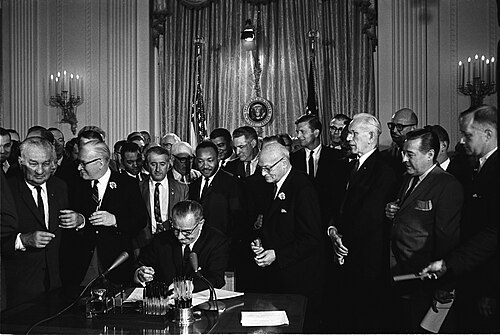
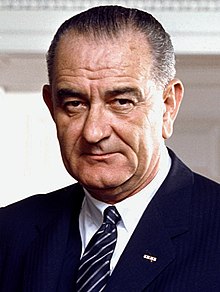
This Day in History: The 36th president of the United States, Lyndon B. Johnson, died on this day in 1973.
From Richard Ebeling:
Fifty years separate us today from 1968 and the two momentous legacies of the then failed presidency of Lyndon Johnson: The declaring of war on America's supposed domestic ills in the form of the "Great Society" programs, and the aggressive military intervention in a real war in Vietnam. Both of these "wars" reflected the arrogance and hubris of the social engineer who believes that he has the power and ability to remake and direct society in his own preferred image.
The Vietnam War still leaves a searing memory of a military conflict ten thousand miles away from the United States, which went on for more than a decade, at the cost of 55,000 American lives and at least one million casualties among the Vietnamese people. It was a war that tore the United States apart unlike any other armed conflict in American history other than the Civil War of the 1860s.
Hundreds of thousands of young men, not fortunate enough to have a college deferment, were conscripted into the U.S. Armed Forces and sent off to fight a war that at least half of the American people either did not support or did not understand, and which finally ended with one of the most humiliating defeats in American military history.
Vietnam: The Hubris of War Planning and Conflict Fine-Tuning
A part of the Vietnam War tragedy was due to the fact that it was managed by "the best and the brightest," as David Halberstam called them in his well-known book of the same title. These were the people within the Kennedy and Johnson administrations who orchestrated and escalated the war as the conflict progressed through the 1960s.
Halberstam referred to these war managers as the "whiz kids." They believed that they had the theoretical and quantitative knowledge and ability to fine-tune a military conflict. By incremental "escalation," they could bring to bear just enough pressure at vital points considered crucial to the enemy in North Vietnam. This would compel the appropriate response from the communist regime in Hanoi to assure that the conflict ended in an "acceptable" outcome. It was a costly lesson in the need for humility and caution in believing that it is in our power to socially engineer global affairs to our own liking.
The disaster and destruction that befell both the American and the Vietnamese people resulted from their arrogant pretense of possessing all the necessary and relevant knowledge for them to design and direct a war on the other side of the world, seemingly all according to a central plan constructed in Washington, D.C.
What they learned (or should have learned) were the inescapable limits to man's ability to consciously direct the future course of human events, and the ever-present occurrence of "unintended consequences." It was a costly lesson in the need for humility and caution in believing that it is in our power to socially engineer global affairs to our own liking.
The Great Society: Designing a "War" on America's Ills
The same was thing happened in the domestic policies of the Lyndon Johnson administration, which became known as the Great Society agenda. While the Vietnam War became inseparably intertwined with Johnson's name and was a defining mark of his presidency, he really viewed his Great Society agenda as the legacy he wanted to be remembered for. In his mind, he was attempting to fulfill and complete the New Deal programs initiated by his mentor, FDR, in the 1930s.
What guided the Great Society agenda was an arrogant pretense of knowledge. There was a general attitude among many economists and a large number of self-proclaimed social critics that most of the "evils" of the world—poverty, illiteracy, lack of decent housing or medical care, and environmental degradation—were all due to a lack of willpower and well-intentioned and implemented policy. The guiding premise was that the private sector had failed in meeting these problems and, indeed, may have contributed to them due to a disregard for "national needs," while pursuing private purposes.What guided the Great Society agenda was an arrogant pretense of knowledge.
In a speech in May of 1964, President Johnson proposed a series of "activist" government policies that would create a "Great Society" for America. He told his audience that he was determined "to assemble the best thought and broadest knowledge from all over the world to find [the] answers" to these social ills. In 1965, following Johnson's reelection to the presidency, he initiated a wide variety of pieces of legislation to fight his declared "wars" on these social ills. Government programs and spending were either introduced or expanded in almost every domestic direction.
Among the leading Great Society programs were:
- Medicare and Medicaid (as amendments to the Social Security Act)
- Economic Opportunity Act
- Office of Economic Opportunity
- Community Action Agencies
- Elementary and Secondary Education Act
- Higher Education Act
- Model Cities Program
- Housing and Urban Development Act
- Urban Mass Transit Act
- Supplemental Nutrition Assistance Program (Food Stamps)
- National Endowments for the Arts
- National Endowments for the Humanities
- Wilderness, Endangered Species, and Federal Water Pollution Control Acts
Political Paternalism and the Reduction of Freedom
The fundamental premise the Great Society vision for America was based on was the idea of political paternalism. Good men, with enough political power, authority, and financial resources can successfully solve the problems of society. The dilemma, however, is that for government to do anything for us, it must at the same time have the police power do things to us.
If government is to plan our retirement, provide our education, oversee and guarantee our health care, supply our housing, and give us various amounts of cash and other in-kind benefits, then that same government must, invariably, determine and dictate the form, quality, quantity, and conditions under which we can be and will remain eligible for such welfare redistributive benefits.
Thus, many of the welfare programs specified, for example, the makeup and membership of a household to receive government housing, child allowances, and cash payments. Federal money to education invariably ended up coming with standards, requirements, and restrictions on the content of what was taught and the benchmarks for measuring student success for continued funding. Government financing of health care necessarily incorporated regulations, controls, and rules about the pricing of health care services, the types of treatments and coverage permitted or restricted, and access to what care in terms of age and gender.
Increasingly, the individual's options and choices narrowed and were confined to what the government directly supplied or mandated through its rules and regulations. This, obviously, hit those in the lower income categories the most. An underclass of more or less permanent wards of the state was created with intergenerational dependency on government transfers growing in frequency.
Once such individuals and groups were completely or heavily dependent upon these government programs, escape from them was difficult due to the significant loss of benefits if such a recipient wished to find private-sector employment at a wage that would greatly reduce or terminate their eligibility. Thus, an underclass of more or less permanent wards of the state was created with intergenerational dependency on government transfers growing in frequency.
This political paternalism also implied that those in the government establishing these standards and rules for welfare eligibility all presumed to know what all those receiving such benefits and services "really" needed. That is, what kind of housing, what type of medical care, what content of education, what kind of nutritional requirements, etc. the recipients of these programs should receive.
Political Hubris and Unintended Consequences
This was no less an arrogance or hubris on the part of the government welfare providers that the poor and unfortunate recipients of this government largess clearly did not have the knowledge, experience, or forethought to make such decisions for themselves. Since the State was providing these benefits, the State clearly knew best what "these" people really needed for them to have some minimum form of a "decent life." The "poor" were classified and homogenized into one size—or a small handful of sizes—that "fit all," with little regard or sensitivity to the diversity between individuals and their personal and family needs and values.
Here, in essence, was the same fundamental flaw in the Great Society agenda as was to be found in the executing of the Vietnam War: the confidence and belief on the part of the implementers of these programs that they could redesign the social order at home just like the foreign policy makers believed they could remake entire societies abroad."Government was the problem, not the solution."
And here, too, were a series of unintended consequences. These included the weakening and break-up of groups and families due to intergenerational dependency on government programs; the emergence of an "entitlement mentality" that taxpayer funded transfers from the government were as legitimate a source of income as earning a living from a private-sector job; the entrapment of those on welfare in isolated, poorly-managed, and increasingly crime-infested public housing projects; and the deterioration of educational standards in public schools, especially in inner city areas of the country.
For the free market critic, the entire direction of the Great Society agenda was wrong-headed. Precisely because it was desirable to see an improvement in the condition of those least and less well off in society, the government's role had to be less rather than more. As a later president was to say, "Government was the problem, not the solution."
The Free-Market Agenda for a Truly Great Society
The free-market agenda for a truly great society was for people to have the liberty to make their own decisions, find and take advantage of their opportunities, and have the latitude and incentive to design their own lives, according to their own conception of the good, desirable, and worthwhile. Government controls, regulations, redistributions, and handouts were the opposite of the direction needed for America.
- Government regulations and licensing requirements had to be abolished to make it easier for the less well-off to start their own businesses, or expand their existing businesses to improve their own lives and create employment opportunities for others.
- Taxes had to be dramatically lowered in all personal income and corporate brackets to leave the income, wealth, and savings in the hands of the people themselves to generate the investment and capital that would create jobs, raise the productivity and value of those in the workforce, and increase standards of living for all over time through more goods and services of all kinds offered on the market.
- Union power had to be reduced since it had historically been used to limit entry into the labor market in many "closed-shop" sectors of the economy in order to artificially keep up the wages and benefits of those fortunate enough to belong to a particular labor union monopoly, at the expense of others locked out of employment opportunities.
Individual freedom, personal choice and responsibility, and open, competitive markets in a setting of limited government taxing, limited government spending, and limited or no government regulation was the social and institutional circumstance most conducive to really fight a war on poverty and illiteracy and a lack of economic opportunity.
Eliminating the disincentives for private sector construction of less expensive housing would better provide more housing for lower income groups. This would include ending or reducing zoning and various building codes that limited the locations for low-income housing and raised the costs of construction; it also required reducing property and other related taxes on the residential housing market.
Shifting to market-based education in place of the government monopoly school system would introduce needed competition in the educational market to improve the quality, variety, and availability of education for all, including—and especially—for those in the lower income categories.
And moving to a truly free-market-based health and medical care system would provide the required market competition to keep costs down while providing the incentives to improve hospital services and treatments.
Benefiting All Through the Freedom of Each
Free market economists, like Friedrich A. Hayek, explained that there is more knowledge and wisdom dispersed and decentralized in all the minds of all the members of society than can ever be known, integrated, or mastered by even the "best and brightest" who assert their ability to manage, direct and redesign the complex society in which we live. There is more knowledge and wisdom dispersed and decentralized in all the minds of all the members of society than can ever be known, integrated, or mastered by even the "best and brightest."
That is the advantage and the benefit of the competitive market order: It brings to bear all that there is to know and can be used to improve the condition of society through the informational mechanism of the price system, and the unhindered interactions of supply and demand. Shall we rely upon (and be limited to) what government regulators, planners, and redistributors are able to know and understand; or shall we be free to utilize and benefit from what all of us can contribute through the institutions and workings of the free-market economy?
Liberalism: True and False
And that gets us to an extremely important question: What is a just and great society? The Great Society advocates of the 1960s argued that theirs was a liberal vision for a better America. But was it?
I suggest that theirs was a false conception of liberalism, and therefore a misguided idea of a free and great society. The real, or true, liberalism, per its nineteenth-century definition, emphasized the freedom and rights of the individual to his life, liberty, and honestly acquired property. The individual human being was an end in himself, not the tool or means to coercing the will of others possessing political power. The Great Society advocates of the 1960s argued that theirs was a liberal vision for a better America. But was it?
These earlier (or, classical) liberals opposed and helped to do away with absolute monarchy and replace it with representative government. They led the cause for, and finally triumphed in bringing about, the end to human slavery. They insisted upon civil liberties and equal justice before the law for those whom the older political order had discriminated against, including Jews, religious dissenters, various ethnic and national groups, and women.
They also considered economic liberty—the freedom to own and use private property for consumption and production purposes, to peacefully compete in any trade, profession, or occupation the individual found attractive and advantageous, and to freely enter into any voluntary association and market exchange found to be mutually agreeable. This included the terms of trade found acceptable by the traders—to be inseparable from any understanding of and practical existence to human freedom.
The classical liberals considered this also to be a "morally" better society. Why? Because it is based on the idea of respecting the dignity of the individual not to be viewed and treated as a "pawn" (a coerced means) to be manipulated, controlled, or restricted by police power to serve someone else's preferred ends—even if that "someone else" is a large majority of his fellows in society.
The Self-Governing Individual and the Free Society
For these liberals, "self-government" did not only mean the right of the citizenry to participate in the political process to select those who will hold political office and enforce the laws of the land. It also crucially meant the "self-governing" individual. The individual was "sovereign" to freely live his life in peace, deciding what values and goals will give meaning and purpose to his own sojourn on Earth. The individual had the unmolested right to the private property he had honestly produced or acquired in trade, as the means for pursuing and possibly fulfilling his dreams and conceptions of a good and happy life for himself and those he may care about. Such a free society is more conducive not only to raising people out of poverty and making it possible for more people to be self-supporting, but also to foster a proper sense of benevolence and compassion towards others.
They considered such a truly liberal society also to be the one that provided the free-market incentives and opportunity structures that would have the good effect of directing men (without force, and through the motive of self-interested improvement) to apply their knowledge, ability and experience in ways—as if by an "invisible hand"—to reciprocally help improve the conditions of others as they advanced their own desired ends in the interplay of market competition.
They also argued that such a free society is more conducive not only to raising people out of poverty and making it possible for more people to be self-supporting, but also to foster a proper sense of benevolence and compassion towards others who may have fallen upon misfortune or "hard times" not of their own making. The history of voluntary charity and benevolence in the era of nineteenth century classical liberalism—before the advent of the modern welfare state and its undermining of some of this philanthropic spirit—attests to the magnitude of this private generosity and its success.
The Government-Governed Individual
What I have called the false liberalism of the Great Society turned its back on this earlier liberal tradition. Indeed, it turned liberalism on its head. Liberalism now meant bigger government, more intrusive government, more regulating and controlling government, with government's very visible hand increasingly in every corner and aspect of American life.
Rather than self-governing, the individual in this new Great Society was to be governed. Governed by whom? By those who arrogated to themselves the idea that they were "the best and brightest," the social engineering "whiz kids," who claimed to know how various segments and groups in the society should and would be made to live. Rather than self-governing, the individual in this new Great Society was to be governed.
This paternalistic legacy of the Great Society era remains with us today. Indeed, it is at the center of the political and social controversies enveloping American debate and conflict about the future direction of the country. Many, if not most, of the supposedly "untouchable" entitlement programs that are at the heart of the current budgetary and debt crisis facing both the federal government and state governments are the outgrowths of the redistributive programs either introduced by or greatly expanded during the Great Society presidency of Lyndon Johnson.
LBJ wanted to be remembered for his Great Society legacy. And he has had his wish. His paternalistic and welfare state agenda is the albatross that has a stranglehold over the fiscal neck of the American people, and continues to threaten the freedom of every individual in the country to this day.
Richard M. Ebeling is BB&T Distinguished Professor of Ethics and Free Enterprise Leadership at The Citadel in Charleston, South Carolina. He was president of the Foundation for Economic Education (FEE) from 2003 to 2008.
This article was originally published on FEE.org. Read the original article.