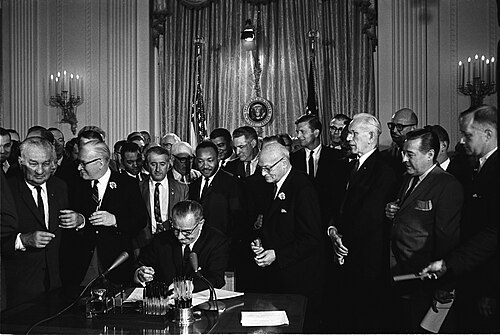
This Day in History: U.S. President Lyndon B. Johnson launched his Great Society program on this day in 1964.
From Robert Higgs:
For the most part President Lyndon B. Johnson was simply lucky in regard to economic stability and growth during his term in office, although he does deserve credit for pushing John F. Kennedy’s stalled tax-cut proposal to quick enactment in February 1964. The economy was already growing and the rate of unemployment declining when LBJ took office in November 1963, and macroeconomic conditions continued to improve throughout his presidency, although the rate of inflation began to edge up after 1965, reaching almost 5 percent during his final year in office. Between 1963 and 1968 real gross domestic product increased 29 percent, or 5.2 percent per year on average. Unemployment declined from 5.7 percent in November 1963, when LBJ became president, to 3.4 percent in January 1969, when he left office.
This macroeconomic success owed nothing to policymakers’ fine tuning, because neither the administration nor Congress made such delicate adjustments of fiscal policy as conditions changed. In truth, the U.S. government was institutionally incapable of fine tuning fiscal policy, however much it appealed to Keynesian economists drawing diagrams on blackboards.
Whatever its sources, this remarkable macroeconomic performance deserves the lion’s share of the credit for the reduction in measured poverty that occurred during the Great Society years. Of course the administration did propose, gain enactment of, and implement a plethora of bills aimed at reducing poverty in one way or another. Indeed, for many observers, the Great Society is virtually synonymous with the War on Poverty.
Major events included enactment of the Civil Rights Act of 1964 (often viewed as an antipoverty measure because blacks had relatively low average income), the Economic Opportunity Act of 1964, the Food Stamp Act of 1964, the Elementary and Secondary Education Act of 1965, and the Social Security Amendments of 1965 (creating Medicare and Medicaid), as well as establishment of the Office of Economic Opportunity (to oversee programs such as VISTA, Job Corps, Community Action Program, and Head Start), hundreds of Community Action Agencies, and many other bureaus ostensibly promoting poor people’s health, education, job training, and welfare.
Nearly all these antipoverty measures, if successful at all, had only a small effect on the national poverty rate, which fell from 19.5 percent in 1963 to 12.8 percent in 1968. Many of the antipoverty programs had scant funding and received news coverage out of proportion to the amount of money they spent. Most of the programs were ineffectual, spending taxpayer money with little or nothing to show for their display of good intentions. “[T]hose who most directly benefited,” says historian Allen J. Matusow, “were the middle-class doctors, teachers, social workers, builders, and bankers who provided federally subsidized goods and services of sometimes suspect value.”
Poverty researcher Michael D. Tanner recently remarked, apropos of the War on Poverty and its programmatic legacies:
Throwing money at the problem has neither reduced poverty nor made the poor self-sufficient. Instead, government programs have torn at the social fabric of the country and been a significant factor in increasing out-of-wedlock births with all of their attendant problems. They have weakened the work ethic and contributed to rising crime rates. Most tragically of all, the pathologies they engender have been passed on from parent to child, from generation to generation.
The Great Society at least did not bring economic growth to a halt, and therefore did not preclude a continuation of the long-term reduction in the proportion of Americans living in poverty. As for the War on Poverty in particular, however, no such benign evaluation is justified. Matusow, by no means a conservative ideologue, concludes that “the War on Poverty was destined to be one of the great failures of twentieth-century liberalism.”
Like most of the other Great Society programs, the War on Poverty rested on the presumption that technocrats possessed the knowledge and capacity to identify what needed to be done, design appropriate remedial measures, and implement those measures successfully through the use of government’s coercive power and taxpayers’ money. The technocrats did not give much weight—indeed, they generally gave no weight whatsoever—to the possibility of what later came to be known in Public Choice theory as “government failure.”
According to LBJ’s biographer, Paul Conkin, Johnson “never easily conceded that any except purely private problems did not lend themselves to a political answer. That is, government could directly or indirectly alleviate any distress.” White House aide Joseph Califano later confessed, “We did not recognize that government could not do it all.” Yet to describe the War on Poverty as merely hubristic would be too kind to its promoters.
All too many of the programs fell short of even this species of defectiveness, amounting to little more than garden-variety efforts to turn taxpayer money into purely personal and political swag for the insiders who designed, operated, and exploited the programs. For example, the Community Action Program, unforgettably lampooned by Tom Wolfe in his 1970 book Mau-Mauing the Flak Catchers, combined ample components of white middle-class guilt, minority shakedowns, and money thrown around basically to appease the menacing claimants who, having been invited to snatch it, resorted to whatever form of intimidation would get it for them quickest. “The money,” Conkin concludes, “often seemed to dwindle away, funding little more than the wages of [Community Action Agency] employees.”
More generally, as historian John A. Andrew notes, “Through ‘iron triangles’ and the use of clientele capture, the very objects of Great Society reforms [including the War on Poverty] all too often seized control of the process to block significant change and enhance their own interests.”
Level-headed analysts could scarcely have been shocked by this outcome. As Adam Smith long ago remarked, although the “man of system”—preeminent examples of which played leading roles in initiating the War on Poverty—treats the members of society as if they were pieces on a chessboard, the people have a motive power of their own. In the mid-1960s those whom the social and economic planners undertook to help in various ways refused to sit still while the technocrats treated them as lab rats. Instead they often reacted by resisting, diverting, or seizing control of the “top-down” schemes the government imposed on them, causing what analysts in retroactive assessments call program failures.
One man’s failed experiment, however, was often another man’s fulfilled political ambition or bulked-up bank account. Across the country, for example, local politicians diverted federal money intended to fund the War on Poverty into support for prosaic, local political priorities. Although many writers now speak of this much-ballyhooed crusade as a failure, it was a rousing success for many of its movers and shakers.
This article was originally published on FEE.org. Read the original article.