Showing posts with label 1666. Show all posts

Monday, October 23, 2023

The 1666 Tornado on This Day in History


This day in history: On this day in 1666, the most intense tornado on record in English history, an F4 storm on the Fujita scale or T8 on the TORRO scale, struck the county of Lincolnshire, with winds of more than 213 miles per hour (343 km/h).

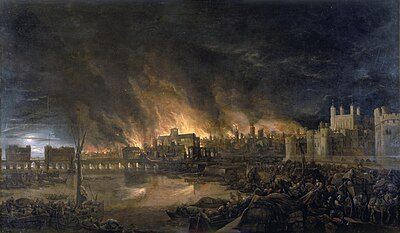
1666 was such a bad year. The Great Fire of London happened in 1666. This fire destroyed 13,200 houses, 87 parish churches, the Royal Exchange, Guildhall, and St. Paul's Cathedral. It also killed off some of the black rats and fleas that carried the plague bacillus. The fire began on September 2, 1666 and lasted just under five days. One-third of London was destroyed and about 100,000 people were made homeless.

A Great Plague also happened in 1666. Also known as the Black Death, this disease had been known in England for centuries. Those who could, including most doctors, lawyers, and merchants, fled the city of London. Charles II and his courtiers left in July for Hampton Court and then Oxford.


Saturday, September 2, 2023

The Great Fire of London on This Day in History


This day in history: The Great Fire of London began on this day in 1666 in Pudding Lane and 80% of London was destroyed.

In 1667 strict new fire regulations were imposed in London to reduce the risk of future fire and allow any fire that did occur to be more easily extinguished. The fire resulted in the emergence of the first insurance companies, starting with Nicholas Barbon's Fire Office. These companies hired private firemen and offered incentives for clients who took measures to prevent fires—for example, a cheaper rate for brick versus wooden buildings. Confusion between parish and private firefighting efforts led the insurance companies in 1832 to form a combined firefighting unit which would eventually become the London Fire Brigade. The fire led to a focus in building codes on restricting the spread of fire between units.

The Great Plague epidemic of 1665 is believed to have killed a sixth of London's inhabitants, or 80,000 people, and it is sometimes suggested that the fire saved lives in the long run by burning down so much unsanitary housing with their rats and their fleas which transmitted the plague, as plague epidemics did not recur in London after the fire. During the Bombay plague epidemic two centuries later, this belief led to the burning of tenements as an antiplague measure. The suggestion that the fire prevented further outbreaks is disputed; the Museum of London identifies this as a common myth about the fire.