Showing posts with label assassination. Show all posts

Monday, June 5, 2023

The Assassination of Robert F. Kennedy on This Day in History


On this day in 1968, Robert F. Kennedy was shot by Sirhan Sirhan at the Ambassador Hotel, and he was pronounced dead the following day.

Kennedy, a United States senator and candidate in the 1968 Democratic Party presidential primaries, won the California and South Dakota primaries on June 4. He addressed his campaign supporters in the Ambassador Hotel's Embassy Ballroom. After leaving the podium, and exiting through a kitchen hallway, he was mortally wounded by multiple shots fired by Sirhan. Kennedy died at Good Samaritan Hospital nearly 25 hours later. His body was buried at Arlington National Cemetery.

Sirhan, a Palestinian who held strong anti-Zionist and pro-Palestinian beliefs, testified in 1969 that he killed Kennedy "with 20 years of malice aforethought"; he was convicted and sentenced to death. Due to People v. Anderson, his sentence was commuted to life in prison in 1972 with a possibility of parole. As of April 2023, his parole request has been denied 17 times.

Kennedy's assassination prompted the Secret Service to protect presidential candidates, and his assassination has led to several conspiracy theories. No credible evidence has emerged that Sirhan was not the shooter, or that he did not act alone. It has been described as one of four major assassinations in the United States that occurred during the 1960s.

But why?

A motive cited for Sirhan's actions is the Middle East conflict. After his arrest, Sirhan said, "I can explain it. I did it for my country." Sirhan believed that he was deliberately betrayed by Kennedy's support for Israel in the June 1967 Six-Day War, which had begun one year to the day before the assassination. 

However, in a June 13, 2010 article titled, "JFK and RFK: The Plots that Killed Them, The Patsies that Didn’t," James Fetzer noted that:

multiple shots targeted RFK, more "than could have come from Sirhan Sirhan’s gun" that was also the wrong caliber;

"RFK was shot behind the right ear from about 1.5 inches, but Sirhan was never that close and always in front of him;"

the coroner and LAPD reports were contradictory;

LAPD "engaged in massive destruction of evidence from the pantry of the hotel because ‘it would not fit into a card file,’ " as part of an official cover-up to blame Sirhan for a state-sponsored assassination, evidence suggesting CIA involvement in both Kennedy brothers and MLK killings;

Sirhan’s gun was a ".22 caliber, eight-round revolver (serial number H-53725);"

he "emptied his weapon from a location in front of Bobby Kennedy;"

Dr. Thomas Hoguchi’s autopsy "showed RFK was hit by four bullets, all of which were fired from behind at upward angles;

five others were wounded by separate shots;"

as many as 13 shots were fired;

Dr. Noguchi’s autopsy "did not point to Sirhan as the killer;"

an eyewitness, DeWayne Wofler, "testified that the bullets fired at RFK had come from an entirely different gun," not Sirhan’s;

a security guard, Eugene Cesar, standing right behind RFK, had a drawn gun of the same caliber as the murder weapon; it was never examined nor was he charged; and

"a woman in a polka dot dress" left the scene hurriedly, "shouting, "We shot him! We shot him! We shot Kennedy!" Source


Monday, April 10, 2023

Lee Harvey Oswald & Edwin Walker on This Day in History


This day in history: An unknown gunman narrowly missed killing former U.S. Army General Edwin A. Walker on this day (April 10) in 1963, who had been working on his taxes at his home in Dallas, Texas. The would-be killer would later be identified as Lee Harvey Oswald.

In February 1963, Walker joined Billy Hargis on an anticommunist tour named "Operation Midnight Ride." In a March 5 speech, Walker called on the American military to "liquidate the [communist] scourge that has descended upon the island of Cuba." Seven days later, Lee Harvey Oswald ordered a Carcano rifle by mail using the alias A. Hidell.

While initially skeptical about the photographic evidence provided by the FBI, the Warren Commission reported that Oswald photographed Walker's Dallas home on the weekend of March 9–10, 1963. Oswald's friend, 51-year-old Russian émigré and petroleum geologist George de Mohrenschildt, would later tell the Warren Commission that he "knew that Oswald disliked General Walker."

On April 10, 1963, as Walker was sitting at a desk in his dining room, a bullet struck the wooden frame of his dining-room window. Walker was injured in the forearm by fragments. Marina Oswald later testified that her husband had told her that he traveled by bus to General Walker's house and shot at Walker with his rifle. Marina said that Oswald considered Walker to be the leader of a "fascist organization."

Police detective D. E. McElroy commented, "Whoever shot at the general was playing for keeps. The sniper wasn't trying to scare him. He was shooting to kill." The bullet was too badly damaged to provide conclusive ballistics tests, but neutron activation analysis tests later determined that it was "extremely likely" that the bullet was manufactured by the Western Cartridge Company and was the same type of ammunition as was used in the Kennedy assassination.


Thursday, March 30, 2023

The Attempted Assassination of Ronald Reagan on This Day in History


This Day in History: On this day in 1981, President of the United States Ronald Reagan was shot and wounded by John Hinckley Jr. in Washington, D.C., as he was returning to his limousine after a speaking engagement at the Washington Hilton. Hinckley believed the attack would impress actress Jodie Foster, with whom he had developed an erotomanic obsession.

White House press secretary James Brady, Secret Service agent Tim McCarthy, and DC police officer Thomas Delahanty were also wounded. All three survived, but Brady had brain damage and was permanently disabled. His death in 2014 was considered a homicide because it was ultimately caused by his injury.

What is never talked about is the caliber of the bullet, a small .22lr. "Everyone scoffs at the .22 cartridge. They say it’s useless for self defense. They say it’s too small. They say it isn’t powerful enough. But I’ve yet to see one of these people volunteer to be shot by one.
Look at the attempted assassination of Reagan. John Hinckley Jr. used a .22 revolver. Secretary Brady was hit in the head, critically wounded and crippled for life. A New York City police officer was hit in the neck and died instantly. A secret service agent went down and stayed down with a bullet in his liver. And finally, Reagan was rushed to the hospital and underwent emergency surgery for a bullet in his lung. And the bullet in question did this AFTER bouncing off the side of Reagan’s armored limousine." Source


Friday, December 30, 2022

The Unkillable Grigori Rasputin on This Day in History


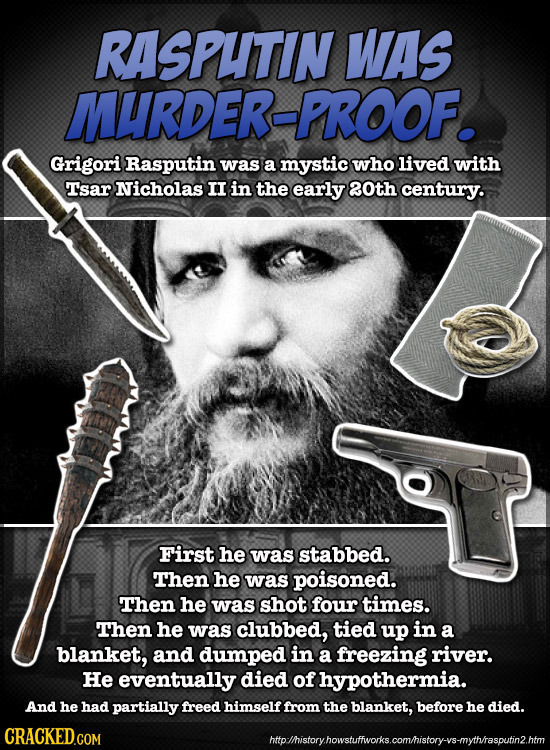
Today in History: Russian mystic and self-proclaimed holy man Grigori Rasputin was assassinated on this day in 1916. Rasputin was a man who insinuated himself inside the Russian royal family, the Romanovs, and in time was able to gain some power and influence. Many did not like that. While seen by some Russians as a mystic, visionary, and prophet, others viewed him as a charlatan. 

In 1916, members of the nobility lured him to the Yusupov Palace with promises of a wild party. He was driven to the site of his execution in a 1913 Rolls Royce Landaulet. At first they tried to poison him. It is said that Rasputin was fed poisoned cakes and wines and that he gorged down enough cyanide to kill an elephant. But no amount of poison would hurt him. Instead, Rasputin kept asking for more.

When that didn't work they shot him in the heart. When his killers went to dispose of his body, Rasputin leapt to his feet, foaming at the mouth. They then took more shots. That didn't work, until someone shot him in the head. However, one of the conspirators saw Rasputin move, even after the shot to the skull. So they then wrapped his body in linen and threw him over the bridge into the water. 

Some reports say that he was also found mutilated...or so the legend goes.

Rasputin joins Hitler, Blackbeard pirate Edward Teach, Ned Kelly, Ferdinand Magellan and Pablo Escobar as the hardest people to kill.

Friday, October 21, 2022

JFK Death Investigator Jim Garrison on This Day in History


This Day in History: American lawyer and judge Jim Garrison died on this day in 1992. Garrison is best known for his investigations into the assassination of President John F. Kennedy and he was portrayed by Kevin Costner in the Oliver Stone movie JFK, while Garrison himself actually portrayed Earl Warren. He also played "Judge Jim Garrison" in the 1986 movie The Big Easy, and as such has his own IMDB entry. The movie JFK was originally four and a half hours long. 

Ever since that pivotal day on November 22 1963, JFK conspiracies have become a cottage industry. One of the first books on the topic was Rush to Judgment by Mark Lane, which sold millions of copies. Vincent Bugliosi estimates that over 1,000 books have been written about the Kennedy assassination, at least ninety percent of which are works supporting the view that there was a conspiracy. As a result of this, the Kennedy assassination has been described as "the mother of all conspiracies". 

Other popular conspiracies are 9/11, the moon landing hoax, the Roswell crash cover-up, Satanic cults, Paul McCartney's death, Princess Diana's murder, flat earth theory, Stephen King shot John Lennon, Kurt Cobain was murdered by Courtney Love, Pro wrestling is real, The "Men in Black" are real, the Titanic was deliberately sunk because Jacob Astor opposed the Federal Reserve which was established a year later, Scientologists rule Hollywood, the world is run by dinosaur-like reptiles, the Mandela effect, Alex Jones is actually Bill Hicks, Elvis is alive, Stevie Wonder isn't really blind, the Masons secretly run everything, CERN is using the LHC to open a portal to hell, and Hitler did not commit suicide in 1945 but rather escaped to South America. I'm sure I missed several thousand.

Sunday, September 18, 2022

Two Unsolved Political Killings on This Day in History


Valerie Percy, 21, daughter of U.S. Senate candidate Charles H. Percy, was murdered in the family mansion in the Chicago suburb of Kenilworth, Illinois on this day in 1966. She had been stabbed to death in her bed. Percy would win election to the Senate in November, but nobody would ever be charged with the murder, and the crime would remain unsolved at the time of his death 45 years later. In 2014, a new book on the murder would identify the late William Thoresen III, who lived with his wealthy family less than two blocks from the Percy home, as the likely suspect. Ironically, Thoresen suffered a fate similar to that of Miss Percy, murdered while lying in his bed.

Also, Secretary-General of the United Nations, Dag Hammarskjöld, was killed in a plane crash on this day in 1961. New evidence supports a theory that the pioneering U.N. secretary general was assassinated.

"Questions surrounded the crash from the first. For one thing, writes Susan Williams in her 2011 book Who Killed Hammarskjold?, the British high commissioner at Ndola, Lord Alport, showed little concern after the U.N. plane failed to land at its scheduled time, instead insisting that Hammarskjold had decided to go elsewhere. Then there was the fact that search for the plane’s wreckage and crash site didn’t begin for hours after the crash, though witnesses had reported seeing a great flash in the sky soon after midnight. 

Local residents in the area had seen a second plane in the sky that night, but their testimony was discounted or ignored by colonial authorities, the Guardian reported in 2011. The crash’s sole survivor, U.N. security officer Harold Julien, also spoke before he died of an explosion on board the plane, but the authorities assumed he was too ill and sedated to be taken seriously.

Two days after Hammarskjold's death, former U.S. President Harry Truman insinuated to reporters that the U.N. leader had been assassinated, saying he 'was on the point of getting something done when they killed him. Notice that I said _when they killed him._'" Source

There is also evidence suggesting the plane was shot down. A CIA report claimed the KGB was responsible.

Sunday, January 30, 2022

The First Assassination Attempt Against a US President on This Day in History

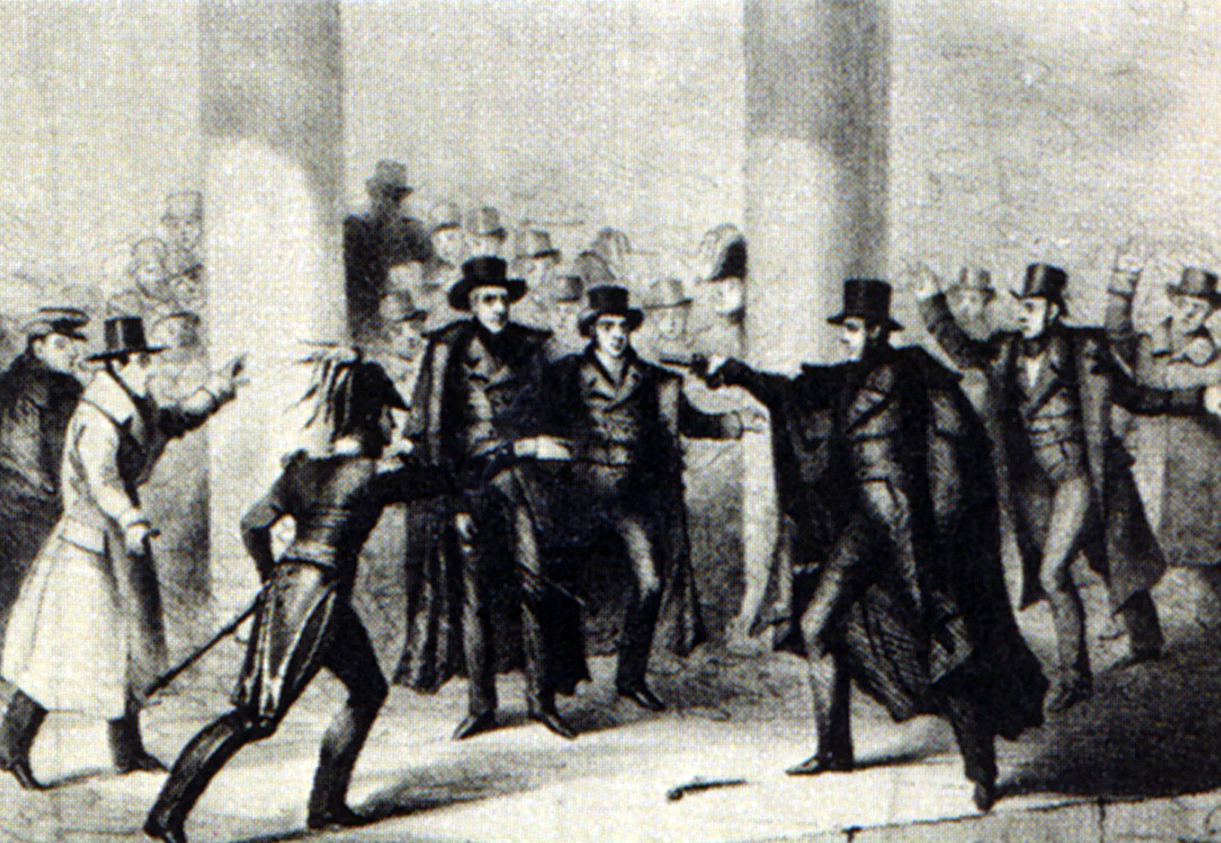
This Day in History: In the first assassination attempt against a President of the United States happened on this day in 1835. Richard Lawrence attempted to shoot president Andrew Jackson on this day, but failed and was subdued by a crowd, including several congressmen as well as Jackson himself.

Richard Lawrence was an English-American house painter, and historians have speculated that exposure to the toxic chemicals in the paints that he used may have contributed to his mental illness, which manifested itself in his thirties, and he later became violent to his siblings. At trial, Lawrence was found not guilty by reason of insanity and spent the remainder of his life in insane asylums.

Lawrence was not the only painter known for his violence. "The Baroque artist Caravaggio is famous for gruesome paintings like 'Judith Beheading Holofernes.' Yet it wasn’t only his paintings that were brutal and violent. In the early 17th century, Caravaggio went to trial at least 11 times for things like writing libelous poems, throwing a plate of artichokes at a waiter and assaulting people with swords. He eventually fled Rome to escape punishment for killing a man and died in exile under mysterious circumstances." Source

16th century painter Benvenuto Cellini "killed repeatedly without remorse and without being punished. He stabbed his brother's murderer to death with a long twisted dagger that he drove downward through the man's shoulder. He also killed a rival goldsmith and shot an innkeeper dead – and recounts all these crimes in his autobiography. He escaped being executed because he was so admired as an artist. In those days, geniuses really could get away with murder." Source

Victorian era painter Richard Dadd stabbed his father to death because he thought he was the devil. He spent the rest of his life in prisons and mental institutions where he painted fantastic fairy scenes of bizarre detail and intensity.


Monday, September 28, 2015

Killing Abraham Lincoln - 40 Books to Download (Plus Garfield & McKinley)

Only $3.00 -  You can pay using the Cash App by sending money to $HeinzSchmitz and send me an email at theoldcdbookshop@gmail.com with your email for the download. You can also pay using Facebook Pay in Messenger


Books Scanned from the Originals into PDF format


Books are in the public domain. I will take checks or money orders as well.

Contents:

Assassination of Lincoln - a History of the Great Conspiracy by T.M. Harris 1892

John Wilkes Booth; Escape and Wanderings until final ending of the trail by suicide at Enid, Oklahoma, January 12, 1903 by WP Campbell 1922

Trial of the Conspirators for the Assassination of President Lincoln by John A Bingham 1865

McKinley, Garfield, Lincoln - their lives-their deeds-their deaths, with a record of notable assassinations and a history of anarchy by William Dixon Bancroft 1901

Trial of the assassins and conspirators for the murder of Abraham Lincoln 1865

The Judicial Murder of Mary E. Surratt by David Miller Dewitt 1895

American Bastile - a History of the arbitrary arrests and imprisonment of American citizens on account of their political opinions during the late Civil War together with a full report of the illegal trial and execution of Mrs. Mary E. Surratt by a military commission, and a review of the testimony showing her entire innocence by John A Marshall 1884

The Assassination of Abraham Lincoln and its Expiation by David Miller Dewitt 1909

Famous Assassinations of history from Philip of Macedon, 336 B. C., to Alexander of Servia, A. D. 1903 by Francis Johnson 1903

Some Incidents in the Trial of President Lincoln's Assassins - The Controversy between President Johnson and Judge Holt by Henry L Burnett 1891

Rome's Responsibility for the Assassination of Abraham Lincoln by TM Harris 1897


Romanism and the republic by Isaac J Lansing 1889
(They claim the right to murder all rulers whom they consider apostates; and has it ever been brought to your attention (I speak of it as a curiosity only), that every person who had anything to do with the assassination of Abraham Lincoln was a Roman Catholic? — that John Wilkes Booth was a Roman Catholic; Payne and Atseroth, also Dr. Nudd, who dressed his leg; Garrett, in whose premises he was killed; also, that Harold was a Roman Catholic; Mrs. Suratt and her son were Roman Catholics; their house was the head-quarters
for Roman Catholics and for the Jesuit priests.)

The Escape and Suicide of John Wilkes Booth - The first true account of Lincoln's assassination containing a complete confession by Booth many years after the crime by Finis L Bates 1907

The Assassination and History of the Conspiracy - a complete digest of the whole affair by James R Hawley 1865

The Flight of J. Wilkes Booth by Paul DeVere 1880

The death of Lincoln  - the Story of Booth's Plot, his deed and the penalty by Clara E Laughlin 1909

The Assassination of Lincoln by EW Coggeshall 1920

The Terrible tragedy at Washington - Assassination of President Lincoln. Last hours and death-bed scenes of the President 1865

The Story of a Crime by Richard Collum 1889

Death of Abraham Lincoln by ES Jordan 1865

The death of President Lincoln by WT Wilson 1910

Glimpses of History by George M Towle 1866

Oration on the death of Abraham Lincoln by William Binney 1865

Eulogy on the death of Abraham Lincoln by George S Boutwell 1865

Trial of John H. Surratt in the Criminal Court for the District of Columbia, Volume 1 1867

Trial of John H. Surratt in the Criminal Court for the District of Columbia, Volume 2 1867

Complete life of William McKinley and story of his assassination by Marshall Everett 1901 (has a chapter on notable assassinations)

Lessons of the hour. A discourse on the assassination of President Garfield by Edward S Atwood 1881

The Life and Public Services of James A. Garfield including full and accurate details of his eventful administration, assassination, last hours, death, etc by Emma E Brown 1881

Our Martyr Presidents - Lincoln, Garfield, McKinley by John Coulter 1901

The Life and Death of James A. Garfield by John Start Ogilvie 1881

The Great Guiteau Trial: with life of the cowardly assassin 1882

An Historic Memento of the Nation's Loss - the true story of the assassination of President McKinley by Richard H Barry 1901


The trial, execution, autopsy and mental status of Leon F. Czolgosz,  alias Fred Nieman, the assassin of President McKinley by Carlos F MacDonald 1901

Our Martyred President by Phebe Hanaford 1865

Our Martyred President as a Man  - memorial life of William McKinley ... together with a full history of anarchy and its infamous deeds by George W Townsend 1901

Assassination of Lincoln by Charles P Chiniquy 1886 (Anti-Catholic)

Reminiscences and souvenirs of the assassination of Abraham Lincoln by JE Buckingham 1894