Showing posts with label philosophy. Show all posts

Friday, September 5, 2025

Altruist Philosopher Auguste Comte on This Day in History


This Day in History: Socialist philosopher Auguste Comte died on this day in 1857. He was the man who coined the term "altruism" and believed that man's highest ideal was to live for others. 

Julius Lloyd wrote in 1884:

"The reasonableness and consistency of M. Comte's doctrine suffer by his arbitrary choice of certain names as representative of Humanity in the past. The selection of 'those who have played their part worthily in life," assumes a power of deciding what is worthy or unworthy, which begs the whole question as to what is the governing principle of morals. The entire scheme depends on the manner in which this choice is exercised, for the ideal of Humanity is defined by means of the representative names which are taken. M. Comte's calendar of names exhibits his own ideal, but not that of any one who differs from him. Mankind are far from being agreed as to the chief characteristics of worth. If Dante, Milton, and Goethe, to take three of the most discerning intellects, were to nominate "those who have played their part worthily in life,' their choice would differ widely in the result. A system of morals, in which so much depends on individual judgment, has no right to profess universality. It is really eclectic, and its pretended comprehensiveness is an illusion.

There is an obvious resemblance between Comte's Altruism and Christian morality, which makes it important to note the particulars in which they are agreed, and those in which they are opposed. They have in common the inculcation of brotherly love as a supreme duty, the worship and imitation of an ideal Humanity, the separation of a select body from the world at large. But Comte's system is in other respects not only distinct, but antagonistic to Christianity. God and Christ are excluded with a jealous intolerance. What is retained is a Brotherhood without a Fatherhood, a Body without a Head. What Comte offers as an ideal of Humanity is a Torso of Christianity, which he has mutilated. It is a curious contradiction of the first principle of Altruism, that the modern gospel of unselfishness should be a selfish plagiarism, in which a large part of the Christian morality is republished with the Author's name expunged.

On one point, however, Comte's Altruism advances beyond the limits of Christian doctrine. He teaches that, instead of loving our neighbour as ourselves, we should endeavour not to love ourselves at all. And this, which is the most original feature in Comte's doctrine, is claimed by his followers as an improvement on Christianity.

A fair comparison of the two will show that this fancied superiority is a dream of the study, and betrays a want of acquaintance with human nature. To exclude self-love is to take away the natural provision for self-preservation and self-culture, which are necessary conditions of the welfare of society. On the other hand, to make self-love a standard of brotherly love, as in the precept, 'Thou shalt love thy neighbour as thyself,' is to supply the most effective means by which brotherly love can promote its own object. Altruism without Egoism would be a vague yearning for the happiness of others, without any clear idea of happiness, what it is, or how it is to be obtained. If we suppose a company of pedestrians, each troubled in mind to be sure that his companions' boots fit them comfortably, and indifferent to his own, we should have a picture of a state of society in which Egoism was extinguished and Altruism remained. It would be necessary to find some kind of substitute for Egoism, in order to keep alive the sensibility to pleasure and pain, which is as necessary for the happiness of others as for our own. A man who wishes to make others happy has more power to do so in proportion as he feels sympathy in their pleasure; and thus Egoism has a function preparatory to Altruism. On strictly Altruist principles arts and sciences would languish. That which impelled Columbus to the discovery of America, and led on the inventors of the printing press and the steam engine, was not a prevision of the social benefits to follow, but rather an unsatisfied desire of the mind to accomplish a noble object."

Many today still uphold altruism as the highest moral ideal. I don't. However, Altruism simply does not put food on the table. As Adam Smith remarked back in 1776, "It is not from the benevolence of the butcher, the brewer, or the baker that we expect our dinner, but from their regard to their own interest."

Friday, July 28, 2023

Philosopher Karl Popper on This Day in History


This day in history: Philosopher, academic and social commentator Karl Popper was born on this day in 1902. One of his greatest works was "The Open Society and Its Enemies." 

"An open society is a place that has a lot of intellectual pluralism and a lot of diversity of viewpoints. Instead of trying to eliminate bias by eliminating biased people, or instead of eliminating wrong hypotheses by eliminating the people who hold those hypotheses, it instead tries to pit bias and prejudice against other biases and prejudices.

It does that by forcing contention, forcing critical argument, and forcing people to persuade each other over time. That's really what science is. It's really what journalism is. It's what all the professions that are engaged in the reality-based community are ultimately trying to do: use these tools of critical comparison and discourse to persuade each other. It takes physical coercion off the table. One way to prove that Nick Gillespie is wrong would be to shoot him, right? That's the most traditional way to do it. It gets rid of the hypothesis. It does not advance knowledge.

Karl Popper, among others, pointed out that the open society is incomparably better at producing knowledge than any other society, because it allows us to make errors and not be punished for making errors. It allows us to make errors, in fact, much more quickly. That's the secret of science. You make errors much faster.

It's also a more peaceful society, because you're settling differences of opinion without using coercion to do it. You're marginalizing bad ideas." Source

We need more of that, instead of the present day censorship and cancel culture.

Popper also criticized Hegel and Marx, knowing that their ideas led to the totalitarianism of the 20th century. He agreed with Schopenhauer's view that Hegel "was a flat-headed, insipid, nauseating, illiterate charlatan, who reached the pinnacle of audacity in scribbling together and dishing up the craziest mystifying nonsense."

350 Books on German Philosophy to Download

Wednesday, June 28, 2023

The Social Contract's Jean-Jacques Rousseau on This Day in History


This day in history: Philosopher Jean-Jacques Rousseau was born on this day in 1712. One of his most important writings was a work called The Social Contract. A Social Contract is an implicit agreement among the members of a society to cooperate for social benefits, for example by sacrificing some individual freedom for state protection.

From Robert Taylor:

Bobby Taylor is a senior at Sullivan South High School in Kingsport, Tennessee.

Political theorists have long attempted to find a plausible rationale for the existence of the coercive State. This quest reached a climax during the Enlightenment when philosophers and political scientists rejoiced over the discovery of a new model depicting the relationship between the individual and the State: the social contract.

According to the theory of the social contract, individuals may leave an anarchic “state of nature” by voluntarily transferring some of their personal rights to the “community” in return for security of life and property. A seemingly rational and practical concept in its general form, the social contract theory began to lose its luster as its proponents clashed over what form the State should take and what rights, if any, the individual should retain.

During this period of intense conflict, French philosopher Jean Jacques Rousseau produced a seminal work entitled “The Social Contract.” In it Rousseau proposes a visionary society in which all rights and property would be vested in the State, which would be under the direct control of “the People.” Large meetings of the public would be held in order to determine the collective interest as perceived by the “general will”; this the State would then dutifully enforce. Rousseau justifies this strange synthesis of communism and direct democracy by arguing that the abrogation of individual rights would abolish special privileges, and that tyranny would be impossible because the People would never oppress themselves.

“The Social Contract” has been used by both democrats and totalitarians to support their respective positions. This ambiguity is rather symptomatic of the contradictions underlying Rousseau’s entire essay. His work is particularly vulnerable in three essential areas: the formulation of the “general will,” the subordination of individual rights, and the validity of the “social contract” concept.

The term “general will” seemingly implies that there is an interest common to all persons involved. But even if this were true, running a direct democracy on this principle would be hopelessly impractical. Rousseau, after building a heady image of united purpose and brotherhood among the masses, finally admits the impracticality later in the essay and provides a slightly less demanding criterion: majority rule.

By accepting this annotation, however, Rousseau deviates from his position that the People would never oppress themselves. History has clearly shown that majoritarianism without constraints, such as the Bill of Rights, leads to oppression of the minority and State confiscation on a vast scale. The only legitimate conception of the “general will” that would satisfy Rousseau’s great expectations is complete unanimity, and if it could ever be reached in a large body of self-interested individuals, why would the coercive State be needed at all?

Rousseau believes that personal liberty need not be secured since the individual would in a sense rule himself via the “general will.” As we have seen, however, Rousseau’s conception of the “general will” is an inadequate safeguard against tyranny, and in reality the individual citizen would be incessantly victimized by the State. This monstrous miscalculation on Rousseau’s part stems from his regard of human beings as means to higher ends, rather than as ends in themselves. His utter disregard for the rights of man runs directly counter to traditional Western individualism and leaves his ideal society suspended in a sterile moral vacuum.

Finally, Rousseau maintains that the State may exercise complete control over the lives and property of its citizens because these individuals have granted it this right by virtue of the social contract. The term “social contract” works to legitimize actions normally considered to be enslavement and theft, and at first glance the concept seems rather reasonable. Upon further reflection, however, an important question arises: Is the social contract really a contract at all?

Where Rousseau Fails

Contracts by definition must have two basic features: they must be entered into voluntarily and they must also clearly enumerate the rights and duties of the parties involved. Rousseau’s social contract fails miserably on both points.

The social contract is ostensibly voluntary, but any individual refusing to enter into the contract would be forced to flee by the State and would have his land confiscated, though he had not initiated force against anyone. Additionally, the terms of the contract are extraordinarily vague: the contracting individual agrees to grant his precious life, liberty, and property to the State in return for one ineffectual vote in the formulation of a governing but extremely faulty “general will.” This so-called contract is actually the epitome of the one-way street: the State receives everything yet grants nothing and therefore holds all the cards. The fact that no contract even faintly resembling Rousseau’s has ever appeared in the free market is ample proof that such an agreement would never be accepted by anyone—except, perhaps, at the point of a gun.

Although “The Social Contract” is a blatantly anti-libertarian document, it should be read and studied closely by all students of the free society. In Rousseau’s work one can discover the roots of contemporary socialism and can see the mass of contradictions and fallacies underlying this morally bankrupt ideology, unobstructed by the clever rhetorical devices of modern collectivists. The principles espoused by Rousseau in his essay haunt us even today, and until they are finally faced, the specter of tyranny will continue to hang like a pall over the Western conscience.


Jean Jacques Rousseau 1712-1778

“Whoever ventures to undertake the founding of a nation should feel himself capable of changing human nature, so to speak, of transforming each individual, who by himself is a perfect and separate whole, into a part of a greater whole, from which that individual receives all or part of his life and his being; of changing the constitution of man in order to fortify it; of substituting a partial and moral existence ,for the physical and independent existence that we have all received from Nature. In a word, he must be able to deprive man of his own powers in order to give him those that are foreign to him. . . .”

—from The Social Contract

Robert Taylor

This article was originally published on FEE.org. Read the original article.


Saturday, April 22, 2023

German Philosopher Immanuel Kant on This Day in History


This Day in History: German philosopher Immanuel Kant died on this day in 1804. His greatest writings he gave the titles (with some hubris) "Pure Reason" and "Practical Reason." I often wonder how someone can build a philosophy when he has never left his immediate neighborhood for his entire life. Perhaps he just re-imagines or re-states a previous philosophy. Take his famous Categorical Imperative: "Act only according to that maxim by which you can at the same time will that it should become a universal law." Is this not just a fancier way of stating the golden rule in Matthew 7: "do unto others what you would have them do to you?"

Perhaps Jason Brennan is right:

"Just as Einstein’s field equations aren’t particularly useful for studying the path of a falling feather, so Kant’s CI isn’t particularly useful to know what to do in a given situation."
https://fee.org/articles/what-do-you-need-philosophy-for/

See also 350 Books on German Philosophy to Download (Kant, Nietzsche,
Schopenhauer, Hegel)
http://thebookshelf2015.blogspot.com/2015/10/350-books-on-german-philosophy-on.html

Dissing Immanuel Kant
https://thebookshelf2015.blogspot.com/2015/10/dissing-immanuel-kant.html

Theosophy and Immanuel Kant by H. T. Edge, M. A. 1916
https://thebookshelf2015.blogspot.com/2018/02/theosophy-and-immanuel-kant-by-h-t-edge.html

Thursday, August 25, 2022

Scottish Philosopher David Hume on This Day in History


This Day In History: Scottish Philosopher David Hume died on this day in 1776. One puzzle that Hume posed is especially pertinent today in the era of mass lockdowns. In his First Principles of Government, Hume wrote, "Nothing appears more surprising to those who consider human affairs with a philosophical eye, than the easiness with which the many are governed by the few; and the implicit submission, with which men resign their own sentiments and passions to those of their rulers."

200 years prior to Hume, Étienne de La Boétie wrote his "Discourse on Voluntary Servitude" wherein he wonders, "how it happens that so many men, so many villages, so many cities, so many nations, sometimes suffer under a single tyrant who has no other power than the power they give him; who is able to harm them only to the extent to which they have the willingness to bear with him; who could do them absolutely no injury unless they preferred to put up with him rather than contradict him. Surely a striking situation!"

It was however the great H.L. Mencken that figured out how this was done: “The whole aim of practical politics is to keep the populace alarmed (and hence clamorous to be led to safety) by menacing it with an endless series of hobgoblins, all of them imaginary.”

Michael Crichton summed it up nicely when he wrote: "Social control is best managed through fear."

David Hume: How Easily the Masses are Manipulated by the Few
https://thebookshelf2015.blogspot.com/2018/02/david-hume-how-easily-masses-are.html

Monday, July 25, 2022

The Longshoreman Philosopher Eric Hoffer on This Day in History

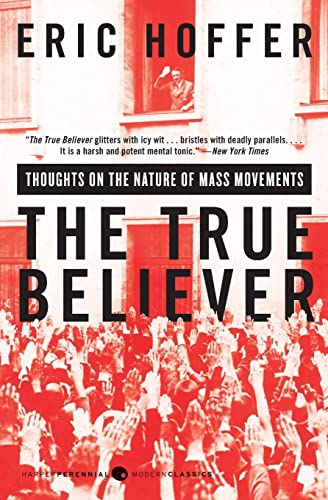
July 25 marks the 1902 birth of Eric Hoffer, known as the “longshoreman philosopher” for the manual labor he performed for most of his life. In 11 books, beginning with The True Believer, the Presidential Medal of Freedom winner focused on the allure of a seemingly ennobling collective cause and the coercive power it puts in the hands of leaders and their discontented followers. He contrasted this with freedom, which is the only milieu in which creative individuals can flourish and find fulfillment. Given the vastly increasing popularity of proposals for further imposing collectivist government policies into Americans’ already-adulterated freedoms we see around us today, his insights into freedom merit renewed attention:

"The aspiration toward freedom is the most essentially human of all human manifestations."

"Freedom means freedom from forces and circumstances which would turn man into a thing, which would impose on man the passivity and predictability of matter."

"The basic test of freedom is perhaps less in what we are free to do than in what we are free not to do."

"People unfit for freedom—who cannot do much with it—are hungry for power. The desire for freedom…says: leave me alone and I shall grow, learn, and realize my capacities."

"We clamor for equality chiefly in matters in which we ourselves cannot hope to attain excellence."

"There is no alienation that a little power will not cure."

"A man is likely to mind his own business when it is worth minding. When it is not, he takes his mind off his own meaningless affairs by minding other people’s business."

"Nothing so offends the doctrinaire individual as our ability to achieve the momentous in a matter-of-fact way, unblessed by words."

"The intellectual…derives his sense of usefulness mainly from directing, instructing, and planning—from minding other people’s business…A free society is…a threat to the intellectual’s sense of worth…Any social order that can function with a minimum of leadership will be anathema to the intellectual."

"The ability to get along without an exceptional leader is the mark of social vigor."

"The real 'haves' are they who can acquire freedom, self-confidence, and even riches without depriving others of them…by developing and applying their potentialities. On the other hand, the real 'have nots' are they who cannot have aught except by depriving others of it. They can feel free only by diminishing the freedom of others, self-confident by spreading fear and dependence among others, and rich by making others poor."

"Men of power…their main purpose is the elimination or neutralization of the independent individual…every device they employ aims at turning men into a manipulable 'animated instrument,' which is Aristotle’s definition of a slave."

"The taint inherent in absolute power is not its inhumanity but its anti-humanity."

"Absolute power is the manifestation most inimical to human uniqueness."

"All leaders strive to turn their followers into children."

"Absolute power corrupts even when exercised for humane purposes. The benevolent despot who sees himself as a shepherd of the people still demands from others the submissiveness of sheep."

"We all have private ails. The troublemakers are they who need public cures for their private ails."

"To the frustrated, freedom from responsibility is more attractive than freedom from restraint."

"The danger inherent in reform is that the cure may be worse than the disease… reformers are not on guard against unpredictable side effects which may divert the course of reform toward unwanted results. Moreover, quite often the social doctors become part of the disease."

"No matter how noble the objectives of a government, if it blurs decency and kindness, cheapens human life, and breeds ill will and suspicion—it is an evil government."

The collectivist mindset that Eric Hoffer so cogently analyzed, primarily in terms of external threats, is increasingly being echoed in America today, presenting an increasing internal threat to freedom. But no amount of power to coerce others, in either instance, can make a life meaningful or good. As Hoffer realized, only freedom can provide that opportunity. It does not guarantee a meaningful life; only the possibility. But to create or preserve that possibility, we need to bolster freedom. As he recognized,

Every device employed to bolster individual freedom must have as its chief purpose the impairment of the absoluteness of power…[or] the defeated individual, however strong and resourceful, can have no refuge and no recourse.

Gary M. Galles
Gary M. Galles

Gary M. Galles is a Professor of Economics at Pepperdine University and a member of the Foundation for Economic Education faculty network.

In addition to his new book, Pathways to Policy Failures (2020), his books include Lines of Liberty (2016), Faulty Premises, Faulty Policies (2014), and Apostle of Peace (2013). 

This article was originally published on FEE.org. Read the original article.

Monday, December 13, 2021

Herd Psychologist Gustave Le Bon on This Day in History


Today in History: Gustave Le Bon died on this day in 1931. He is best known for his 1895 work The Crowd: A Study of the Popular Mind, which is considered one of the seminal works of crowd psychology. This book became very influential, though he was ignored in his lifetime because he was critical of democracy and socialism. He wrote, "The Socialists of every school are loathe to admit the importance of intellectual superiority. Their high priest Marx understands by the term work nothing but manual labour, and relegates the spirit of invention, capacity, and direction, which has nevertheless transformed the world, to a second place. This hatred of intelligence on the part of the Socialists is well founded, for it is precisely this intelligence that will prove the eternal obstacle on which all their ideas of equality will shatter themselves."

Despite this, Adolf Hitler and Benito Mussolini used his book to learn how to incite a mob. 

Gustave le Bon has been reborn these past 2 years with the resurgence of civil unrest. 

"Gustave Le Bon, the French philosopher who 126 years ago in The Psychology of Crowds, was the first thinker systematically to outline how herd psychology differs from that of the individual. Le Bon it was who observed that the consciousness bestowed by membership of a crowd can be transformative, possessing individual members with ‘a sort of collective mind which makes them feel, think and act in a manner quite differently from that in which each individual would feel, think and act were that person in a state of isolation.’ In such a ‘psychological crowd’, individual personality disappears, brain activity is replaced by reflex activity: a lowering of intelligence, provoking a complete transformation of sentiments, which collectively may manifest as better and worse than those of the crowd’s constituent members. A crowd may just as easily become heroic or criminal, but is generally disposed towards destruction. ‘The ascendancy of crowds,’ wrote Le Bon, ‘indicates the death throes of a civilisation.’ The upward climb to civilisation is an intellectual process driven by individuals; the descent is a herd in stampede. 
‘Crowds are only useful for destruction.’"~John Waters

His brilliance in understanding mobs is displayed in the following quotes:

"All the civilizations we know have been created and directed by small intellectual aristocracies, never by people in the mass. The power of crowds is only to destroy."

"In crowds it is stupidity and not mother wit that is accumulated."

"The role of the scholar is to destroy chimeras, that of the statesman is to make use of them."

"If atheism spread, it would become a religion as intolerable as the ancient ones."

"One of the most constant characteristics of beliefs is their intolerance. The stronger the belief, the greater its intolerance. Men dominated by a certitude cannot tolerate those who do not accept it."

“Crowds exhibit a docile respect for force, And are but slightly impressed by kindness, Which for them is scarcely other than a form of weakness. Their sympathies have never been bestowed upon easy going masters, but the tyrants who vigorously oppressed them. It is to these latter that they always erect the loftiest statues. It is true that they willingly trample on the despot whom they have stripped of his power, but it is because having lost his power he resumes his place among the feeble who are to be despised because they are not to be feared. The type of hero dear to a crowd will always have the semblance of a Caesar, His insignia attract them, His authority overawes them, and his sword instills them with fear.”

"In a crowd every sentiment and act is contagious, and contagious to such a degree that an individual readily sacrifices his personal interest to the collective interest."

"A chain of logical argumentation is totally incomprehensible to crowds"

"The masses have never thirsted after truth. They turn aside from evidence that is not to their taste."

"The leaders [of crowds] are not gifted with keen foresight, nor could they be, as this quality generally conduces to doubt and inactivity."

"The majority of men, especially among the masses, do not possess clear and reasoned ideas on any subject whatever outside their own speciality."

Of Socialism he wrote: "One nation, at least, will have to suffer . . . for the instruction of the world. It will be one of those practical lessons which alone can enlighten the nations who are amused with the dreams of happiness displayed before their eyes by the priests of the new [socialist] faith."

The Crowd, and Mackay's Extraordinary Popular Delusions and the Madness of Crowds are two of the greatest texts from the 19th century that deal with crowd psychology and the irrational behavior that characterizes large groups of people acting en masse.

See also:


Tuesday, June 29, 2021

Economic Humorist & Storyteller Frederic Bastiat on This Day in History


This Day In History: Economist Frederic Bastiat was born on this day in 1801. Economics is often called the "Dismal Science" but this became less so with Bastiat often injecting humor into it. Robert Heilbroner writes in his "Worldly Philosophers": "There was...a man who has been almost forgotten in the march of economic ideas. He is Frederic Bastiat, an eccentric Frenchman, who lived from 1801 to 1850, and who in that short space of time and an even shorter space of literary life—six years—brought to bear on economics that most devastating of all weapons: ridicule...Bastiat had a gift for pointing out absurdities; his little book Economic Sophisms is as close to humor as economics has ever come." For instance, in his Candlemakers’ Petition he wrote of candlemakers petitioning the Government to help them combat their enemy the sun, as sunlight was hurting their business.

"If a posthumous Nobel Prize were to be awarded to just one person for crystal-clear writing and masterful storytelling in economics, no one would be more deserving of it than Bastiat. Here is the great pity of his short time on this earth: while he lived and ever since, his own country never possessed the collective wisdom to give him the honor and attention he deserved. His selfless courage in expressing timeless, irrefutable truths while almost all around him wallowed in fallacy constitutes a great moral victory indeed."~Lawrence W. Reed

He was also one of the earliest opponents of Socialism. “Socialism, like the ancient ideas from which it springs, confuses the distinction between government and society. As a result of this, every time we object to a thing being done by government, the socialists conclude that we object to its being done at all. We disapprove of state education. Then the socialists say that we are opposed to any education. We object to a state religion. Then the socialists say that we want no religion at all. We object to a state-enforced equality. Then they say that we are against equality. And so on, and so on. It is as if the socialists were to accuse us of not wanting persons to eat because we do not want the state to raise grain.” 


Other great quips from Bastiat: “The state is that great fiction by which everyone tries to live at the expense of everyone else.” 

“If the natural tendencies of mankind are so bad that it is not safe to permit people to be free, how is it that the tendencies of these organizers are always good? Do not the legislators and their appointed agents also belong to the human race? Or do they believe that they themselves are made of a finer clay than the rest of mankind?” 

“When goods do not cross borders, soldiers will.” 

“When law and morality contradict each other, the citizen has the cruel alternative of either losing his moral sense or losing his respect for the law.” 

“The most urgent necessity is, not that the State should teach, but that it should allow education. All monopolies are detestable, but the worst of all is the monopoly of education.” 

“The politician attempts to remedy the evil by increasing the very thing that caused the evil in the first place: legal plunder.” 

“Legal plunder has two roots: One of them, as I have said before, is in human greed; the other is in false philanthropy.” 

“The safest way to make laws respected is to make them respectable.” 


In his essay, That Which Is Seen, and That Which Is Not Seen, Bastiat introduced the parable of the broken window to illustrate why destruction, and the money spent to recover from destruction, is not actually a net benefit to society.

See also The History & Mystery of Money & Economics-250 Books to download

The History and Mystery of Alchemy is now available on Amazon...and it is only 99 cents.


Thursday, June 3, 2021

Franz Kafka, Writer of the Absurd, on This Day in History


This Day in History: Franz Kafka, regarded as one of the major figures of 20th-century literature, died on this day in 1924. His work fuses elements of realism and the fantastic. It typically features isolated protagonists facing bizarre or surrealistic predicaments and incomprehensible socio-bureaucratic powers.

Both Albert Camus and Franz Kafka dealt with the Absurd, but Kafka targeted his idea of the Absurd on bureaucracies, and who has not had puzzling encounters in one form or another when it comes to bureaucracy. The only saving grace in Kafka's dystopia was that the bureaucracy was inefficient. "No one wants to inhabit a Franz Kafka novel. But the surveillance states he describes do have one thing going for them—incompetence. In Kafka’s stories, important forms get lost, permits are unattainable, and bureaucrats fail to do their jobs. Like the main character in Kafka’s unfinished story, “The Castle,” if you were trapped in Kafka’s world you could live your whole life doing nothing but waiting for a permit. But at least you could live. Incompetence creates a little space.
What is terrifying about Orwell’s 1984 is the complete competence of the surveillance state."~Sarah Skwire

Kafka's works recently went online thanks to the National Library of Israel, to which someone brilliantly responded, "If there’s one thing I think we can feel confident in, it’s that Kafka would hate having his work digitized online in a state-run archive run by midlevel bureaucrats of a nationalist state."


Some Kafka Quotes: “I think we ought to read only the kind of books that wound or stab us. If the book we're reading doesn't wake us up with a blow to the head, what are we reading for? So that it will make us happy, as you write? Good Lord, we would be happy precisely if we had no books, and the kind of books that make us happy are the kind we could write ourselves if we had to. But we need books that affect us like a disaster, that grieve us deeply, like the death of someone we loved more than ourselves, like being banished into forests far from everyone, like a suicide. A book must be the axe for the frozen sea within us. That is my belief.”

“I am a cage, in search of a bird.”

“A First Sign of the Beginning of Understanding is the Wish to Die.”

“I write differently from what I speak, I speak differently from what I think, I think differently from the way I ought to think, and so it all proceeds into deepest darkness.”

“It's only because of their stupidity that they're able to be so sure of themselves.”
― The Trial

“He is terribly afraid of dying because he hasn’t yet lived.”

“In man's struggle against the world, bet on the world.”

“We photograph things in order to drive them out of our minds. My stories are a way of shutting my eyes.”

“My guiding principle is this: Guilt is never to be doubted.”

“Logic may indeed be unshakeable, but it cannot withstand a man who is determined to live.”


Friday, February 22, 2019

More Wisdom from Schopenhauer

NO child under the age of fifteen should receive instruction in subjects which may possibly be the vehicle of serious error, such as philosophy, religion, or any other branch of knowledge where it is necessary to take large views; because wrong notions imbibed early can seldom be rooted out, and of all the intellectual faculties, judgment is the last to arrive at maturity. The child should give its attention either to subjects where no error is possible at all, such as mathematics, or to those in which there is no particular danger in making a mistake, such as languages, natural science, history, and so on. And in general, the branches of knowledge which are to be studied at any period of life should be such as the mind is equal to at that period and can perfectly understand. Childhood and youth form the time for collecting materials, for getting a special and thorough knowledge of individual and particular things. In those years it is too early to form views on a large scale; and ultimate explanations must be put off to a later date. The faculty of judgment, which cannot come into play without mature experience, should be left to itself; and care should be taken not to anticipate its action by inculcating prejudice, which will paralyze it forever.
........

THERE is an unconscious propriety in the way in which, in all European languages, the word person is commonly used to denote a human being. The real meaning of persona is a mask, such as actors were accustomed to wear on the ancient stage; and it is quite true that no one shows himself as he is, but wears his mask and plays his part. Indeed, the whole of our social arrangements may be likened to a perpetual comedy; and this is why a man who is worth anything finds society so insipid, while a blockhead is quite at home in it.
........

HATRED comes from the heart; contempt from the head; and neither feeling is quite within our control. For we cannot alter our heart; its bias is determined by motives; and our head deals with objective facts and applies to them rules which are immutable. Any given individual is the union of a particular heart with a particular head.
........

HATRED and contempt are diametrically opposed and mutually exclusive. There are even not a few cases where hatred of a person is rooted in nothing but forced esteem for his qualities. And besides, if a man sets out to hate all the miserable creatures he meets, he will not have much energy left for anything else; whereas he can despise them, one and all, with the greatest ease. True, genuine contempt is just the reverse of true, genuine pride; it keeps quite quiet and gives no sign of its existence. For if a man shows that he despises you, he signifies at least this much regard for you, that he wants to let you know how little he appreciates you; and his wish is dictated by hatred, which cannot exist with real contempt. On the contrary, if it is genuine, it is simply the conviction that the object of it is a man of no value at all. Contempt is not incompatible with indulgent and kindly treatment, and for the sake of one’s own peace and safety, this should not be omitted; it will prevent irritation; and there is no one who cannot do harm if he is roused to it. But if this pure, cold, sincere contempt ever shows itself, it will be met with the most truculent hatred; for the despised person is not in a position to fight contempt with its own weapons.
........

THERE is no doubt that many a man owes his good fortune in life solely to the circumstance that he has a pleasant way of smiling, and so wins the heart in his favor. However, the heart would do better to be careful, and to remember what Hamlet put down in his tablets—“that one may smile, and smile, and be a villain.”


NOT to go to the theatre is like making one’s toilet without a mirror. But it is still worse to take a decision without consulting a friend. For a man may have the most excellent judgment in all other matters, and yet go wrong in those which concern himself; because here the will comes in and deranges the intellect at once. Therefore let a man take counsel of a friend. A doctor can cure every one but himself; if he falls ill, he sends for a colleague.
........

EVERY parting gives a foretaste of death; every coming together again a foretaste of the resurrection. This is why even people who were indifferent to each other, rejoice so much if they come together again after twenty or thirty years’ separation.
........

OPINION is like a pendulum and obeys the same law. If it goes past the centre of gravity on one side, it must go a like distance on the other; and it is only after a certain time that it finds the true point at which it can remain at rest.
......

A MAN sees a great many things when he looks at the world for himself, and he sees them from many sides; but this method of learning is not nearly so short or so quick as the method which employs abstract ideas and makes hasty generalizations about everything. Experience, therefore, will be a long time in correcting preconceived ideas, or perhaps never bring its task to an end: for wherever a man finds that the aspect of things seems to contradict the general ideas he has formed, he will begin by rejecting the evidence it offers as partial and one-sided; nay, he will shut his eyes to it altogether and deny that it stands in any contradiction at all with his preconceived notions, in order that he may thus preserve them uninjured. So it is that many a man carries about a burden of wrong notions all his life long—crotchets, whims, fancies, prejudices, which at last become fixed ideas. The fact is that he has never tried to form his fundamental ideas for himself out of his own experience of life, his own way of looking at the world, because he has taken over his ideas ready made from other people; and this it is that makes him as it makes how many others!—so shallow and superficial.
.......

WEALTH, in the strict sense of the word, that is, great superfluity, can do little for our happiness; and many rich people feel unhappy just because they are without any true mental culture or knowledge, and consequently have no objective interests which would qualify them for intellectual occupations. For beyond the satisfaction of some real and natural necessities, all that the possession of wealth can achieve has a very small influence upon our happiness, in the proper sense of the word; indeed, wealth rather disturbs it, because the preservation of property entails a great many unavoidable anxieties.
......

IT occasionally happens that, for no particular reason, long-forgotten scenes suddenly start up in the memory. This may in many cases be due to the action of some hardly perceptible odor, which accompanied those scenes and now recurs exactly the same as before. For it is well known that the sense of smell is specially effective in awaking memories, and that in general it does not require much to rouse a train of ideas. And I may say, in passing, that the sense of sight is connected with the understanding, the sense of hearing with the reason, and, as we see in the present case, the sense of smell with the memory. Touch and taste are more material and dependent upon contact. They have no ideal side.
.......

CHEERFULNESS is a direct and immediate gain — the very coin, as it were, of happiness, and not, like all else, merely a check upon the bank; for it alone makes us immediately happy in the present moment, and that is the highest blessing for beings like us, whose existence is but an infinitesimal moment between two eternities. To secure and promote this feeling of cheerfulness should be the supreme aim of all our endeavors after happiness.
.......

THE greatest of follies is to sacrifice health for any other kind of happiness, whatever it may be, for gain, advancement, learning or fame, let alone, then, for fleeting sensual pleasures. Everything else should rather be postponed to it.
......

THE most general survey shows us that the two foes of human happiness are pain and boredom. We may go further, and say that in the degree in which we are fortunate enough to get away from the one, we approach the other. Life presents, in fact, a more or less violent oscillation between the two. The reason of this is that each of these two poles stands in a double antagonism to the other, external or objective, and inner or subjective. Needy surroundings and poverty produce pain; while, if a man is more than well off, he is bored. Accordingly, while the lower classes are engaged in a ceaseless struggle with need, in other words, with pain, the upper carry on a constant and often desperate battle with boredom. The inner or subjective antagonism arises from the fact that, in the individual, susceptibility to pain varies inversely with susceptibility to boredom, because susceptibility is directly proportionate to mental power.
......

THE reason why people of limited intellect are apt to be bored is that their intellect is absolutely nothing more than the means by which the motive power of the will is put into force: and whenever there is nothing particular to set the will in motion, it rests, and their intellect takes a holiday, because, equally with the will, it requires something external to bring it into play. The result is an awful stagnation of whatever power a man has —in a word, boredom.

See also 350 Books on German Philosophy to Download (Kant, Nietzsche, Schopenhauer, Hegel,)

Wednesday, October 31, 2018

Schopenhauer on the Emptiness of Existence


For a list of all of my digital books click here 

The Emptiness of Existence by Arthur Schopenhauer 1881

[Schopenhauer needs little introduction to those with a pessimistic philosophical outlook. Born in 1788 and died 1860, he was a well-known German philosopher who is best known for his 1818 work The World as Will and Representation.]

This emptiness finds its expression in the whole form of existence, in the infiniteness of Time and Space as opposed to the finiteness of the individual in both; in the flitting present as the only manner of real existence; in the dependence and relativity of all things; in constantly Becoming without Being; in continually wishing without being satisfied; in an incessant thwarting of one's efforts, which go to make up life, until victory is won. Time, and the transitoriness of all things, are merely the form under which the will to live, which as the thing-in-itself is imperishable, has revealed to Time the futility of its efforts. Time is that by which at every moment all things become as nothing in our hands, and thereby lose all their true value.

* * * * *

What has been exists no more; and exists just as little as that which has never been. But everything that exists has been in the next moment. Hence something belonging to the present, however unimportant it may be, is superior to something important belonging to the past; this is because the former is a reality and related to the latter as something is to nothing.

A man to his astonishment all at once becomes conscious of existing after having been in a state of non-existence for many thousands of years, when, presently again, he returns to a state of non-existence for an equally long time. This cannot possibly be true, says the heart; and even the crude mind, after giving the matter its consideration, must have some sort of presentiment of the ideality of time. This ideality of time, together with that of space, is the key to every true system of metaphysics, because it finds room for quite another order of things than is to be found in nature. This is why Kant is so great.

Of every event in our life it is only for a moment that we can say that it is; after that we must say for ever that it was. Every evening makes us poorer by a day. It would probably make us angry to see this short space of time slipping away, if we were not secretly conscious in the furthest depths of our being that the spring of eternity belongs to us, and that in it we are always able to have life renewed.

Reflections of the nature of those above may, indeed, establish the belief that to enjoy the present, and to make this the purpose of one's life, is the greatest wisdom; since it is the present alone that is real, everything else being only the play of thought. But such a purpose might just as well be called the greatest folly, for that which in the next moment exists no more, and vanishes as completely as a dream, can never be worth a serious effort.


* * * * *

Our existence is based solely on the ever-fleeting present. Essentially, therefore, it has to take the form of continual motion without there ever being any possibility of our finding the rest after which we are always striving. It is the same as a man running downhill, who falls if he tries to stop, and it is only by his continuing to run on that he keeps on his legs; it is like a pole balanced on one's finger-tips, or like a planet that would fall into its sun as soon as it stopped hurrying onwards. Hence unrest is the type of existence.

In a world like this, where there is no kind of stability, no possibility of anything lasting, but where everything is thrown into a restless whirlpool of change, where everything hurries on, flies, and is maintained in the balance by a continual advancing and moving, it is impossible to imagine happiness. It cannot dwell where, as Plato says, continual Becoming and never Being is all that takes place. First of all, no man is happy; he strives his whole life long after imaginary happiness, which he seldom attains, and if he does, then it is only to be disillusioned; and as a rule he is shipwrecked in the end and enters the harbour dismasted. Then it is all the same whether he has been happy or unhappy in a life which was made up of a merely ever-changing present and is now at an end.

Meanwhile it surprises one to find, both in the world of human beings and in that of animals, that this great, manifold, and restless motion is sustained and kept going by the medium of two simple impulses—hunger and the instinct of sex, helped perhaps a little by boredom—and that these have the power to form the primum mobile of so complex a machinery, setting in motion the variegated show!

Looking at the matter a little closer, we see at the very outset that the existence of inorganic matter is being constantly attacked by chemical forces which eventually annihilates it. While organic existence is only made possible by continual change of matter, to keep up a perpetual supply of which it must consequently have help from without. Therefore organic life is like balancing a pole on one's hand; it must be kept in continual motion, and have a constant supply of matter of which it is continually and endlessly in need. Nevertheless it is only by means of this organic life that consciousness is possible.

Accordingly this is a finite existence, and its antithesis would be an infinite, neither exposed to any attack from without nor in want of help from without, and hence [Greek: aei hosautos on], in eternal rest; [Greek: oute gignomenon, oute apollymenon], without change, without time, and without diversity; the negative knowledge of which is the fundamental note of Plato's philosophy. The denial of the will to live reveals the way to such a state as this.

* * * * *

The scenes of our life are like pictures in rough mosaic, which have no effect at close quarters, but must be looked at from a distance in order to discern their beauty. So that to obtain something we have desired is to find out that it is worthless; we are always living in expectation of better things, while, at the same time, we often repent and long for things that belong to the past. We accept the present as something that is only temporary, and regard it only as a means to accomplish our aim. So that most people will find if they look back when their life is at an end, that they have lived their lifelong ad interim, and they will be surprised to find that something they allowed to pass by unnoticed and unenjoyed was just their life—that is to say, it was the very thing in the expectation of which they lived. And so it may be said of man in general that, befooled by hope, he dances into the arms of death.

Then again, there is the insatiability of each individual will; every time it is satisfied a new wish is engendered, and there is no end to its eternally insatiable desires.

This is because the Will, taken in itself, is the lord of worlds; since everything belongs to it, it is not satisfied with a portion of anything, but only with the whole, which, however, is endless. Meanwhile it must excite our pity when we consider how extremely little this lord of the world receives, when it makes its appearance as an individual; for the most part only just enough to maintain the body. This is why man is so very unhappy.

In the present age, which is intellectually impotent and remarkable for its veneration of what is bad in every form—a condition of things which is quite in keeping with the coined word "Jetztzeit" (present time), as pretentious as it is cacophonic—the pantheists make bold to say that life is, as they call it, "an end-in itself." If our existence in this world were an end-in-itself, it would be the most absurd end that was ever determined; even we ourselves or any one else might have imagined it.

Life presents itself next as a task, the task, that is, of subsisting de gagner sa vie. If this is solved, then that which has been won becomes a burden, and involves the second task of its being got rid of in order to ward off boredom, which, like a bird of prey, is ready to fall upon any life that is secure from want.

So that the first task is to win something, and the second, after the something has been won, to forget about it, otherwise it becomes a burden.

That human life must be a kind of mistake is sufficiently clear from the fact that man is a compound of needs, which are difficult to satisfy; moreover, if they are satisfied, all he is granted is a state of painlessness, in which he can only give himself up to boredom. This is a precise proof that existence in itself has no value, since boredom is merely the feeling of the emptiness of life. If, for instance, life, the longing for which constitutes our very being, had in itself any positive and real value, boredom could not exist; mere existence in itself would supply us with everything, and therefore satisfy us. But our existence would not be a joyous thing unless we were striving after something; distance and obstacles to be overcome then represent our aim as something that would satisfy us—an illusion which vanishes when our aim has been attained; or when we are engaged in something that is of a purely intellectual nature, when, in reality, we have retired from the world, so that we may observe it from the outside, like spectators at a theatre. Even sensual pleasure itself is nothing but a continual striving, which ceases directly its aim is attained. As soon as we are not engaged in one of these two ways, but thrown back on existence itself, we are convinced of the emptiness and worthlessness of it; and this it is we call boredom. That innate and ineradicable craving for what is out of the common proves how glad we are to have the natural and tedious course of things interrupted. Even the pomp and splendour of the rich in their stately castles is at bottom nothing but a futile attempt to escape the very essence of existence, misery.


* * * * *

That the most perfect manifestation of the will to live, which presents itself in the extremely subtle and complicated machinery of the human organism, must fall to dust and finally deliver up its whole being to dissolution, is the naïve way in which Nature, invariably true and genuine, declares the whole striving of the will in its very essence to be of no avail. If it were of any value in itself, something unconditioned, its end would not be non-existence. This is the dominant note of Goethe's beautiful song:

  "Hoch auf dem alten Thurme steht
  Des Helden edler Geist."

That man is nothing but a phenomenon, that he is not-the-thing-in-itself—I mean that he is not [Greek: ontos on]-—is proved by the fact that death is a necessity.

And how different the beginning of our life is to the end! The former is made up of deluded hopes, sensual enjoyment, while the latter is pursued by bodily decay and the odour of death.

The road dividing the two, as far as our well-being and enjoyment of life are concerned, is downhill; the dreaminess of childhood, the joyousness of youth, the troubles of middle age, the infirmity and frequent misery of old age, the agonies of our last illness, and finally the struggle with death—do all these not make one feel that existence is nothing but a mistake, the consequences of which are becoming gradually more and more obvious?

It would be wisest to regard life as a desengaño, a delusion; that everything is intended to be so is sufficiently clear.

Our life is of a microscopical nature; it is an indivisible point which, drawn out by the powerful lenses of Time and Space, becomes considerably magnified.

Time is an element in our brain which by the means of duration gives a semblance of reality to the absolutely empty existence of things and ourselves.

How foolish it is for a man to regret and deplore his having made no use of past opportunities, which might have secured him this or that happiness or enjoyment! What is there left of them now? Only the ghost of a remembrance! And it is the same with everything that really falls to our lot. So that the form of time itself, and how much is reckoned on it, is a definite way of proving to us the vanity of all earthly enjoyment.

Our existence, as well as that of all animals, is not one that lasts, it is only temporary, merely an existentia fluxa, which may be compared to a water-mill in that it is constantly changing.

It is true that the form of the body lasts for a time, but only on condition that the matter is constantly changing, that the old matter is thrown off and new added. And it is the chief work of all living creatures to secure a constant supply of suitable matter. At the same time, they are conscious that their existence is so fashioned as to last only for a certain time, as has been said. This is why they attempt, when they are taking leave of life, to hand it over to some one else who will take their place. This attempt takes the form of the sexual instinct in self-consciousness, and in the consciousness of other things presents itself objectively—that is, in the form of genital instinct. This instinct may be compared to the threading of a string of pearls; one individual succeeding another as rapidly as the pearls on the thread. If we, in imagination, hasten on this succession, we shall see that the matter is constantly changing in the whole row just as it is changing in each pearl, while it retains the same form: we will then realise that we have only a quasi-existence. That it is only Ideas which exist, and the shadow-like nature of the thing corresponding to them, is the basis of Plato's teachings.

That we are nothing but phenomena as opposed to the thing-in-itself is confirmed, exemplified, and made clear by the fact that the conditio sine qua non of our existence is a continual flowing off and flowing to of matter which, as nourishment, is a constant need. So that we resemble such phenomena as smoke, fire, or a jet of water, all of which die out or stop directly there is no supply of matter. It may be said then that the will to live presents itself in the form of pure phenomena which end in nothing. This nothingness, however, together with the phenomena, remain within the boundary of the will to live and are based on it. I admit that this is somewhat obscure.

If we try to get a general view of humanity at a glance, we shall see everywhere a constant fighting and mighty struggling for life and existence; that mental and bodily strength is taxed to the utmost, and opposed by threatening and actual dangers and woes of every kind.

And if we consider the price that is paid for all this, existence, and life itself, it will be found that there has been an interval when existence was free from pain, an interval, however, which was immediately followed by boredom, and which in its turn was quickly terminated by fresh cravings.

That boredom is immediately followed by fresh needs is a fact which is also true of the cleverer order of animals, because life has no true and genuine value in itself, but is kept in motion merely through the medium of needs and illusion. As soon as there are no needs and illusion we become conscious of the absolute barrenness and emptiness of existence.

If one turns from contemplating the course of the world at large, and in particular from the ephemeral and mock existence of men as they follow each other in rapid succession, to the detail of life, how like a comedy it seems!

It impresses us in the same way as a drop of water, crowded with infusoria, seen through a microscope, or a little heap of cheese-mites that would otherwise be invisible. Their activity and struggling with each other in such little space amuse us greatly. And it is the same in the little span of life—great and earnest activity produces a comic effect.

No man has ever felt perfectly happy in the present; if he had it would have intoxicated him.


Wednesday, August 30, 2017

Great Quotes from Schopenhauer


Great Quotes from Schopenhauer

See also 350 Books on German Philosophy to Download (Kant, Nietzsche, Schopenhauer, Hegel,)

More Wisdom from Schopenhauer


Schopenhauer on Thinking and Reading

Men of very great capacity, will as a rule, find the company of very stupid people preferable to that of the common run; for the same reason that the tyrant and the mob, the grandfather and the grandchildren, are natural allies.
...................

Every moment of our life belongs to the present for a moment; then it belongs to the past forever. Every evening we are poorer by a day.
....................

Why is it that, in spite of all the mirrors in the world, no one really knows what he looks like?
..................
A man may call to mind the face of his friend, but not his own. Here, then, is an initial difficulty in the way of applying the maxim, Know thyself.
...................
With people of only moderate ability, modesty is mere honesty; but with those who possess great talent, it is hypocrisy. Hence, it is just as becoming in the latter to make no secret of the respect they bear themselves and no disguise of the fact that they are conscious of unusual power, as it is in the former to be modest. Valerius Maximus gives some very neat examples of this in his chapter on self-confidence, de fiducia sui.
..................
Not to go to the theatre is like making one's toilet without a mirror. But it is still worse to take a decision without consulting a friend. For a man may have the most excellent judgment in all other matters, and yet go wrong in those which concern himself; because here the will comes in and deranges the intellect at once. Therefore let a man take counsel of a friend. A doctor can cure everyone but himself; if he falls ill, he sends for a colleague.
..................
In all that we do, we wish, more or less, to come to the end; we are impatient to finish and glad to be done. But the last scene of all, the general end, is something that, as a rule, we wish as far off as may be.
..................
Every parting gives a foretaste of death; every coming together again a foretaste of the resurrection. This is why even people who were indifferent to each other, rejoice so much if they come together again after twenty or thirty years' separation.
..................
Are we, then, to look upon laughter as merely a signal for others—a mere sign, like a word? What makes it impossible for people to laugh when they are alone is nothing but want of imagination, dullness of mind generally. The lower animals never laugh, either alone or in company. Myson, the misanthropist, was once surprised by one of these people as he was laughing to himself. Why do you laugh? he asked; "there is no one with you. That is just why I am laughing," said Myson.


Every man takes the limits of his own field of vision for the limits of the world. This is an error of the intellect as inevitable as that error of the eye which lets us fancy that on the horizon heaven and earth meet. This explains many things, and among them the fact that everyone measures us with his own standard—generally about as long as a tailor's tape, and we have to put up with it: as also that no one will allow us to be taller than himself—a supposition which is once for all taken for granted.
..................
Why is it that common is an expression of contempt? and that uncommon, extraordinary, distinguished, denote approbation? Why is everything that is common contemptible?
Common in its original meaning denotes that which is peculiar to all men, i.e., shared equally by the whole species, and therefore an inherent part of its nature. Accordingly, if an individual possesses no qualities beyond those which attach to mankind in general, he is a common man. Ordinary is a much milder word, and refers rather to intellectual character; whereas common has more of a moral application.
.................
Any incident, however trivial, that rouses disagreeable emotion, leaves an after-effect in our mind, which for the time it lasts, prevents our taking a clear objective view of the things about us, and tinges all our thoughts: just as a small object held close to the eye limits and distorts our field of vision.
.................
Melancholy is a very different thing from bad humor, and of the two, it is not nearly so far removed from a gay and happy temperament. Melancholy attracts, while bad humor repels.
Hypochondria is a species of torment which not only makes us unreasonably cross with the things of the present; not only fills us with groundless anxiety on the score of future misfortunes entirely of our own manufacture; but also leads to unmerited self-reproach for what we have done in the past.
Hypochondria shows itself in a perpetual hunting after things that vex and annoy, and then brooding over them. The cause of it is an inward morbid discontent, often co-existing with a naturally restless temperament. In their extreme form, this discontent and this unrest lead to suicide.
.................
There is an unconscious propriety in the way in which, in all European languages, the word person is commonly used to denote a human being. The real meaning of persona is a mask, such as actors were accustomed to wear on the ancient stage; and it is quite true that no one shows himself as he is, but wears his mask and plays his part. Indeed, the whole of our social arrangements may be likened to a perpetual comedy; and this is why a man who is worth anything finds society so insipid, while a blockhead is quite at home in it.
.................
There are some really beautiful landscapes in the world, but the human figures in them are poor, and you had better not look at them.
................
The fly should be used as the symbol of impertinence and audacity; for whilst all other animals shun man more than anything else, and run away even before he comes near them, the fly lights upon his very nose.
................
Two Chinese men traveling in Europe went to the theatre for the first time. One of them did nothing but study the machinery, and he succeeded in finding out how it was worked. The other tried to get at the meaning of the piece in spite of his ignorance of the language. Here you have the Astronomer and the Philosopher.
................
In a field of ripening corn I came to a place which had been trampled down by some ruthless foot; and as I glanced amongst the countless stalks, every one of them alike, standing there so erect and bearing the full weight of the ear, I saw a multitude of different flowers, red and blue and violet. How pretty they looked as they grew there so naturally with their little foliage! But, thought I, they are quite useless; they bear no fruit; they are mere weeds, suffered to remain only because there is no getting rid of them. And yet, but for these flowers, there would be nothing to charm the eye in that wilderness of stalks. They are emblematic of poetry and art, which, in civic life—so severe, but still useful and not without its fruit—play the same part as flowers in the corn.
................
Wisdom which is only theoretical and never put into practice, is like a double rose; its color and perfume are delightful, but it withers away and leaves no seed.
No rose without a thorn. Yes, but many a thorn without a rose.
................
The man who goes up in a balloon does not feel as though he were ascending; he only sees the earth sinking deeper under him.
There is a mystery which only those will understand who feel the truth of it.
................
For a list of all of my downloads and ebooks (PDF and Amazon) click here