This day in history: On this day in 1962, President Kennedy announced in a press conference that he would seek "an across-the-board reduction in personal and corporate income taxes", commenting that "Our tax structure, as presently weighted, exerts too heavy a drain on a prospering economy." At the time, earnings of more than $200,000 were in a 91% federal tax bracket. In 1965, the top rate would drop to 70%. By 1988, the highest rate would be 28% for income over $31,050.
By January of 1963, Kennedy would go on to say: “The largest single barrier to full employment of our manpower and resources and to a higher rate of economic growth is the unrealistically heavy drag of federal income taxes on private purchasing power, initiative and incentive.”
“Our tax system still siphons out of the private economy too large a share of personal and business purchasing power and reduces the incentive for risk, investment and effort — thereby aborting our recoveries and stifling our national growth rate.”
"Kennedy’s speechwriter and longtime aide, Ted Sorensen, said, 'Kennedy was a fiscal conservative. Most of us and the press and historians have, for one reason or another, treated Kennedy as being much more liberal than he so regarded himself at the time… in fiscal matters, he was extremely conservative, very cautious about the size of the budget.'” 21 Reasons JFK Was Actually A Conservative
This day in history: On this day in 2011, an unnamed woman from Gatineau, Canada, 25, and an unnamed 40-year-old man from Ottawa were killed in an accident on a rural Quebec road when a "flying bear" collided with their SUV. The 440 lb black bear was sent airborne by a car in front of the SUV after it had stepped into the path of traffic on Highway 148. The bear passed through the windshield, hitting the driver and the passenger sitting behind her before passing through the rear window. The driver's boyfriend was in the front passenger seat and received injuries to his upper body which were described as "not life-threatening". The bear also died.
On this day in 1968, Robert F. Kennedy was shot by Sirhan Sirhan at the Ambassador Hotel, and he was pronounced dead the following day.
Kennedy, a United States senator and candidate in the 1968 Democratic Party presidential primaries, won the California and South Dakota primaries on June 4. He addressed his campaign supporters in the Ambassador Hotel's Embassy Ballroom. After leaving the podium, and exiting through a kitchen hallway, he was mortally wounded by multiple shots fired by Sirhan. Kennedy died at Good Samaritan Hospital nearly 25 hours later. His body was buried at Arlington National Cemetery.
Sirhan, a Palestinian who held strong anti-Zionist and pro-Palestinian beliefs, testified in 1969 that he killed Kennedy "with 20 years of malice aforethought"; he was convicted and sentenced to death. Due to People v. Anderson, his sentence was commuted to life in prison in 1972 with a possibility of parole. As of April 2023, his parole request has been denied 17 times.
Kennedy's assassination prompted the Secret Service to protect presidential candidates, and his assassination has led to several conspiracy theories. No credible evidence has emerged that Sirhan was not the shooter, or that he did not act alone. It has been described as one of four major assassinations in the United States that occurred during the 1960s.
But why?
A motive cited for Sirhan's actions is the Middle East conflict. After his arrest, Sirhan said, "I can explain it. I did it for my country." Sirhan believed that he was deliberately betrayed by Kennedy's support for Israel in the June 1967 Six-Day War, which had begun one year to the day before the assassination.
However, in a June 13, 2010 article titled, "JFK and RFK: The Plots that Killed Them, The Patsies that Didn’t," James Fetzer noted that:
multiple shots targeted RFK, more "than could have come from Sirhan Sirhan’s gun" that was also the wrong caliber;
"RFK was shot behind the right ear from about 1.5 inches, but Sirhan was never that close and always in front of him;"
the coroner and LAPD reports were contradictory;
LAPD "engaged in massive destruction of evidence from the pantry of the hotel because ‘it would not fit into a card file,’ " as part of an official cover-up to blame Sirhan for a state-sponsored assassination, evidence suggesting CIA involvement in both Kennedy brothers and MLK killings;
Sirhan’s gun was a ".22 caliber, eight-round revolver (serial number H-53725);"
he "emptied his weapon from a location in front of Bobby Kennedy;"
Dr. Thomas Hoguchi’s autopsy "showed RFK was hit by four bullets, all of which were fired from behind at upward angles;
five others were wounded by separate shots;"
as many as 13 shots were fired;
Dr. Noguchi’s autopsy "did not point to Sirhan as the killer;"
an eyewitness, DeWayne Wofler, "testified that the bullets fired at RFK had come from an entirely different gun," not Sirhan’s;
a security guard, Eugene Cesar, standing right behind RFK, had a drawn gun of the same caliber as the murder weapon; it was never examined nor was he charged; and
"a woman in a polka dot dress" left the scene hurriedly, "shouting, "We shot him! We shot him! We shot Kennedy!" Source
This day in history: A 7 year old American girl died after touching an African Snail in Japan on this day in 2000.
"Bliss Scott, a first-grader at Stearley Heights Elementary School on Kadena Air Base, died of meningo-encephalitis, an infection of the brain and its covering that has symptoms of both meningitis and encephalitis. It was caused by a rare parasite transmitted by snails and slugs, according to the Stars and Stripes.
The U.S. military’s semiofficial daily said tests conducted by the university showed the girl had contracted a parasite called rat lung worm.
The doctors said that Scott suffered from severe headaches and that blood serum tests suggested she had contracted the parasite angiostrongylus cantonensis.
One or two cases of the disease are reported annually in Okinawa, but it is the first death linked to the parasite." Source
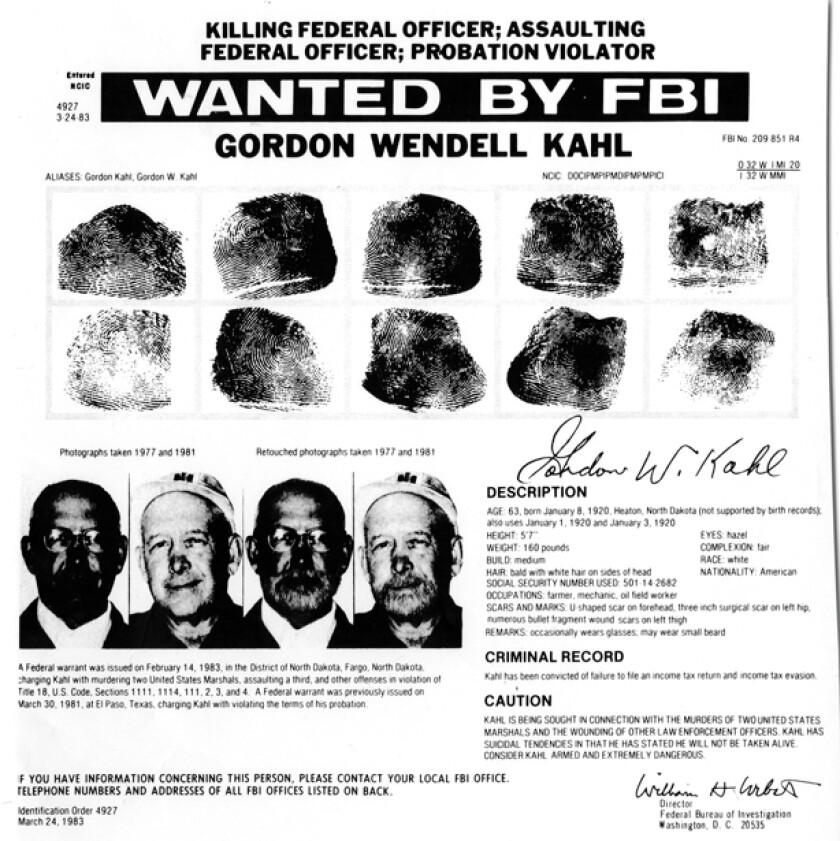
This day in history: Tax Protester Gordon Kahl was shot and killed by law enforcement on this day in 1983.
Before Waco and Ruby Ridge, there was Gordon Kahl. Gordon Wendell Kahl was a tax protester, who, in 1967, wrote a letter to the Internal Revenue Service stating that he would no longer pay taxes to the, in his words, "Synagogue of Satan under the 2nd plank of the Communist Manifesto." During the 1970s, Kahl organized the first Texas chapter of the Posse Comitatus, although he later left the group and was not a member at the time of the 1983 shootouts. In 1976 he appeared on a Texas television program stating that the income tax was illegal and encouraging others not to pay their income taxes.
On November 16, 1976, Kahl was charged with willful failure to file Federal income tax returns for the years 1973 and 1974. He was found guilty, and was sentenced to two years in prison and a fine of $2,000. However, one year of the sentence was suspended, as was the fine. The court placed Kahl on a five year probation. Kahl appealed his conviction, but the conviction was affirmed in 1978 by the United States Court of Appeals for the Fifth Circuit, after Kahl's release from prison on probation. Kahl served eight months in prison in 1977.
Kahl is now known for the shootouts he was involved with in 1983. Too many people died just to make sure one person paid their taxes.
This day in history: The Novocherkassk Massacre happened on this day in 1962. On June 1 1962, the Soviet Union raised the price of consumer goods by more than 25 percent in order to cover higher operating expenses for the U.S.S.R.'s collective farm program. Butter was up 25%, and pork and beef by 30%. In protest, workers walked off of the job at the Novocherkassk Electric Locomotive Factory and the strike soon turned into an uprising.
The day after price rises took effect in the Soviet Union, protests in the city of Novocherkassk were brutally suppressed in what is remembered as the Novocherkassk massacre. Strikers marched to the center of town, where they were joined by other protesters. After word spread that some of the strike leaders had been arrested, the local Communist party headquarters was invaded, after which the group marched into the police station and at 1:10 pm, after firing a warning volley of shots, one of the units of soldiers fired into the crowd. It was revealed thirty years later that 23 people were killed, and 116 arrested. Of those arrested, seven were convicted of sedition and executed, while others received prison terms ranging from 10 to 15 years. The news was kept out of the Soviet press. Months later, unofficial reports in the West referred to "hundreds" of deaths and in 1976, Alexander Solzhenitsyn's book The Gulag Archipelago would report that there had been more than 70 deaths. The Soviet government would finally confirm the killings on June 3, 1989, in an article in Komsomolskaya Pravda.
This day in history: Kentucky is admitted as the 15th state of the United States on this day in 1792, though technically it is a Commonwealth.
Did you know: The song “Happy Birthday to You” was penned by two Louisville sisters.
Post-its were invented in Kentucky.
Waverly Hills Sanatorium is in Kentucky and is considered to be the most haunted hospital in the world.
There are more bourbon barrels than people in Kentucky. Despite this, Kentuck still has DRY counties.
Owensboro Kentucky bills itself as “The BBQ Capital of the World.”
Kentucky is known as the horse capital of the world.
More than half of all U.S. troops killed in the War of 1812 were Kentuckians.
Colonel Sanders developed his “secret recipe” for fried chicken in Corbin, KY.
Cumberland Falls in the Daniel Boone National Forest is one of the few places on earth you might be able to see a moonbow.
The McCoys from the Hatfields and McCoys feud were Kentucky boys.
Kaelin's restaurant in Louisville claims to have invented the cheeseburger in 1934, although a Denver drive-in called Humpty Dumpty's patented it a year later.
Kentucky is bordered by a whopping seven other states: Virginia, West Virginia, Tennessee, Indiana, Ohio, Illinois and Missouri.
"The state’s signature sandwich, the hot brown, isn’t the healthiest choice, but it’s undeniably delicious. This open-faced delicacy consists of bread piled with turkey, ham, bacon, and sliced tomato, drowned in a rich cheddar sauce and then broiled. The sandwich originated at Louisville’s Brown Hotel in 1923." Source